On a cold Thursday evening in Modesto, California, Elena Ruiz stood barefoot in her tiny kitchen counting coins beside the microwave while tomato soup simmered in a dented pot. The apartment smelled faintly of bleach from the motel rooms she had cleaned all morning, mixed with laundry detergent from clothes hanging to dry across the living room. Her ten-year-old son, Mateo, sat at the table with his science workbook open, chewing the eraser of a pencil worn nearly down to the metal.
Bills covered half the counter.
Rent overdue.
Power warning notice.
One envelope stamped FINAL REMINDER.
Elena rubbed her temples and tried not to let Mateo see the fear on her face.
That was when her older cousin Raul walked in carrying a six-pack and too much bitterness.
He glanced around the apartment with open disgust.
“You still doing all this for him?” he scoffed. “Working yourself to death just so the kid can end up stuck here anyway?”
The words landed like broken glass.
Mateo froze instantly.
Elena turned from the stove so sharply the spoon clattered from her hand.
“What did you just say?”
Raul shrugged like cruelty was common sense.
“I’m saying you can’t save everybody. Look around, Elena. This place swallows people whole.”
Mateo stared at the table.
Elena stepped closer to Raul, anger rising through exhaustion.
“You do not talk about my son like his future is already ruined.”
Raul laughed once, harsh and defensive.
“Future?” he muttered. “People like us don’t get those.”
Then he grabbed his keys and slammed the door behind him hard enough to rattle the windows.
Silence filled the apartment.
Mateo kept staring at his workbook long after Raul left.
Finally, in a small voice, he asked, “Mom… are we losers?”
The question nearly broke her.
Elena crossed the room immediately and knelt beside him, taking his face gently in both hands.
“No,” she said firmly. “Never believe that.”
“But everybody talks like we are.”
“We’re struggling,” she corrected softly. “That’s different.”
Mateo looked unconvinced.
Elena brushed his dark curls back from his forehead.
“Money changes,” she whispered. “Hard times change. What matters is who you become while things are difficult.”
He looked up at her carefully.
“Then why do people act like poor people don’t matter?”
Elena swallowed hard.
“Because some people decide who someone is before they learn their story.”
Mateo thought about that quietly.
Then he asked, “Even scary people?”
She smiled faintly despite herself.
“Especially them sometimes.”
The next afternoon, those words would follow her son onto a lonely road and alter all their lives forever.
—
Mateo always walked home through the outskirts instead of downtown.
The shorter route crossed busy intersections and passed liquor stores where men argued outside all afternoon. The longer route curved past empty farmland and abandoned barns beyond the edge of Modesto. Out there, things felt quieter. Safer somehow.
That Friday afternoon the wind carried the smell of dry grass and engine oil. Mateo adjusted the backpack digging into his shoulders and kicked a pebble along the road while thinking about the bad grade hidden inside his folder.
Then the world exploded.
A deafening screech tore through the air.
Rubber screamed against asphalt.
Metal slammed violently into metal.
Something enormous crashed beyond the curve ahead.
Mateo stopped cold.
For one frozen second, fear locked every muscle in his body.
His mother’s warnings rushed through his mind all at once.
Stay away from dangerous situations.
Find an adult.
Do not get involved.
But there were no houses nearby.
No cars.
No people.
Only silence after the wreck.
And somewhere ahead, somebody hurt.
Mateo’s chest tightened.
He could keep walking.
Pretend he heard nothing.
Instead, terrified down to his bones, he ran toward the bend in the road.
—
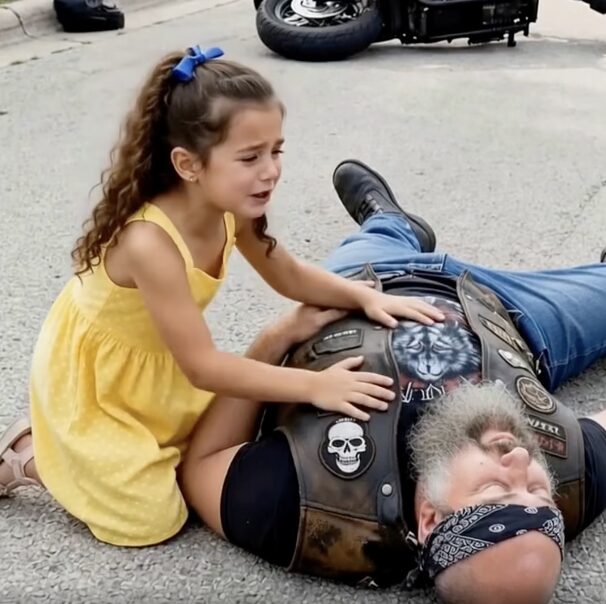
The motorcycle lay twisted beside a drainage ditch, black paint shredded across the pavement. One saddlebag had burst open, scattering tools and chains across the weeds.
The rider had been thrown several yards.
Mateo skidded to a stop.
The man looked enormous even lying broken in the dirt. Heavy boots. Tattooed arms. Thick gray beard. Leather vest covered in patches. One patch carried a name people around town spoke carefully.
The Iron Saints.
Mateo had heard stories.
Everyone had.
Blood streaked the side of the man’s face. His arm bent wrong. His breathing sounded wet and painful.
Then his eyes opened.
Sharp green eyes fixed on the boy immediately.
“Kid,” he rasped. “Go.”
Mateo couldn’t move.
The biker tried to push himself up and failed instantly.
“You don’t want problems with men like me.”
Men like me.
Something about the way he said it sounded less like a warning and more like a sentence already handed down long ago.
Mateo swallowed hard.
His mother’s words echoed in his head.
Some people decide who someone is before they learn their story.
Slowly, Mateo stepped closer.
“You’re bleeding really bad,” he whispered.
The biker shut his eyes briefly.
“That’s not your problem.”
“Maybe not,” Mateo said nervously. “But I’m still here.”
The man stared at him in disbelief.
—
Mateo shrugged off his hoodie and pressed it carefully against the wound near the biker’s head. Blood soaked through almost instantly, warm against his shaking hands.
His stomach twisted.
This was real.
Not television.
Not movies.
A real human being hurting in front of him.
“What’s your name?” Mateo asked.
The man gave a weak grunt.
“Knox.”
“That your real name?”
“It’s enough of one.”
Mateo nodded seriously.
“I’m Mateo Ruiz. I’m ten. My mom says keeping injured people talking helps them stay awake.”
Despite everything, one corner of Knox’s mouth twitched.
“Your mom sounds bossy.”
“She says that’s called leadership.”
A rough laugh escaped the biker before pain cut it short.
Mateo glanced around desperately until he spotted an old gas station farther down the road.
“There’s a pay phone,” he said quickly. “I’m calling an ambulance.”
Knox grabbed weakly at his sleeve.
“Kid… don’t come back after.”
Mateo frowned.
“Why?”
“Because people around me bring trouble.”
The boy hesitated.
Then he stuck out his little finger.
“My mom says promises matter,” he said. “Promise me you stay awake.”
Knox stared at the tiny finger for several seconds.
Slowly, painfully, he hooked his own finger around it.
“Fine,” he whispered.
“Don’t cheat.”
Another weak laugh escaped him.
“Bossy. Just like your mother.”
Then Mateo ran.
—
By the time he reached the pay phone, his hands shook so badly he dialed wrong twice.
When the emergency operator answered, the words came tumbling out between breaths.
“There’s a motorcycle crash near Old River Road and a man’s hurt really bad and you have to hurry!”
The operator tried calming him down, asking questions, but Mateo kept glancing back toward the road.
“I have to go back,” he said desperately.
“Stay on the line, sweetheart—”
But he had already hung up.
When Mateo returned, Knox was barely conscious.
Still, when he heard the boy’s footsteps, his eyes opened again.
“You came back,” he mumbled.
“I said I would.”
Knox looked at him strangely.
Like loyalty was something unfamiliar.
“Why help me?” he asked weakly.
Mateo thought for a second.
“Because you were alone.”
That answer hit harder than the injuries.
Knox stared at the sky for a long moment before quietly saying, “I got a son somewhere.”
Mateo blinked.
“You don’t see him?”
A shadow crossed the biker’s face.
“Not anymore.”
“Why not?”
“Made too many bad choices.”
Mateo pressed the hoodie tighter against the wound.
“Then say sorry.”
Knox let out the faintest laugh.
“You make life sound simple.”
“It’s probably not,” Mateo admitted. “But staying wrong forever sounds worse.”
For the first time, something vulnerable cracked through the hard edges of the biker’s face.
Regret.
Old and heavy.
Then the sirens arrived.
—
Paramedics moved quickly around the wreck while deputies secured the road. One officer noticed the Iron Saints patch and immediately stiffened before continuing professionally.
Mateo answered questions while trying not to cry.
“What’s his name?”
“Knox.”
“Full name?”
“That’s all he told me.”
As they loaded the biker into the ambulance, Knox reached weakly toward the boy once.
Mateo grabbed his hand briefly.
“You kept the promise,” he said.
Knox squeezed once.
“So did you.”
—
At Memorial Valley Hospital, a nurse cleaned blood from Mateo’s hands while another wrapped him in a blanket.
Twenty minutes later, the waiting room doors burst open.
“Elena!”
Mateo jumped from his chair as his mother rushed across the room and pulled him tightly into her arms.
She checked his face, hands, clothes, searching for injuries.
“Are you hurt? What happened?”
“I’m okay,” he said quickly. “The blood isn’t mine.”
A deputy explained everything carefully.
The accident.
The biker.
How Mateo had stayed with him until help arrived.
When he mentioned the Iron Saints Motorcycle Club, Elena’s face drained of color.
“You stayed alone with one of them?” she whispered.
Mateo looked guilty for the first time.
“You told me people matter even when they look scary.”
Elena closed her eyes briefly.
“I meant call for help.”
“I did that too.”
Despite her fear, a small broken laugh escaped her.
A surgeon finally emerged an hour later.
“He survived,” she announced. “Broken ribs, leg fracture, concussion, but he’s stable.”
Elena thanked her immediately.
Then the deputy quietly added one more thing.
“His club knows what your son did.”
Elena stiffened.
“And?”
“They’ll probably come by.”
That frightened her far more than the accident itself.
—
The next morning, the neighborhood woke to thunder.
Motorcycles filled the narrow street outside the apartment complex, stretching nearly an entire block. Black bikes. Leather jackets. Silent men stepping off machines with military precision.
Neighbors peeked through curtains.
Children stopped playing.
The engines shut off one by one until the street fell eerily quiet.
Then came three calm knocks at Elena’s door.
“Stay behind me,” she whispered to Mateo before opening it.
A massive bald man with tattooed knuckles stood outside holding his sunglasses in one hand.
“Ma’am,” he said respectfully. “Name’s Bishop. I ride with Knox.”
His eyes shifted toward Mateo.
“That the kid?”
Mateo peeked around his mother carefully.
Bishop crouched slowly until he was eye level with the boy.
“He’s alive because of you.”
Then he reached into his vest and removed a small stitched patch.
Silver wings over black leather.
The words beneath read:
Road Guardian.
Mateo accepted it carefully like it was something sacred.
“What’s it mean?” he asked.
Bishop glanced briefly at Elena.
“It means our people remember kindness.”
Then he handed Elena a folded card.
Phone numbers covered the back.
“If you ever need help,” he said quietly, “you call.”
Elena stared at the card uncertainly.
“Why would you do this?”
Bishop’s expression softened.
“Because your son reminded some hard men there’s still good left in the world.”
Then the bikers left as quietly as they came.
Only the smell of gasoline remained behind.
And one frightened mother sat down heavily at the kitchen table while her son held a patch against his chest like treasure.
—
Knox visited three weeks later.
No leather vest.
No motorcycle.
Just jeans, boots, and a cane.
Without the patches, he looked less dangerous and more tired.
Mateo opened the door first.
“You lived,” he announced proudly.
Knox smiled for real then.
“Guess I did.”
Mateo hugged him instantly.
The biker froze in surprise before carefully hugging him back.
Coffee turned into conversation.
Conversation became Sunday dinners.
Then came more visits.
Sometimes groceries appeared outside Elena’s apartment.
Sometimes somebody quietly fixed problems around the building.
Sometimes Knox simply sat at the table listening while Mateo talked endlessly about school.
Piece by piece, they learned his real name was Daniel Knox.
They learned he had once been married.
They learned he had a son named Eli who no longer answered his calls.
And slowly, over time, Daniel learned what it felt like to sit somewhere without needing to guard every part of himself.
—
Years passed.
Mateo grew taller, sharper, more confident.
Elena became a certified nursing assistant after years of night classes and exhaustion.
Daniel kept showing up.
Not as a visitor anymore.
As family.
Slowly, painfully, he rebuilt things with his son too.
One answered phone call became lunch.
Lunch became birthdays.
Birthdays became forgiveness.
One evening during Mateo’s senior year of high school, he looked up from homework and said casually, “I want to become a paramedic.”
Daniel blinked.
“That specific?”
Mateo nodded.
“Because when bad things happen fast, somebody has to stay.”
The room fell quiet.
Elena looked at her son and suddenly saw that roadside all over again.
The crash.
The fear.
The choice to remain.
That moment had never ended.
It had simply become the shape of his future.
Daniel nodded slowly.
“Then we’ll get you there.”
And they did.
With scholarships.
Night shifts.
Old motorcycles sold quietly for tuition money.
Long drives.
Sacrifices nobody bragged about.
Years later, Mateo Ruiz stood in uniform beside an ambulance outside Memorial Valley Hospital as a licensed paramedic.
Elena cried openly during the ceremony.
Daniel stood beside her older now, slower now, gray heavy in his beard.
And nearby stood Eli, finally healed enough to call him Dad again without hesitation.
During a public safety speech later that afternoon, Mateo addressed a room full of students and emergency volunteers.
“There’s something people forget about rescue,” he said. “Sometimes saving a life starts long before medicine. Sometimes it starts when somebody decides another person is still worth helping.”
His eyes drifted briefly toward Daniel.
He never said the rest aloud.
He didn’t need to.
Afterward, Mateo wrapped his arms around all three of them at once.
Daniel groaned dramatically.
“This is a terrible angle for my back.”
Mateo laughed.
“Too bad. Accept the love.”
This time, Daniel did.
Because years earlier, a frightened little boy on a lonely road had refused to walk away from him.
And because of that choice, a broken man found his son again, a struggling mother found hope again, and one scared child discovered the purpose that would define his entire life.
Sometimes fate doesn’t arrive looking beautiful.
Sometimes it arrives screaming around a bend in the road, wrapped in fear and blood and one impossible promise between strangers.
And sometimes the smallest act of courage becomes the beginning of everything.
Bought tears to my eyes . Really liked the lesson in the story.