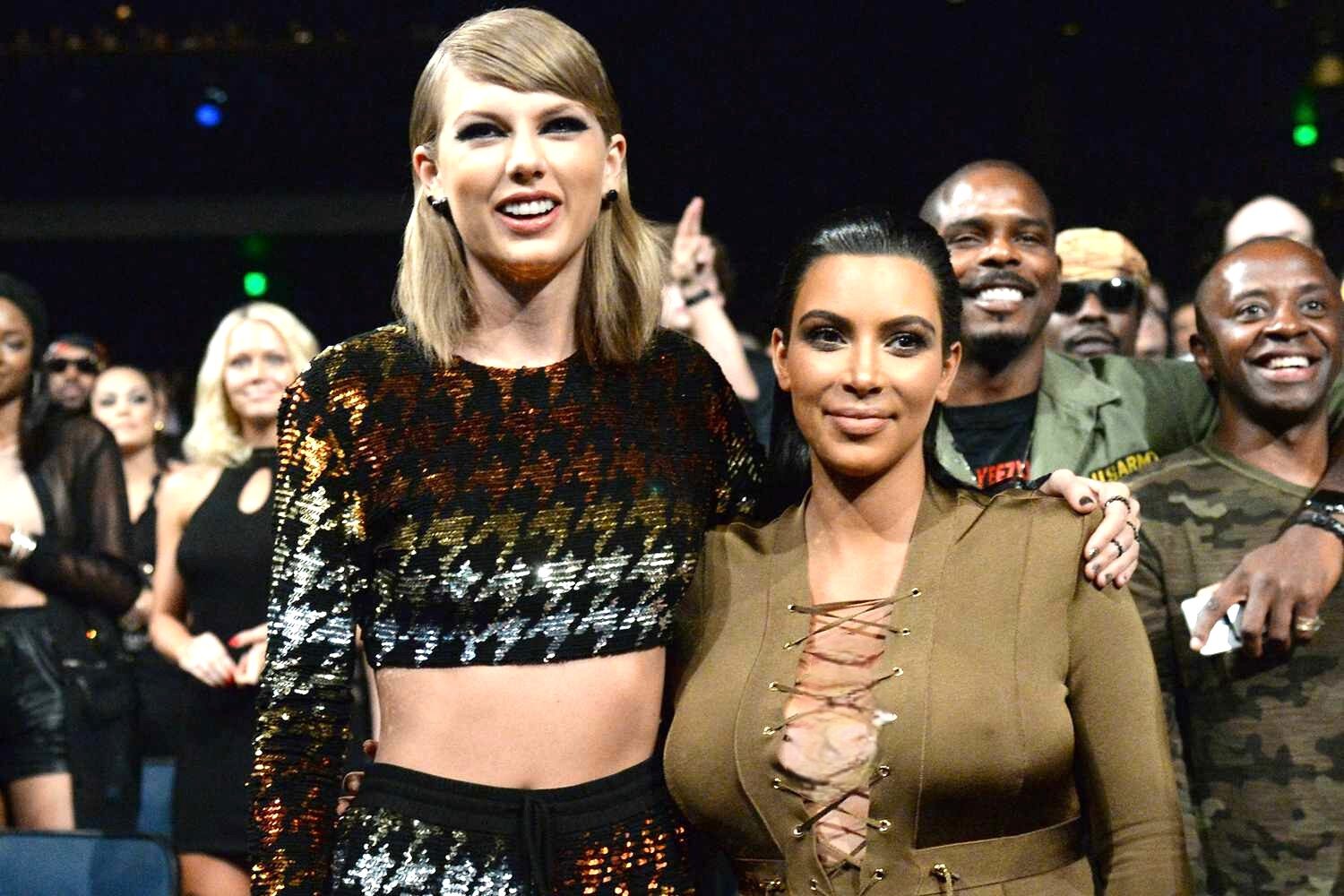
Few pop culture conflicts have lasted as long—or generated as much online debate—as the public fallout between Taylor Swift and Kim Kardashian.
What began as a disagreement involving a song lyric eventually grew into a global cultural flashpoint, dividing fans, dominating headlines, and shaping how both women were viewed for years.
At the center of the controversy was Swift’s 2016 track Famous, released by Kanye West. The song included a lyric referencing Swift in a way she publicly stated she had not fully approved or been made aware of beforehand. West and his team argued otherwise, saying she had been informed.
The situation escalated when Kardashian released edited phone call clips on social media, suggesting Swift had given permission for part of the lyric.
Almost instantly, the internet turned into a battlefield.
Hashtags trended. Fanbases split. Memes spread. And Swift’s public image took a major hit. For a period of time, the narrative online heavily favored Kardashian and West, framing Swift as dishonest in the eyes of many casual observers.
Swift largely stepped back from public discussion during this period, choosing silence while criticism grew louder.
But what looked like a settled story would eventually shift again in a way few expected.
Years later, the full unedited context of the recorded phone call resurfaced online, and it told a more complicated story than the original clips had shown. It became clear that key parts of the conversation had not been included in the earlier release, including details that changed how many people interpreted Swift’s response.
As a result, public opinion slowly began to shift.
Supporters of Swift pointed out that the original narrative circulating online had been incomplete. Many who had previously criticized her began re-evaluating what had actually happened. Over time, the situation became less about a single lyric and more about how information spreads and how quickly public perception can form—and solidify—before all facts are known.
Swift eventually addressed the emotional impact of the situation in later interviews, describing how difficult it was to be defined by a version of events she felt was incomplete or misleading. Rather than engaging in constant public arguments, she continued focusing on her music, releasing new albums that explored themes of reputation, control, and public judgment.
One of those albums, Reputation, became widely interpreted as her artistic response to the entire experience. It leaned heavily into imagery of public perception, media narratives, and reclaiming identity after controversy.
Over time, the cultural tone around the feud softened.
Kardashian has since acknowledged that she moved past the situation and expressed a desire to move forward, while Swift has similarly shifted her focus toward her evolving career and artistic reinvention.
What makes the story so notable is not just the conflict itself, but how it reflects modern celebrity culture. In the age of social media, narratives can form instantly—and last for years—even when the full context is not widely understood at first.
For a long time, the public perception of the dispute felt one-sided.
But as more context emerged and time passed, that perception evolved.
And in that gradual shift, many observers began to see the situation differently—not as a simple clash between two celebrities, but as an example of how quickly reputation, truth, and public opinion can be shaped in the digital era.
In the end, there was no dramatic final confrontation, no public resolution moment, and no official “winner.”
Instead, the shift happened slowly.
Through context, time, and reflection, the narrative changed.
And that quiet change in perception became, for many fans, the most important turning point of all.