Pop-star biopics have been quietly reliable at the box office for over two decades. They’re not guaranteed hits, but they’re steady enough that studios keep coming back to them—and actors keep saying yes. There’s also another incentive baked into the genre: awards recognition.
Jamie Foxx won Best Actor for Ray. Reese Witherspoon took Best Actress for Walk the Line. Rami Malek became an Oscar winner for Bohemian Rhapsody. Even when they didn’t win, Austin Butler (Elvis) and Timothée Chalamet (A Complete Unknown) turned in nominations that solidified their “next big thing” status.
So it’s natural to wonder whether Michael, the upcoming Michael Jackson biopic starring Jaafar Jackson, could follow the same path.
A familiar awards trajectory—but not a guaranteed one
At first glance, Michael seems like it could be positioned for the same kind of Academy Awards attention. If it performs like other major musician biopics, history suggests it will at least enter the awards conversation.
In fact, of the ten highest-grossing musician biopics of this century, most received at least one acting nomination. That pattern alone might make it seem like Jaafar Jackson has a shot at joining that list.
But there’s a major difference this time: the performance itself.
A debut lead performance under unusual conditions
Jaafar Jackson isn’t just a newcomer—he’s essentially a first-time screen actor stepping into one of the most recognizable performance legacies in music history. Before Michael, his public creative output was limited to reality TV appearances, minor music releases, and family-brand-adjacent work.
That matters because the Academy has historically been cautious about awarding debut performances in major categories, especially Best Actor. The list of exceptions is extremely short—names like Orson Welles (Citizen Kane) and James Dean (East of Eden) are more legendary outliers than precedent.
And those cases also came with unusual circumstances: Welles was a writer-director-producer auteur; Dean was nominated posthumously.
Jackson’s role is different. He’s not being asked to reinvent cinema—he’s being asked to embody a cultural icon within a tightly controlled, estate-approved narrative.
A performance shaped by restraint
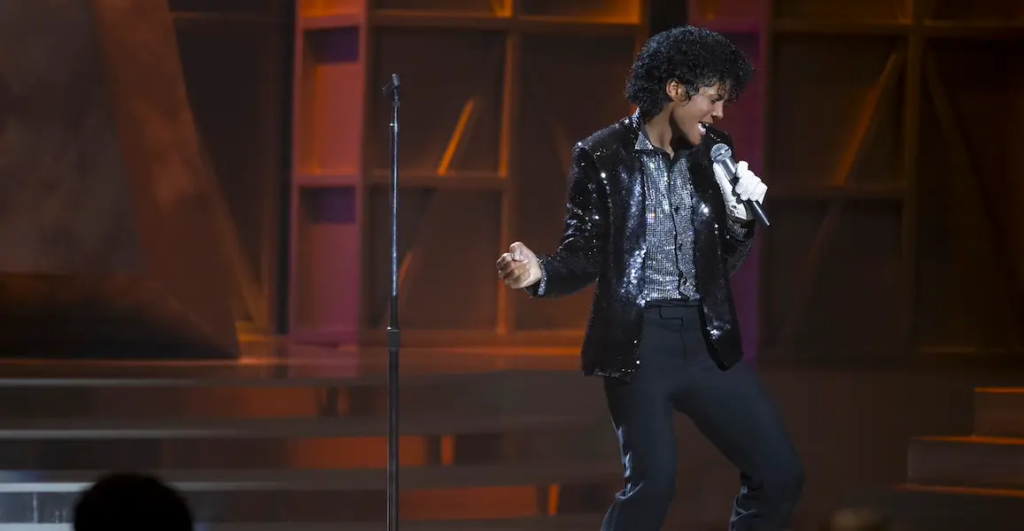
From what’s been described, Michael doesn’t seem designed to give its actors much dramatic space. The film leans heavily on Michael Jackson’s real vocals, remastered and used over Jaafar Jackson’s physical performance. That creates a kind of split experience: you’re watching an impersonation, but hearing the original voice.
That choice may preserve authenticity, but it also flattens the acting challenge. Instead of transformation through voice and performance, the role becomes more about physical mimicry and controlled gestures.
The film’s portrayal of Jackson also appears intentionally softened—focused on innocence, emotional fragility, and creative genius, while avoiding the more complicated or controversial aspects of his life. That kind of framing often limits dramatic tension, and by extension, limits the actor’s opportunity to deliver a layered, award-caliber performance.
The problem of “too polished” biopics
Modern music biopics often walk a tightrope between celebration and complexity. The most successful awards contenders tend to allow some messiness—conflict, contradiction, or emotional volatility that actors can really dig into.
But Michael, at least in its current framing, seems designed more as a reverent portrait than a psychologically complex study. That approach can work for audiences looking for spectacle and nostalgia. It’s less helpful for awards season, where voters tend to respond to performances that feel lived-in, unpredictable, or emotionally risky.
Even a strong supporting cast can struggle under that constraint. When the central performance is intentionally subdued, everything around it often follows suit.
Box office success doesn’t equal Oscar success
None of this means Michael will fail commercially. In fact, it could very well become one of the highest-grossing musician biopics ever made. The global recognition of Michael Jackson alone guarantees interest.
But box office dominance doesn’t automatically translate into Academy Awards momentum. Plenty of films make huge money without serious Oscar traction—especially when they lean more toward celebration than reinvention.
Where that leaves Jaafar Jackson
If Michael ends up performing as strongly as expected commercially, it may still find its way into awards conversations. But a Best Actor nomination for Jaafar Jackson would require something the film, as described, doesn’t seem designed to prioritize: a fully dimensional, emotionally volatile, transformation-driven performance.
Instead, what appears to be on offer is something more controlled—an impression rather than a deep character study.
And while impression-based performances can be impressive in their own way, the Academy has historically rewarded something riskier, messier, and more human.
In other words, Michael might be built to recreate the myth of Michael Jackson.
But Oscar voters tend to reward the breaking of myths, not just their reconstruc