Like most towering figures in music, Bob Dylan has always worn his influences openly. In the early days of his meteoric rise through the 1960s, he spoke with reverence about the artists who shaped him—drawing inspiration from blues, folk, poetry, and the restless spirit of American songwriting. His admiration for those who came before him wasn’t just polite homage; it was foundational to his identity as an artist.
But as Dylan’s own legend grew, so too did his protectiveness over his artistic voice.
By the mid-1960s, Dylan had evolved beyond the traditional folk mold, electrifying his sound and, in the process, alienating purists—most famously at the 1965 Newport Folk Festival. Yet, in an interesting twist, the same artist who once challenged rigidity in others began displaying a sharp critical edge toward his contemporaries. Particularly, he seemed wary of anyone who drifted too close to his stylistic territory.
This tension surfaced in subtle but pointed ways. When he suspected imitation, Dylan didn’t always respond with confrontation—he responded with art. His song “4th Time Around” is often interpreted as a veiled retort, a lyrical counterpunch wrapped in ambiguity and wit.
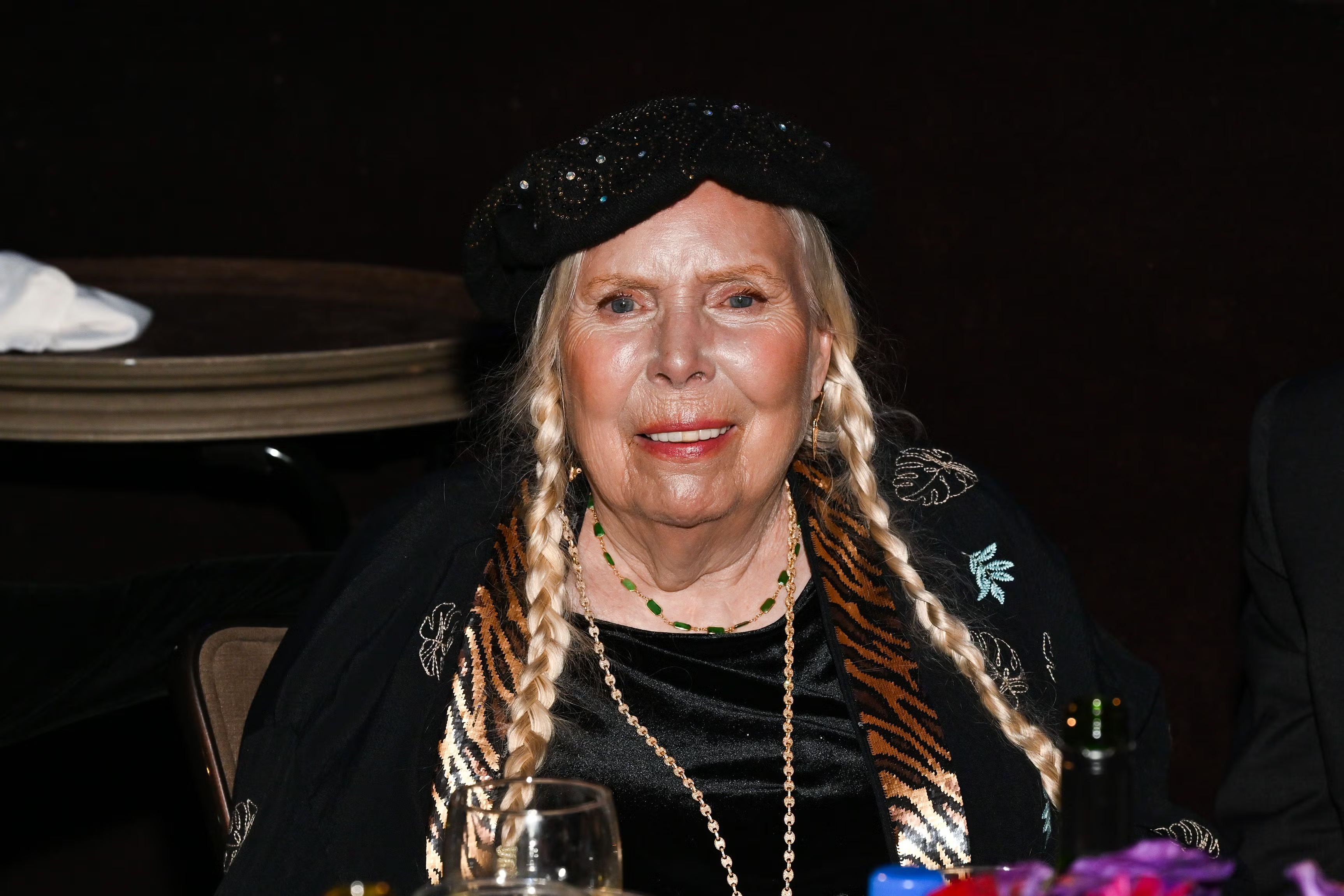
Dylan’s presence in the cultural elite of the ’60s and ’70s placed him in close proximity to many artists navigating similar creative currents. Among them was Joni Mitchell, a luminous force in her own right. Their relationship was never quite warm, never fully hostile—something more elusive, hovering in the space between mutual awareness and quiet friction.
One moment, in particular, has become part of music lore.
In 1974, Mitchell played her newly completed album Court and Spark for Dylan. It was an intimate setting, one that might have invited admiration or thoughtful critique. Instead, Dylan fell asleep.
Whether it was exhaustion, indifference, or something more deliberate, the gesture didn’t land lightly. Mitchell later suggested he may have been trying to appear aloof—perhaps even “cute”—in front of others in the room. Whatever the reason, the silence spoke volumes.
Ironically, Court and Spark would go on to become Mitchell’s most successful and critically acclaimed work.
Artists don’t always respond to criticism with confrontation. Sometimes, they respond with creation. In 1977, Mitchell released “Talk to Me,” a song that feels less like an attack and more like a plea—an attempt to break through Dylan’s enigmatic persona. Its lyrics reach toward connection, questioning his distance, his guarded nature, his almost calculated way of engaging with others.
It’s not just frustration—it’s curiosity.
Years later, Mitchell’s reflections on Dylan would turn more pointed. In a 2010 interview, she drew a stark contrast between them, questioning his authenticity and accusing him of borrowing heavily from other traditions. Her critique wasn’t just about music—it was about identity, about the line between influence and invention.
And yet, like many complicated artistic relationships, time softened the edges.
By 2013, her tone had shifted. While still critical of his musical technique, she acknowledged an appreciation for his songwriting. It was no longer dismissal—it was recognition, albeit a measured one.
What emerges from this long, winding dynamic isn’t a clear feud or rivalry, but something more nuanced. Two artists, both deeply original, both shaped by tradition, both navigating the blurred boundaries between inspiration and ownership.
Dylan, the shapeshifter, cloaked in myth and reinvention.
Mitchell, the confessional poet, searching for clarity and truth.
They were never quite in harmony—but perhaps that dissonance is what makes their story so compelling.
Because sometimes, in art as in life, the most interesting relationships aren’t the ones built on agreement—but on tension.