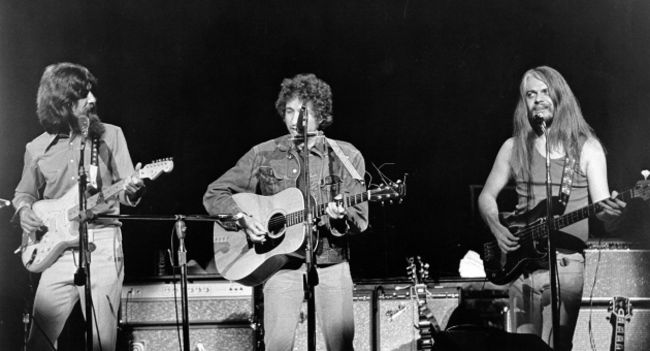
Although countless folk artists have passed through the revolving door of popular music, Bob Dylan has always stood apart. His writing carried a sense of mystery—listeners felt deeply connected to songs like ‘Blowin’ in the Wind’, yet the man behind them remained elusive, almost unknowable.
Dylan didn’t just expand what music could say—he expanded what it could be. But even as critics and fans positioned him as a revolutionary force, Dylan himself never saw creativity as a solo endeavor. He kept his ears open, especially to artists working at the edges of convention.
One of those artists was Frank Zappa.
A Different Kind of Visionary
The 1960s are often remembered as a cohesive movement—but in reality, they were a collision of ideas. While The Beatles were crafting meticulously layered pop on Sgt. Pepper’s Lonely Hearts Club Band, other bands were pulling rock in entirely different directions.
Acts like The Velvet Underground and The Stooges stripped music down to something raw and confrontational—sounds that wouldn’t be fully appreciated until decades later.
Zappa, meanwhile, was doing something else entirely.
From the opening moments of Freak Out!, recorded with The Mothers of Invention, he set out to dismantle rock’s conventions. His work blended avant-garde experimentation with satire, jazz, and chaos—often all within the same track.
Albums like Hot Rats and Apostrophe (‘) pushed even further, laying early groundwork for what would later be recognized as jazz fusion. Zappa wasn’t chasing hits—though he came close with ‘Don’t Eat the Yellow Snow’—he was chasing possibility.
Dylan Goes Electric—And Zappa Goes Further
Even Dylan wasn’t immune to backlash. When he plugged in an electric guitar in the mid-1960s, many fans accused him of abandoning folk’s authenticity for mainstream appeal. But if Dylan’s electric shift was controversial, Zappa’s approach was almost confrontational by design.
Where Dylan was revered as a lyrical poet, Zappa often treated lyrics as secondary—or even disposable. He filled his songs with irony, absurdity, and deliberate nonsense, sometimes handing vocal duties to others entirely. His focus was purity of sound and freedom of structure.
And yet, Dylan saw something profound in that.
In an interview with The Wall Street Journal, Dylan reflected on revisiting Freak Out!:
“What an eloquent record. No doubt about it, Zappa was light years ahead of his time.”
More Than Admiration
Dylan’s praise wasn’t just about Zappa—it was about what Zappa represented.
It was an acknowledgment that the 1960s weren’t driven by a single sound or ideology, but by a restless creative energy spreading in all directions at once. Folk, rock, avant-garde, and proto-punk weren’t separate lanes—they were colliding, reshaping each other in real time.
Dylan had once embodied that same forward momentum. And in Zappa, he recognized a kindred spirit—another artist unwilling to stand still, unwilling to conform.
Following the Muse
Throughout his career, Zappa continued to reshape his music, treating his band like a fluid, ever-evolving orchestra. Guitar solos became orchestral movements; albums became experiments rather than statements.
Though Zappa passed away decades ago, his philosophy remains strikingly aligned with Dylan’s early ethos: follow the work wherever it leads.
Trends will come and go. Genres will rise and collapse. But artists who truly matter—the ones Dylan listened for—are the ones who refuse to chase any of it.