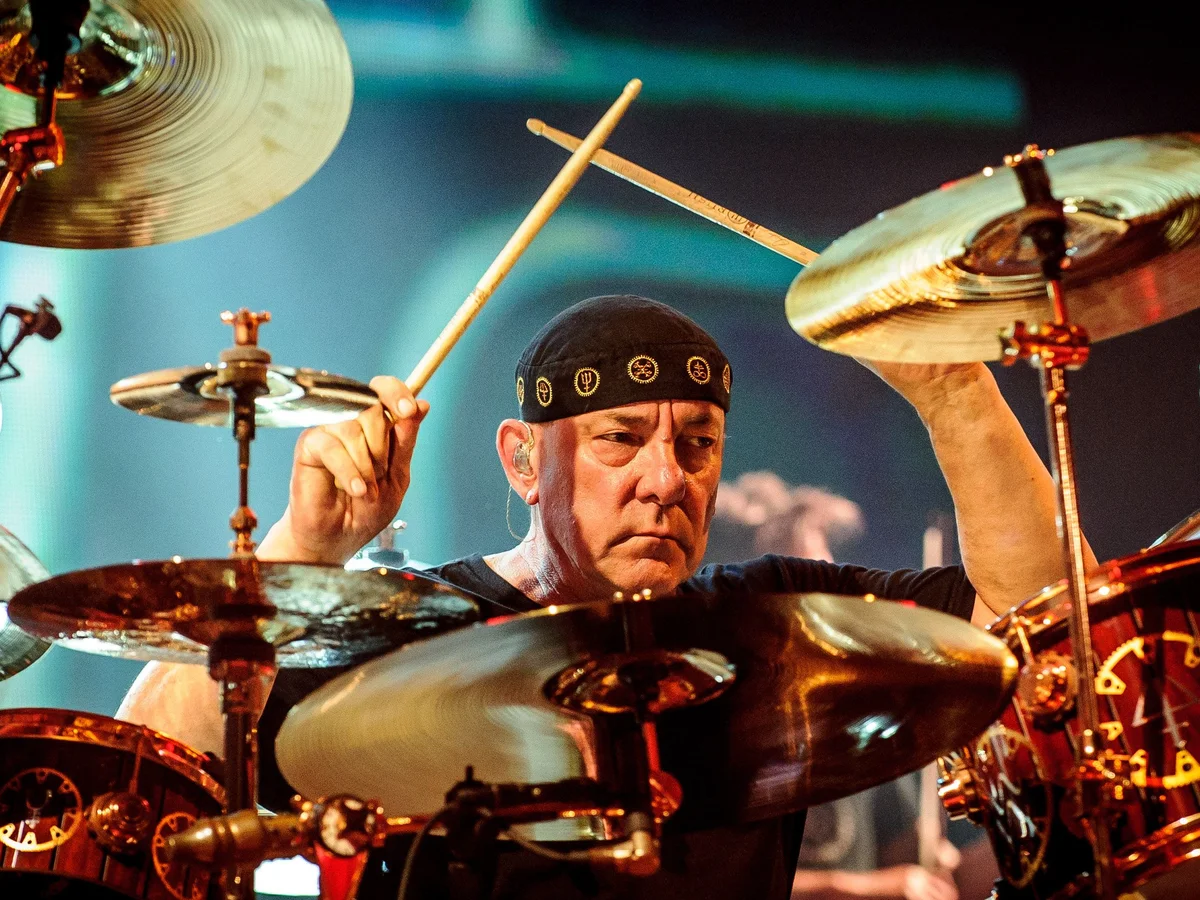
More than a decade after their final tour and five years after the loss of their legendary drummer, Rush are finding their way back to the stage — not to rewrite their past, but to celebrate it.
When Geddy Lee and Alex Lifeson first began talking about playing together again, the conversation inevitably circled around Neil Peart. His absence isn’t just felt — it defines the boundaries of what this new chapter can and cannot be. Widely regarded as one of the greatest drummers in rock history, Peart’s death in 2020 marked the true end of Rush as fans had known it.
For years, both Lee and Lifeson were firm: Rush was over. The band had already closed the curtain on touring with 2015’s R40 run, and Peart himself had stepped away from performing even before his passing. It felt like a complete story.
But time has a way of softening absolutes.
As the years passed, Lee and Lifeson found themselves reconnecting — not just personally, but musically. What began as casual playing slowly turned into something deeper: a shared desire to revisit the music that defined their lives. Not to replace what was lost, but to honor it.
That idea eventually grew into what is now being called the “Fifty Something Tour,” a sweeping celebration of more than five decades of Rush’s music. It’s both a retrospective and a tribute — a way to keep the spirit of their work alive while acknowledging the man who helped shape it.
Still, one question lingers for fans and the band alike: what would Neil Peart have thought?
According to Lifeson, they believe he would have understood. While no one could ever take his place, the idea of celebrating the band’s catalogue — of sharing those songs with audiences once more — feels aligned with the pride Peart had in their work. It’s not about moving on without him; it’s about carrying forward what they built together.
That doesn’t make it easy.
For more than forty years, the chemistry between Lee, Lifeson, and Peart was the foundation of Rush’s identity. Their interplay wasn’t just technical — it was almost telepathic. Stepping onstage without that dynamic will never feel entirely natural.
To help bring the music to life, the band has enlisted German drummer Anika Nilles, known for her remarkable precision and complex rhythmic sensibility. Joining her is keyboardist Loren Gold, whose presence adds new depth to the band’s live sound. Together, they aren’t replacements — they’re collaborators in a tribute to something larger than any one musician.
What started as a limited series of performances has quickly grown into something far more ambitious. The tour has expanded into a global run, with a schedule that Lifeson himself admits is more intense than expected. With a touch of humor, he’s joked that one of his main goals is simply “living to the end of it.”
Despite the demands, the excitement is undeniable.
The setlists are expected to span Rush’s vast catalogue, from early progressive epics like 2112 to enduring anthems such as “Tom Sawyer” and “The Spirit of Radio.” It’s a journey through time — not just for the audience, but for the musicians themselves.
Importantly, this isn’t about recreating Rush as it once was. That version of the band is irreplaceable. Instead, this new chapter is about celebration — of the music, the history, and the bond that still connects its surviving members to their late bandmate.
For fans, it’s the return of a legendary group. For Lee and Lifeson, it’s something far more personal: a way to honor Neil Peart’s memory, not in silence, but in sound.
And in that sense, the music never really stopped.