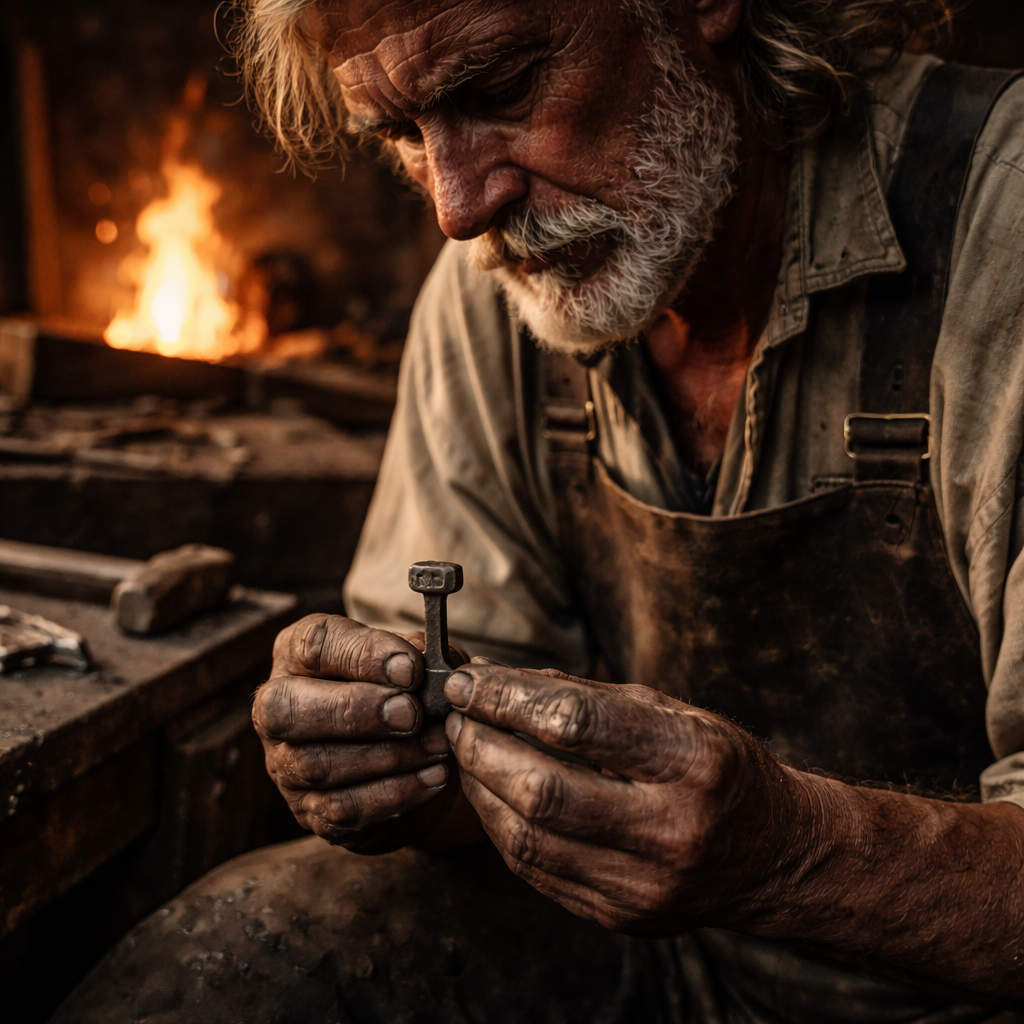
In a small village near Krakow, where the streets were paved with stones worn smooth by centuries of footsteps, there stood a modest house with a forge attached to its side. The house was nothing remarkable to the passerby—low roof, smoke-stained chimney, wooden door that creaked in winter—but within its walls lived a man whose work, though unseen, would one day be found in the most sacred places of Poland.
In that forge worked Stanley Kowalsski.
For 77 years, Stanley was a blacksmith.
His hands had known iron before they had known rest. His first memory was not of toys or games, but of heat—of standing beside his father, watching sparks leap like fireflies into the dim air. At the age of five, he was already overseeing small tasks, holding tools too large for his tiny fingers, learning the rhythm of hammer against metal.
His life never changed.
Each day was the same.
Coal.
Metal.
Fire.
Hammer.
And prayer.
The forge was his world. The ringing of steel against steel was his language. The glow of molten iron was his sunrise and his sunset. Outside, the village lived and aged and changed, but inside the forge, time stood still.
Stanley did not speak much. He did not need to. His work spoke for him. Hinges for doors, nails for homes, ironwork for churches—his hands shaped the quiet foundations of life around him. His work stood in places he himself rarely visited, built into structures that would outlive him by generations.
And though the world forgot him, it never stopped using what he made.
But everything changed one evening in October.
The air was colder that night. The kind of cold that crept into bones and lingered. Stanley had returned from the forge later than usual, his clothes carrying the scent of smoke and iron. Inside the house, a small candle flickered near the bed where his son lay.
Peter.
Seven years old.
Blue eyes that reflected the sky. Golden hair that caught the light like wheat in summer. A boy full of quiet curiosity, always watching his father’s hands, always asking silent questions with his gaze.
That night, Peter was burning with fever.
Stanley sat beside him, his large, calloused hands awkward against the fragility of the child. He did not understand sickness the way he understood metal. There was no hammer for this. No fire to reshape it. No tool to fix what was breaking.
He could only sit.
And watch.
And wait.
The night stretched on endlessly.
At some point, Peter’s small hand found his father’s.
And then… it stopped holding.
Just like that.
Quietly.
Without warning.
The boy was gone.
Stanley did not cry.
He did not scream.
He did not call out for help.
He simply sat.
For five days and five nights, Stanley remained with his son’s body. He did not eat. He did not sleep. The candle burned low and was replaced. The village came and went. People whispered. Some knocked. Some prayed outside the door.
But Stanley did not move.
He sat there, holding what was left of the only softness in his life.
Time lost meaning.
Grief became something heavier than tears—something silent, immovable, and vast.
When the funeral finally came, Stanley walked behind the small coffin without a word. The village gathered. Prayers were spoken. Dirt was placed upon wood.
And still…
He did not cry.
On the fifth day after the funeral, Stanley returned to the forge.
The door creaked open as it always had. The air inside was cold, still, untouched since the night everything changed. For a long moment, he stood there, unmoving, as if unsure whether he belonged in this place anymore.
Then, slowly, he stepped forward.
He lit the fire.
The flames rose hesitantly at first, then stronger, filling the forge with familiar heat. The glow returned. The smell of coal. The crackle of burning fuel.
Everything as it had always been.
But nothing was the same.
Stanley took a piece of metal.
Placed it into the fire.
Waited.
Removed it.
And began to hammer.
The sound rang out—sharp, deliberate, echoing through the forge and out into the quiet village.
Each strike was heavier than before. Slower. More deliberate.
When the piece was finished, it fell from his hammer into his trembling hands.
A nail.
Simple. Small. Ordinary.
But not like any he had made before.
On its side, with careful precision, Stanley inscribed two letters:
“P.K.”
And beneath it, the date.
The day his son died.
He held it there for a long time, staring at it as though it held something more than metal.
And in that moment… he understood something.
Every nail driven in is a prayer.
Every prayer is a conversation with God.
If he had to live…
If he had to breathe…
If every breath from that day forward would feel like fire in his chest…
Then let every breath be something more.
Let it be an act of love.
For Peter.
And so, he continued.
For 47 years, Stanley forged nails.
Not the ordinary nails he once made in countless numbers for everyday use. These were different.
Each one was unique.
Each one carried the initials **P.K.**
Each one bore a date.
Each one was a prayer etched in steel.
Day after day, year after year, he worked in silence.
The village saw him grow older. His back bent. His hands grew more worn. His hair turned gray, then white. But his rhythm never stopped.
Coal.
Metal.
Fire.
Hammer.
And prayer.
He made 3,200 nails.
3,200 pieces of grief.
3,200 acts of love.
And one by one… he placed them.
In churches.
Always in secret.
Beneath the floorboards where no one would look.
Behind altars where candles flickered.
Inside the walls of chancels.
Within communion rails.
Under pews where people knelt in prayer.
In hidden cracks and quiet corners of sacred spaces.
Everywhere.
He moved quietly. Carefully. Respectfully.
No one saw him.
No priest ever knew.
No architect ever found them.
They became part of the buildings themselves—hidden, silent, enduring.
Prayers of steel woven into the fabric of faith.
Years passed.
Decades passed.
The world changed. Wars came and went. The village aged. People forgot names, faces, stories.
But Stanley continued.
Until the last day of his life.
He died in his forge.
Hammer still in his hand.
The fire dim but not extinguished.
And before he fell, he placed one final nail into a crack in the wall of his own home.
His last prayer.
For his son.
A year later, a restorer working in the Wawel Basilica uncovered something unusual. Pressed into the wall beneath a marble plaque was a small, carefully made nail.
On its side were initials.
**P.K.**
And a date.
October 15th, 1952.
The date of death of a boy who had lived only seven years.
And then… the world began to understand.
One nail became two.
Two became dozens.
Dozens became hundreds.
And then thousands.
3,200 nails.
3,200 prayers.
3,200 places where a father had quietly left pieces of his heart, hidden within sacred walls.
No grand monument.
No inscription of his name.
No recognition in his lifetime.
Only this:
A trail of love forged in steel.
Driven into places closest to God.
So that somehow… in ways no one could explain… he could remain close to Peter.
Every nail was a piece of his heart.
Every nail was a death.
Every nail was a rebirth.
And though Stanley Kowalsski was a man the world had forgotten…
His prayers remained.
Hidden.
Enduring.
Waiting to be found.