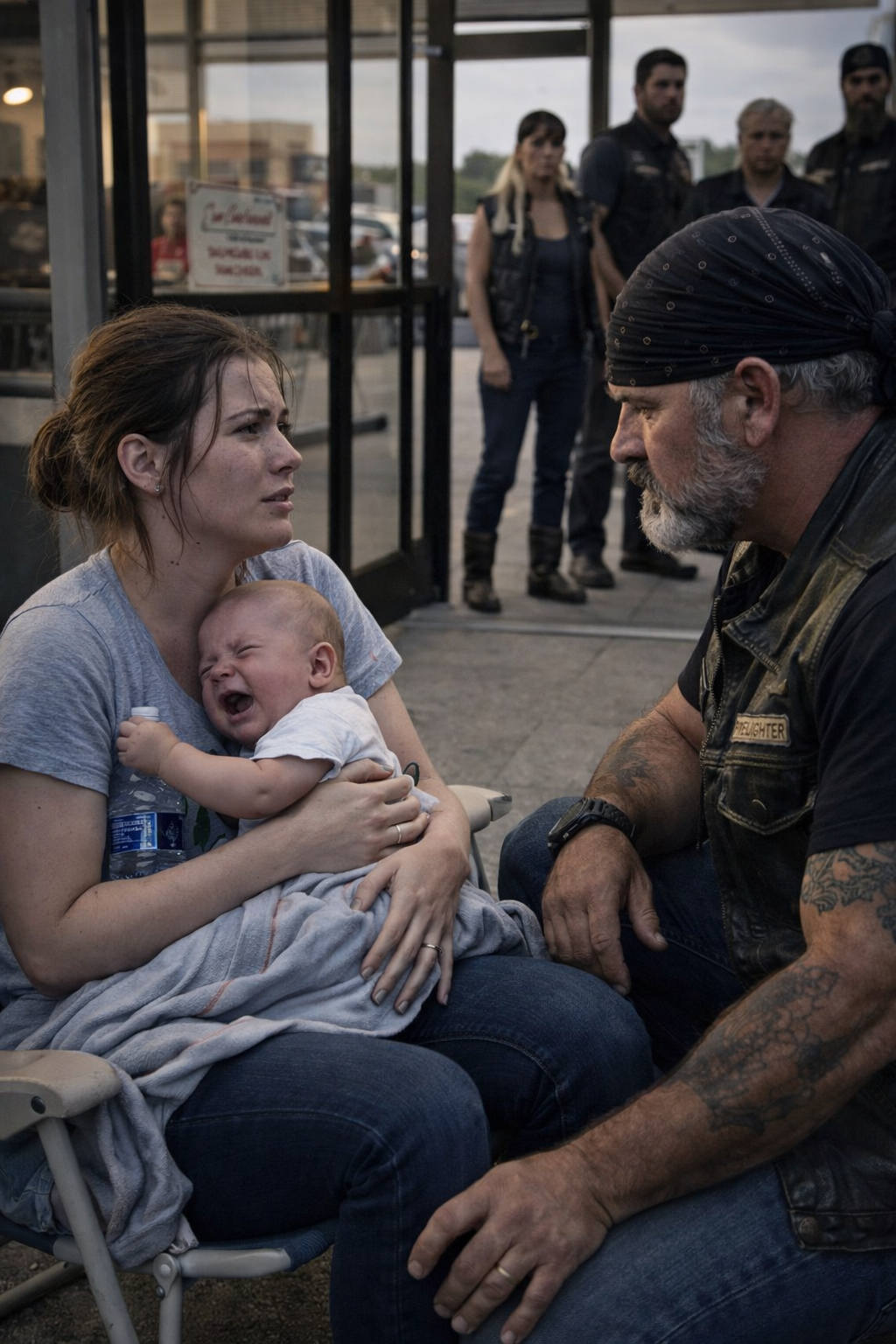
He snatched the diaper bag before it hit the ground.
That was the first thing everyone saw.
Not the reason.
Not the panic in the mother’s face.
Not the baby arching in her arms, red-cheeked and screaming so hard the tiny body shook with every breath.
Just a big man in black leather reaching fast—too fast—across a young woman’s shoulder while she stood half-turned near the front doors of a grocery store, already humiliated, already cornered, already trying not to cry in front of strangers.
The bag swung up into his hand.
A jar of formula slipped free and shattered on the tile.
The sound cracked through the checkout lanes like a gunshot.
People froze.
Then came the gasps.
“Hey!”
“What are you doing?”
“Somebody call security!”
The young mother flinched backward so hard she nearly lost her balance. Her baby let out another desperate cry, thinner now, tired and raw. Her free hand flew to her chest. She looked from the shattered glass to the man holding her bag and saw what everybody else saw.
Black leather.
Tattooed arms.
Gray-flecked beard.
Heavy boots planted wide on the polished floor.
And that smell.
Gasoline and smoke.
The sharp, stubborn scent of road and engine and old fires.
He was the kind of man people avoid on instinct.
That was the verdict in the room before he said a single word.
The baby cried harder.
The mother’s voice broke. “Please. I’m leaving.”
He didn’t answer her right away.
He was staring at the floor.
At the broken jar.
At the white powder spreading through the glass in a pale cloud across the aisle—right where a toddler in light-up sneakers was stepping forward with a juice box in one hand and absolutely no idea what sharp edges looked like under grocery-store lights.
The biker moved first.
Again.
Fast.
He blocked the child with one arm and shoved a shopping cart sideways with the other. Metal slammed against tile. The cart hit the display of canned soup and rattled it so hard three cans dropped and rolled away.
That did it.
That gave the fear shape.
That gave it noise.
“Call the police!”
“He’s out of control!”
“He just shoved that cart!”
The store manager came rushing from customer service with the rigid posture of a woman who thought firmness could solve anything if she arranged her face correctly.
“What is happening here?”
A cashier pointed. “He grabbed her bag.”
Another shopper added, “And he’s scaring customers.”
The manager took in the scene—the crying baby, the flustered mother, the leather vest, the broken formula, the tattooed arms—and chose her side in seconds.
Of course she did.
People often do.
A young mother with a screaming baby had already made the room uncomfortable.
A biker made it easy to explain the discomfort away as danger.
The mother hugged her child closer, cheeks burning. “It’s okay,” she whispered, though nothing was okay. “I’m going. I was already going.”
Because she had been.
Five minutes earlier, before the bag, before the glass, before the man in leather and the crowd and the tightening circle of judgment, she had simply been standing in aisle seven trying to calculate how much dignity a person could lose in one public afternoon.
Her baby—maybe four months old, maybe less—had started crying near the dairy section. Not fussing. Not whining. Crying with the terrible, body-deep desperation of a child who could not explain pain, hunger, heat, exhaustion, or overload, only feel it all at once.
Heads had turned.
First with sympathy.
Then impatience.
Then irritation.
An older couple near the yogurt had exchanged a look.
A college kid in earbuds muttered, “Come on.”
A woman pushing an organic produce cart had said to no one in particular, “Some people really should step outside.”
The young mother had heard that.
She had heard all of it.
The embarrassed little sounds. The throat-clears. The sighs. The way strangers suddenly became experts in what she should have been able to control.
She had bounced the baby. Whispered. Changed shoulders. Checked the diaper. Tried a bottle that got slapped away by tiny furious fists.
Then the manager had appeared with her customer-service smile—thin, polished, exhausted by other people’s problems.
“Ma’am,” she said gently, which somehow made it worse, “maybe it would be more comfortable for everyone if you stepped outside until he settles.”
For everyone.
Not for you.
Not for the baby.
For everyone.
The mother had nodded because shame makes people obedient.
She had whispered, “Okay,” because once you’re publicly inconvenient, the room starts treating your compliance as a form of gratitude.
She had gathered the diaper bag and half her groceries with one hand, baby in the other arm, trying to move fast enough that no one would have to keep looking at her.
Then the jar of formula slipped.
Then the biker moved.
Now the whole store held its breath around him.
The manager stiffened. “Sir, I’m going to need you to hand that bag back and leave.”
He turned his head slowly.
His face wasn’t angry.
That made people even more nervous.
“No.”
Just one word.
Flat.
Certain.
The manager folded her arms. “You are upsetting customers.”
He glanced toward the mother. Toward the baby, whose crying had changed now—ragged, almost wheezing between screams.
Then back to the manager.
“Your customer,” he said, “looks like she’s about to pass out.”
The room went strangely still.
The mother blinked.
“What?”
He handed the diaper bag back to her, but not roughly, not possessively. He held the strap out until she took it. Then he pointed at the hand gripping the cart.
It was shaking.
Not a little.
Badly.
Her face had gone pale beneath the fluorescent lights. There was sweat at her temples. Her lips were dry. The baby’s blanket had slipped, and in the confusion she hadn’t noticed. She was breathing fast, shallow, like her body had been sprinting while her feet were trapped in place.
“You eaten today?” the biker asked.
She opened her mouth.
Closed it.
Tried again.
“Coffee.”
The answer was so small the room almost missed it.
He nodded once, like that confirmed something.
The manager said, “That doesn’t change the fact that—”
He cut her off with a look so quiet and solid it stopped her cold.
“A leather vest became a verdict.”
Nobody said anything.
He hadn’t shouted the words. He hadn’t performed them. He’d simply laid them in the middle of the store like a fact no one wanted to trip over.
Then he pointed toward the front seating area near the pharmacy.
“Chair. Water. Now.”
The manager bristled. “You do not tell my staff what to do.”
But one of the cashiers was already moving.
Because sometimes authority comes from title.
And sometimes it comes from the unmistakable tone of a man who has seen worse emergencies than this and knows one when it starts.
The mother swayed.
The cashier rushed faster.
The biker stepped in and took the cart from her hands before it rolled away. “Sit down.”
She hesitated, still more frightened of causing a scene than of collapsing.
He lowered his voice.
“Sit before you fall while you’re holding him.”
That got through.
She let him guide the cart aside. Another clerk brought a chair. Someone else arrived with bottled water. The mother sat shakily, baby still crying against her shoulder, and the biker crouched—not too close, not imposing, just present. Waiting without pressure.
That mattered.
He didn’t reach for the baby.
Didn’t tell her to calm down.
Didn’t act like her embarrassment belonged to him to manage.
He simply said, “Small sips.”
She drank.
Her hand shook so badly water spilled down her wrist.
The manager looked around and saw her authority slipping through the cracks of public opinion. That always makes the polished ones sharper.
“Sir, I don’t care what you think you saw. You are still causing a disturbance. I’ve asked you to leave.”
He stood.
Slowly.
That was worse than if he had jumped to his feet.
Slow control unnerves people more than anger.
Boots against tile.
The hum of fluorescent lights.
A baby crying in ragged bursts.
And that smell of gasoline and smoke still drifting from his vest like a warning label everyone thought they understood.
He towered over the manager without actually looming. “I’m not leaving her alone out there.”
The manager laughed once. Brittle. “Excuse me?”
He nodded toward the glass front doors. The parking lot outside shimmered in late-afternoon heat. Three men in neon utility shirts leaned against a pickup smoking and staring at the entrance with the lazy interest of people who had noticed a vulnerable woman being pushed out.
“I watched them clock her when you told her to go,” he said.
The mother looked up.
The manager followed his gaze and went quiet.
Because suddenly the store’s polite solution didn’t look so polite.
It looked dangerous.
The baby coughed between cries. The mother’s eyes filled. Not because of the men outside. Because somebody had noticed. Really noticed. Not the noise. Not the inconvenience. Her.
A man in a golf polo near register three muttered, “Well, she still can’t just disturb everybody.”
The biker turned toward him.
Not aggressive.
Not theatrical.
Just direct.
“Then buy your cereal and go home,” he said. “You don’t get to mistake your comfort for policy.”
Nobody answered that.
The manager pulled out her phone. “Fine. Security can deal with this.”
He nodded once. “Call them.”
And maybe that should have ended there.
Maybe it would have.
Except the baby suddenly made a sound that changed the room.
Not a cry.
A gasp.
A wet, tight little sound that didn’t belong.
The biker was moving before anyone else understood why.
He snatched the pacifier clip from where it had twisted around the baby’s neck under the blanket and ripped it free in one motion. The mother screamed in shock. A cashier dropped the water bottle she was holding. The manager actually stepped back.
“What did you do?”
The baby coughed.
Then breathed.
Deeply.
Once.
Twice.
Then started crying again—loud, furious, alive.
The whole front end of the store went dead silent.
Absolute silence.
The mother stared at the clip in his hand. One end had wound around the blanket seam. In all the bouncing and shifting and public shaming and scrambling to leave, it had pulled high and tight against the baby’s throat without her seeing.
Her face crumpled.
“Oh God.”
She clutched the child against her chest, then loosened immediately, terrified now of holding too tight. “Oh God, oh God…”
The biker gave her the clip. “Not your fault,” he said.
But guilt is greedy. It had already sunk its teeth in.
The manager swallowed. “I didn’t— I wasn’t—”
No one wanted to hear her finish.
Security arrived at exactly the wrong moment.
Two men in gray uniforms came fast from the back corridor, taking in the crowd, the biker, the crying infant, the manager’s face, the tension, and doing what people do when they arrive late to a story: they trusted the posture of the scene more than the truth of it.
One of them stepped forward. “Sir, we’ve had complaints.”
Of course they had.
The biker lifted his hands slightly away from his sides. Empty. Calm. “Then you came late.”
The second guard moved closer to the mother. “Ma’am, are you alright?”
She looked from the guards to the biker to her baby and seemed unable to gather the pieces of the last two minutes into anything coherent.
“I… I think so.”
The first guard frowned at the biker’s vest, the tattoos, the beard. “We’re going to ask you to step outside.”
A leather vest became a verdict.
Again.
Always faster than evidence.
The biker exhaled through his nose. “No.”
“Sir—”
“No.”
The baby cried. The mother looked weaker now that adrenaline was burning off. Her head had dipped once, briefly, like she might still faint if she stood too quickly. The clerk with the water lingered nearby. Another employee had quietly started bagging the young mother’s abandoned groceries without being asked.
The manager tried to reclaim control. “He interfered with a customer. He was aggressive. He created panic.”
“He stopped a choking hazard,” one cashier said.
No one had expected her to speak.
She was maybe twenty. Tired eyes. Name tag half peeled off. She looked at the security guards and repeated it stronger. “He stopped a choking hazard. And she nearly fainted.”
The room shifted again.
Public certainty is fragile. Sometimes one honest voice is enough to crack it.
Then came the sound.
At first it was distant enough to be mistaken for traffic.
Then deeper.
Closer.
Low, steady, disciplined engines.
Not the chaotic snarl of men looking for trouble.
Not noise for its own sake.
A rhythm. Measured. Intentional. Controlled.
Heads turned toward the front windows.
The parking lot began to fill.
One motorcycle.
Then three.
Then eight.
Then more.
They came in controlled formation, gliding between carts and painted lines with exact spacing, shutting down in sequence beneath the slanting sun. Chrome flashed. Leather darkened the glass. Helmets came off. Faces appeared—older, younger, men, women, all road-worn in different ways, all carrying the same unmistakable calm.
To half the store, it looked like a gang had arrived.
To the other half, it looked like something even more unsettling.
Organization.
One of the utility workers outside straightened from the pickup and flicked away his cigarette. The three of them exchanged a look and, without any announcement, began climbing into the truck.
The biker at the front of the store didn’t smile.
Didn’t gloat.
He just said, almost to himself, “Good.”
The manager stared. “Did you call them?”
“No,” he said.
The answer came from the mother.
Very quietly.
“I did.”
Every head turned.
Tears had started spilling down her face now, not dramatic tears, not showy ones. Exhausted tears. Humiliated tears. The kind that come when a person has been carrying too much alone for too long and finally realizes somebody might not let her drown in public.
Her hand trembled as she fished her phone from the diaper bag. On the cracked case was a sticker: Riding for Rowan Foundation.
“My brother…” She swallowed. “My brother rode with them. He died last year.” Her fingers tightened around the phone. “They told me if I ever got stuck somewhere and didn’t feel safe… call.”
The glass doors opened.
The engines outside had stopped, but their presence kept humming in the room anyway.
In walked the Brotherhood.
No shouting.
No peacocking.
No anger looking for a target.
Just expert discipline.
A woman with silver hair braided under a bandana moved first. She went straight to the mother, crouched to eye level, and said, “You called. We’re here.”
That was all.
And the mother broke.
Not loudly.
Just a small collapse in the shoulders, like her body had been holding itself together with borrowed string and somebody had finally taken the weight.
Another rider moved to stand near the door. Not threatening. Protective.
A third quietly took position near the front windows, making sure the men in the pickup kept driving.
One older Black rider with medic patches on his vest stepped toward the baby. “May I?”
The mother nodded.
He didn’t scoop the baby away or play hero. He just checked color, breathing, pupils, tiny neck, the spot where the clip had caught. “Scared,” he said. “But okay.”
The room exhaled.
Some people for the first time.
The security guards looked at one another, suddenly unsure who, exactly, had been supposed to fix the situation.
The manager found her voice, thin and strained. “This is highly irregular. We can’t just have a whole biker group—”
The gray-bearded biker turned to her.
It was not an angry look.
It was worse.
It was patient.
“Ma’am,” he said, “you asked a dehydrated mother with an infant to stand outside alone because your customers were uncomfortable.”
She opened her mouth. Closed it.
He continued. “Then you nearly sent her into a parking lot where three men had already picked her out.”
The room watched her try and fail to recover language that sounded human.
“I was only trying to keep things calm.”
“No,” the silver-haired woman said from beside the chair. “You were trying to keep things quiet.”
That landed harder.
Because it was true.
Fear dressed up as policy. Discomfort dressed up as procedure. Indifference dressed up as professionalism.
The biker in front looked back at the mother. “You got somewhere to go?”
She laughed once through tears. “Honestly? No.”
Another silence.
Different this time.
The Brotherhood heard something the crowd hadn’t bothered to hear beneath the crying baby and the public inconvenience.
No partner in sight.
No extra hands.
No one coming to get her.
She sat in a grocery store chair with a half-starved expression, a sweating bottle of water, and the stunned look of somebody who had been one shove away from breaking open completely.
The gray-bearded biker crouched again, putting himself smaller than her this time. Less imposing. More human.
“What’s your name?”
“Lena.”
“Lena, you eaten?”
She gave the smallest shake of her head.
He nodded, unsurprised.
One rider peeled off toward the deli.
Another toward checkout to pay for the groceries still being bagged by the quiet cashier.
The manager snapped, “They don’t have to do that.”
“No,” the biker said. “You should.”
She stared at him.
Around them, shoppers began looking anywhere but at each other, which is what people do when shame arrives and finds a chair.
The quiet cashier spoke again. “I’ll ring it under store courtesy.”
The manager shot her a look.
The cashier didn’t care.
Maybe something had shifted in her too.
Maybe watching a tired mother get treated like a disruption had broken some final little thread of tolerance.
The Brotherhood moved with the same controlled formation they’d parked in.
One brought sandwiches.
One checked on the baby again.
One called someone from a women’s resource center.
One stood near the entrance like a wall that refused to collapse.
And the gray-bearded biker simply stayed beside Lena without crowding her. Waiting without pressure.
After a few minutes, when the baby had finally settled into hiccuping breaths, a pharmacy tech came over hesitantly.
“I know her,” she said, looking at Lena. “She comes in for prescription formula sometimes.”
Lena closed her eyes briefly. Shame again. That reflex to apologize for existing in public while poor, tired, and visible.
The tech swallowed. “Her son has reflux issues. It’s why he cries like that.”
Suddenly all the judgment about bad parenting, lack of discipline, failure to soothe, and public inconvenience had another ugly layer under it.
The baby wasn’t just fussy.
He was hurting.
The manager leaned against the counter as if something inside her knees had gone unreliable.
One of the security guards took off his radio earpiece and rubbed the back of his neck. “I’m sorry,” he said, though he wasn’t even sure to whom.
The gray-bearded biker finally stood when an ambulance crew came in—not because the baby needed one, but because Lena did. Mild dehydration. Exhaustion. Blood sugar crash. Nothing dramatic enough for the evening news. Exactly the kind of thing public judgment can turn dangerous anyway.
One of the EMTs looked at the biker and blinked in recognition.
“Dale?”
The biker nodded once.
The EMT gave a short, incredulous laugh. “Of course it’s you.”
The manager looked up. “You know him?”
The EMT was already unpacking a blood pressure cuff. “Everybody in county fire knows him.”
The whole front of the store went still again.
The EMT tightened the cuff around Lena’s arm and kept talking. “Retired battalion chief. Started the rider network that escorts women and kids out of unsafe domestic situations. Funds formula drives every winter. Shows up before half the calls even reach us.”
No one said anything.
Because now the leather vest, the smell of gasoline and smoke, the tattoos, the beard—all of it rearranged itself in the minds of everyone watching. The same details. New meaning.
Dale didn’t help them by acting humble.
He also didn’t help them by acting proud.
He just said, “She needed a chair.”
As if that were all.
As if dignity itself didn’t need defending in loud rooms.
As if stepping between a vulnerable woman and the machinery of public discomfort were not, in fact, the kind of courage most people outsource to somebody else.
The EMT glanced at the baby, then back at Lena. “You have family nearby?”
She shook her head.
The silver-haired rider answered for her. “She does now.”
Lena looked up at that.
Really looked.
And whatever she saw in those faces—creased, scarred, patient, unbothered by the mess of her day—made her cry again.
Not because she was weak.
Because she had been strong too long without witnesses.
The store had gone very quiet.
The hum of fluorescent lights.
The soft beep of a register left idle.
The rustle of plastic bags being packed by the same cashier who had spoken when nobody else wanted to.
And underneath it all, like a memory still vibrating in the tile, the echo of low, steady, disciplined engines outside.
The manager stepped forward eventually.
She had lost the polished smile. Lost the customer-service armor. What remained was a woman face to face with the cheapest version of herself.
“I was wrong,” she said.
Dale looked at her.
She tried again. “I made her leave because people were uncomfortable.”
“No,” he said quietly. “You made her leave because it was easier than asking your customers to be decent.”
That one stayed in the air.
No one moved to rescue her from it.
Lena’s groceries were packed. A resource volunteer was on the way. A rider had installed the baby seat more securely in her old sedan without comment. Another had put fresh formula from the pharmacy under the cart. Someone from the Brotherhood had slipped an envelope of grocery cards into the diaper bag without announcing it.
No spectacle.
No sermon.
No savior pose.
Just a network of people who had built their whole moral life around showing up where softness gets punished.
When Lena stood, she wobbled.
Dale was there instantly, but he didn’t grab. Just held out a hand until she chose it.
Waiting without pressure.
Respect can look like that.
Outside, the sky had gone gold at the edges. The utility truck was long gone. The parking lot felt different now. Safer because safety had been made visible.
The Brotherhood moved with her to the door.
Shoppers parted.
Not out of fear this time.
Out of something heavier.
A wave of guilt.
Because every person still standing there knew exactly when they had chosen convenience over compassion. Knew exactly how fast they had let a crying baby become a social offense. Knew exactly how eagerly they had mistaken the one person paying attention for the problem.
At the threshold, Lena turned back once.
To the cashier. To the EMT. To Dale. To the woman with silver hair. To the manager who could not quite meet her eyes.
“Thank you,” she whispered.
Dale nodded. “Get some food in you.”
That was all.
No dramatic embrace.
No demand for gratitude.
No performative gentleness.
Just competent kindness.
Outside, the Brotherhood helped her load the groceries and settle the baby. A volunteer’s car would follow her home. Another rider would return later with a crib mattress from storage because the silver-haired woman had quietly learned the current one was splitting at the seam.
The doors of the store slid shut behind them.
Inside, no one rushed back to shopping.
Not right away.
People lingered in the hum of fluorescent lights, holding the weight of a judgment they’d made too fast.
The manager stood with both hands on the customer-service counter like it was the only thing keeping her upright.
The golf-shirt man stared at his cereal and looked like it had become evidence.
The security guards said nothing.
And the cashier, still bagging the last of Lena’s groceries out of habit though they were already gone, wiped her eyes with the back of her wrist and kept working.
Outside, helmets went on.
Engines started.
Low.
Steady.
Disciplined.
One by one, the bikes pulled out in controlled formation, surrounding Lena’s car without boxing it in, escorting without trapping, protecting without claiming.
Dale rode last.
He didn’t look back at the store.
Didn’t wait for applause.
Didn’t care whether the lesson had landed cleanly.
He had done what mattered.
As the sound of his engine faded down the road, it softened gradually, like a heartbeat returning to normal.
And inside that grocery store, all that remained was the terrible clarity of what had happened there:
A young mother had needed help.
A room had offered discomfort.
A biker had noticed.
And everyone else had to live with how long it took them to see her.