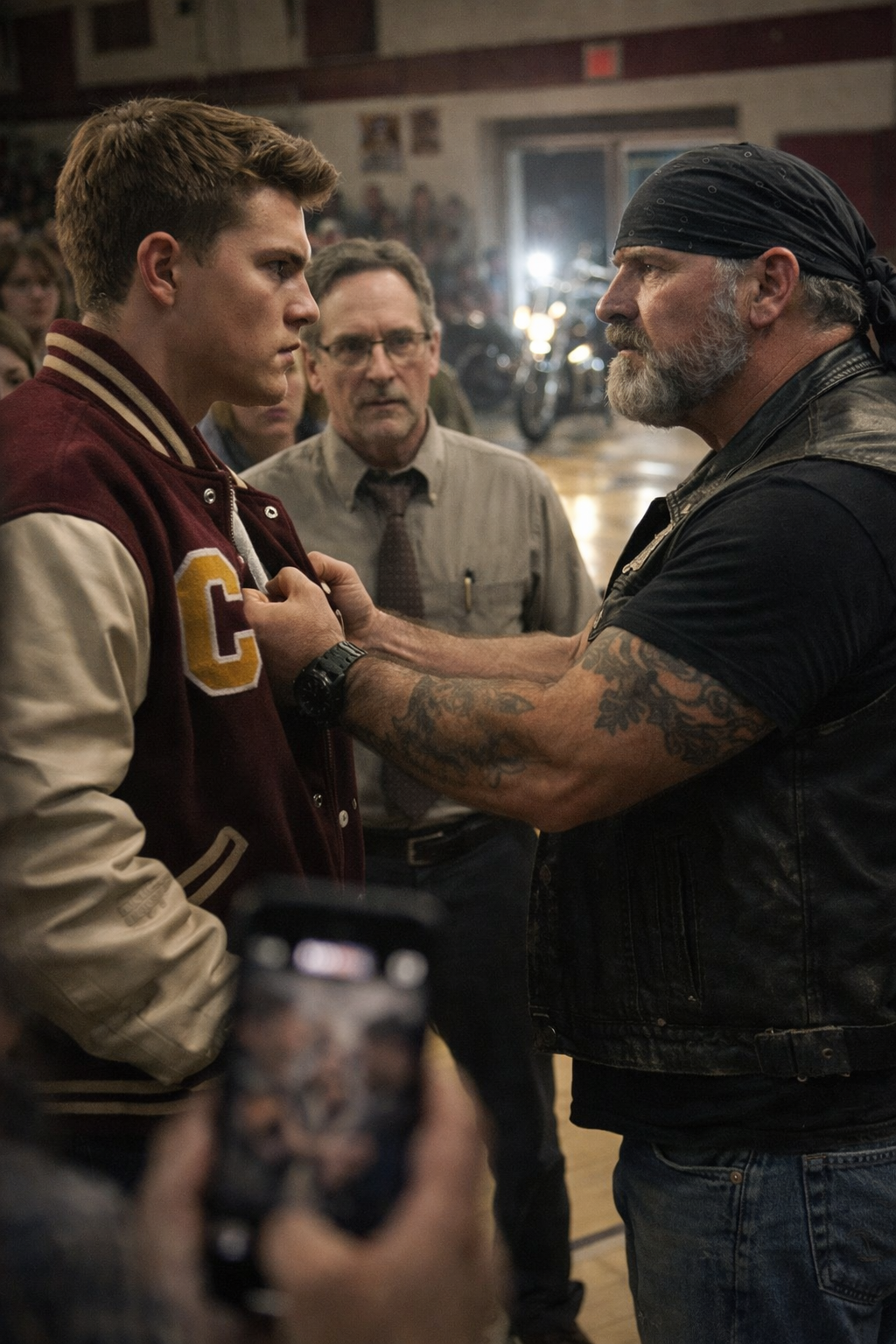
The laughter started before the teacher even finished his sentence.
It came from the back of the gym first. Then the sides. Then the folding chairs nearest the trophy case. A rolling, mean kind of laughter. The kind that doesn’t just hear weakness. It hunts it.
And standing at the center of it all was Caleb Ransom.
Quarterback.
Homecoming king.
Small-town legend before graduation had even arrived.
He was broad-shouldered, bright-jacketed, grinning in that easy way people do when life has spent years teaching them they will be forgiven for almost anything.
Coach’s favorite.
Parents’ pride.
The boy whose name got shouted across fields and painted across posters and spoken in diners like a promise.
And that afternoon, in front of half the school, he snatched the microphone out of Mr. Adler’s hand.
The sound screeched through the gym speakers.
Every head turned.
Mr. Adler froze.
The quiet teacher had been standing on the assembly stage with a clipboard tucked under one arm, trying to explain the schedule for senior service week. His voice had never been loud. It didn’t need to be. He spoke the way some men carry water: carefully, so none of it spilled.
But Caleb yanked the microphone free, stepped forward, and threw one arm around the teacher’s shoulders like it was all one big joke.
“Hold on,” Caleb said, laughing. “I think we all need this in English class volume so maybe the living can hear it.”
The gym exploded.
Mr. Adler said nothing.
He just stood there in his wrinkled button-down shirt and old brown tie, shoulders tight, face pale beneath the fluorescent lights. His glasses caught the glare. His hands hung still at his sides.
Waiting without pressure.
Even now.
Even while a hundred students laughed.
Even while teachers in the front row looked down at their laps and pretended they were suddenly very interested in event programs.
Even while the principal rose halfway from her seat, then sat back down because Caleb Ransom was Caleb Ransom, and in little towns, popularity often outranks courage.
He was an easy man to mock, Mr. Adler.
Soft-spoken.
Thin.
Gray at the temples.
Always carrying too many papers.
The kind of teacher students said “probably sleeps in that classroom” about.
He never raised his voice. Never shoved back. Never embarrassed anyone, even when they deserved it.
And because he was gentle, people mistook him for weak.
That’s how it works sometimes.
Cruelty dresses itself up as confidence.
And kindness gets called fragile.
Caleb lifted the microphone again and said, “Seriously, Mr. Adler, is there a class where you teach eye contact? Or is whispering your whole brand?”
More laughter.
Hotter this time.
Meaner.
A girl near the cheer block covered her mouth, half-shocked and half-thrilled to be watching someone untouchable do something rotten in public.
A boy in the band section slapped his friend’s knee.
One teacher quietly muttered, “Enough,” but not loudly enough to matter.
Mr. Adler reached for the microphone.
“Caleb,” he said softly, “give it back.”
Caleb held it above his head.
Like a toy.
Like the whole thing was harmless.
Then Mr. Adler moved.
Fast.
Faster than anyone expected.
He slammed his hand around Caleb’s wrist and twisted the microphone down and out of reach in one clean motion. The move was so sudden, so precise, so aggressive-looking that half the gym gasped like they had just watched a fight begin.
Caleb stumbled.
The microphone dropped.
Feedback screamed.
Someone yelled, “Yo!”
The principal shot to her feet.
Coach Brenner started toward the stage.
And Mr. Adler did something that made the whole room go cold.
He blocked Caleb from stepping forward again.
Not with panic.
Not with anger.
With control.
One hand flat against the football star’s chest.
One foot planted.
Body square.
A wall that refused to collapse.
For a second, Caleb looked less like a hero and more like a boy who had just met something he didn’t understand.
“What the hell?” he barked, face flushing. “Get your hands off me!”
But Mr. Adler wasn’t looking at him.
He was looking past him.
Toward the side entrance near the bleachers.
Toward the custodian’s hall.
Toward the sharp crackling sound no one else had noticed because the laughter had drowned it out.
The smell hit next.
Faint.
Then stronger.
Hot plastic and smoke.
The hum of fluorescent lights kept buzzing overhead, stupidly normal, while a thin gray ribbon began curling from the vent near the side wall.
At first only Mr. Adler seemed to register it.
Then one of the girls in the front row sniffed and frowned.
Then another kid turned.
Then everyone saw it at once.
Smoke.
Real smoke.
Not from outside.
Not from the parking lot grill behind the concession stand.
From inside the gym.
The laughter died so fast it felt ripped from the room.
Silence.
Absolute silence.
Then chairs scraped.
Teachers stood.
Students twisted around in their seats.
The principal’s voice cracked over the sound system. “Everybody stay calm—”
But calm had already left.
A freshman near the side exit screamed, “Fire!”
And panic did what panic always does.
It moved faster than reason.
People surged.
Rows collapsed into chaos. Shoes squealed on hardwood. Metal chair legs shrieked. Someone started crying. Someone else shoved. The band section bunched too tight near the aisle. A teacher dropped a binder and loose pages skittered across the floor.
The nearest exit, the side one beneath the smoking vent, suddenly became the one everyone wanted.
And the one nobody should have used.
Mr. Adler knew it.
That was why he had grabbed Caleb.
That was why he had blocked him.
Because Caleb, in all his swagger and blind momentum, had been one second away from charging straight toward the worst possible door and taking half the senior class with him.
Coach Brenner reached the stage stairs. “Adler! Back off the student!”
Mr. Adler finally turned.
“Keep them away from that exit,” he said.
He didn’t shout.
Didn’t need to.
Something in the way he said it cut through the room sharper than any yell could have.
Coach stopped.
The principal stared at the smoke now thickening above the side wall. “Oh my God.”
Mr. Adler didn’t wait for approval.
He moved down the stage steps, boots against tile echoing from the lobby beyond the gym doors, each stride hard and direct. Not teacher-soft. Not hesitant.
Disciplined.
He snatched the red crash bar on the main lobby doors and shoved them wide open. Cold afternoon air rushed in.
“This way!” he called. “Not the side exit. Main doors only. Move!”
Students were too scared to argue. Teachers too stunned.
They obeyed.
At first in clumps. Then in a stream.
Mr. Adler stood planted at the front like a human barricade, redirecting bodies, catching panicked shoulders, peeling students away from the smoke-heavy side aisle and forcing them toward clean air.
Waiting without pressure had always been his style.
Now he turned it into command.
A girl stumbled. He caught her.
A boy lost a shoe. Mr. Adler shoved him forward anyway.
Two freshmen froze, crying, and he lowered his voice so only they could hear. “Eyes on me. Good. Breathe. Walk.”
A wall that refused to collapse.
Coach Brenner grabbed Caleb’s arm. “Go help outside.”
Caleb jerked away, humiliated and furious. “He grabbed me in front of everybody!”
Coach stared at him like he no longer knew who he was looking at. “He probably saved your life.”
That landed.
Hard.
But not hard enough to quiet the crowd outside.
Because when students and parents and faculty poured into the front parking lot, coughing and shaken, the whole small-town machine of judgment booted up again almost instantly.
By the time the fire trucks were called, the story had already started mutating.
“He attacked Caleb.”
“I saw him grab him.”
“He shoved him.”
“He looked crazy.”
“He snapped.”
And because most people see what they expect to see, a new detail suddenly mattered more than smoke.
Mr. Adler had removed his blazer in the rush.
Under it, when the wind caught his shirt, they could see the ink running down both forearms.
Dark tattoos.
Old ones.
Military-style.
One parent near the curb whispered, “Since when does Adler have those?”
Someone else noticed the heavy black leather saddlebag strapped to the old motorcycle parked near the faculty lot.
Another noticed the thick boots.
Another said they’d smelled gasoline and smoke on him before, once in the hallway, and thought maybe he worked on cars.
Then all those harmless details fused into one ugly conclusion.
Not teacher.
Not really.
Something else.
Something wrong.
By the time Principal Weller reached the curb, two deputies were pulling in.
And standing twenty feet away from them, calm and alone, was Mr. Adler.
His sleeves were rolled high now. Gray-flecked beard visible beneath the soot smudged on his jaw where he’d wiped his face. Black T-shirt under the dress shirt. Tattooed arms. Broad shoulders people had never really noticed under cardigans and chalk dust and gentleness.
He smelled like gasoline and smoke.
He was the kind of man people avoid on instinct.
The visual verdict arrived all at once, and with it came permission.
A mother pulled her daughter closer.
A father muttered, “I knew something was off.”
Coach Brenner looked uncertain.
And Principal Weller, voice tight with the brittle authority of someone desperate to regain control, stepped forward and said, “Mr. Adler, I need you to stand back until the deputies sort this out.”
He looked at her.
Then at the building.
Then back at her.
“There are still two kids unaccounted for,” he said.
One of the deputies held out a hand. “Sir, step away from the entrance.”
A leather vest became a verdict.
Except in this case, it wasn’t a vest yet.
Not fully.
Just the shape of one inside the saddlebag on the motorcycle.
The possibility of one.
And that was enough.
Fear dressed up as policy.
Principal Weller swallowed. “You’ve frightened students. You physically restrained one. We have procedures.”
Mr. Adler’s expression didn’t change.
“So do fires.”
Inside the gym, a window cracked with a pop.
Several students screamed.
One deputy reached for his radio.
The other took two steps toward Adler. “Sir, don’t make this harder than it needs to be.”
Mr. Adler looked past him, scanning the roofline, the smoke drift, the old maintenance wing connection. Thinking.
Always thinking.
Then a terrified voice cut through everything.
“Maya’s still inside!”
It came from a girl in the sophomore row, face white with panic. “And Ben! They were in the costume closet!”
The whole crowd jolted.
Mrs. Kim from theater pressed both hands to her mouth. “No…”
Principal Weller spun toward the building. “Is that true?”
The sophomore nodded so hard she nearly fell over. “They went back for props before the assembly.”
Time changed shape.
All the adults who had been so busy deciding what Mr. Adler looked like now had to confront what he was hearing, calculating, and preparing to do.
One deputy started toward the entrance.
Mr. Adler caught his arm.
Not rough.
Final.
“No.”
The deputy bristled. “Excuse me?”
“The smoke’s banked low to the east side. Roof venting’s not active. You’ll lose visibility at the costume corridor in under a minute.”
The deputy stared. “How would you know that?”
Mr. Adler answered by pulling open the saddlebag on his motorcycle.
And there it was.
Black leather.
Worn soft by time.
A vest folded with military neatness.
Not flashy. Not decorated for show. Just old road leather carrying patches the crowd couldn’t read from that distance.
A few gasps rose anyway.
People think leather explains a man.
Sometimes they stop learning after that.
Principal Weller actually took a step back.
The deputy’s voice hardened. “Sir, this is not the time.”
Mr. Adler ignored him. He reached deeper into the bag and pulled out a compact smoke hood, a flashlight, a pry tool, and a small radio.
The whole parking lot went still.
Coach Brenner whispered, “What the hell…”
Mr. Adler shrugged into the leather vest over his soot-marked shirt. The patches showed now.
Station insignia.
Service tabs.
A memorial strip.
Not outlaw colors.
Not gang marks.
Something older.
Something earned.
Then, from beyond the football field and down the two-lane road that cut past the school entrance, came a sound that made every head turn.
Motorcycles.
Not wild.
Not chaotic.
Not a storm of reckless noise.
Low, steady, disciplined engines.
One.
Then five.
Then many.
The sound rolled across the school grounds like thunder with its anger under control.
Students backed away.
Parents stiffened.
One deputy cursed under his breath.
Because now, with the smoke rising behind the gym and the teacher in leather by his motorcycle, it looked exactly like the worst version of the story people had been rushing to tell.
The Brotherhood arrived in controlled formation.
A dozen bikes.
Then more.
Black, chrome, weathered steel. They turned into the parking lot in precise spacing, engines idling low, every rider holding the line like they’d done it a thousand times.
To frightened eyes, it looked like a gang coming to claim one of their own.
To anyone paying closer attention, it looked like expert discipline.
No one revved.
No one yelled.
No one postured.
They parked in a clean arc near the curb and dismounted with purposeful speed.
Men and women.
Older mostly.
Road-worn faces.
Steady hands.
One rider carried a medical bag.
Another pulled traffic cones from a side compartment.
Another immediately began directing students farther back from the gym entrance without touching anyone, using voice and posture alone.
Controlled formation.
Expert discipline.
A woman with a silver braid under her helmet walked straight to Mr. Adler and said, “Nate.”
Not Mr. Adler.
Nate.
“You called a smoke pattern on the radio,” she said. “What’s the layout?”
“Theater closet off east hall,” he replied. “Two kids unaccounted for. Roof tie-in over old boiler seam. It’ll flash if the panel fire reaches curtains.”
She nodded once. No emotion wasted. “I’ll take ventilation side.”
The deputy stepped in. “Hold on. Who are you people?”
The silver-braided rider looked at him evenly. “We’re who he called because your trucks aren’t here yet.”
It was sharp.
But true.
Another rider, a huge man with a white beard and trauma shears clipped to his vest, had already opened the medical bag and begun checking on a student with an asthma attack.
A third rider handed out water bottles from saddlebags.
A fourth crouched beside the crying sophomore and got the exact location of the costume closet without making her repeat herself twice.
The crowd stared.
These were not intruders.
These were responders.
Just not the kind people were comfortable receiving.
Principal Weller found her voice. “Mr. Adler—Nate—what is this?”
He tightened the smoke hood straps around his neck.
“This,” he said, “is the reason you don’t judge a man by what makes other people comfortable.”
Then he turned to the deputy. “You want to stop me, do it now. But if those kids are still in there, every second matters.”
The deputy hesitated.
And in that hesitation, the truth began to crack open.
Coach Brenner stepped closer, eyes fixed on the patch over Nate Adler’s heart.
He went pale.
“I know that emblem,” he said.
Nate didn’t answer.
Coach looked at Principal Weller, then at the crowd, and said in a hoarse voice, “My brother wore that patch in Kandahar.”
Silence.
Absolute silence.
Coach swallowed hard. “It’s 3rd Battalion Rescue Support.”
Heads turned back to Nate.
To the tattoos.
To the leather.
To the face they had all reduced to quiet harmlessness when that was convenient and suspicious danger when that was useful.
Coach’s voice shook now. “What are you, Adler?”
For the first time, Nate looked tired.
Not ashamed.
Just tired.
“Retired Army combat medic,” he said. “Volunteer fire response after that. Taught here because I got tired of funerals.”
The words hit like blows.
Someone near the back whispered, “Oh my God.”
He kept going, not because he wanted to explain himself, but because the moment required facts.
“I smelled the panel burning before it vented. Caleb was moving toward the side exit. If that crowd had pushed through there, they would’ve fed oxygen into the corridor and trapped the east wing.”
He glanced toward the gym, where smoke now pushed harder through the roof seam.
“I grabbed him because he was about to lead half the room into the wrong door.”
Every face in the parking lot changed then.
Not at once. But enough.
The mother who had whispered “something’s off” covered her mouth.
The deputy lowered his hand from his belt.
Principal Weller looked as if someone had quietly placed a mirror in front of her.
And Caleb Ransom, still flushed from public embarrassment, stood frozen near the flagpole with the entire weight of his cruelty crawling back over him, inch by inch.
The town hero looked very small.
Nate adjusted the vest and took one step toward the entrance.
Caleb found his voice. “Wait.”
Nate stopped.
The football star swallowed. “You… you saved me?”
Nate didn’t soften.
He didn’t harden either.
He just told the truth.
“I saved the crowd. You were in front.”
Then he went in.
Two riders went with him.
The silver-braided woman circled toward the maintenance side.
The white-bearded medic kept working on students outside.
And everyone else in that parking lot could do nothing but wait with the awful understanding that the man they had mocked, doubted, and nearly removed was now walking into smoke for children they had not even realized were missing.
Minutes stretch differently when guilt is involved.
One minute feels like judgment.
Two feels like punishment.
By the third, the only sound anyone noticed was the distant crackle from inside the gym and the low, steady, disciplined engines still idling near the curb like a held breath.
Waiting without pressure.
Even the Brotherhood did that with respect.
No theatrics.
No speeches.
No one milking the moment.
Just readiness.
Then came movement at the entrance.
First one rider.
Then Nate.
Bent low beneath smoke.
One child in his arms.
Another guided beside him, wrapped in a jacket too large for his shoulders.
The crowd surged, then stopped itself, as if suddenly afraid of making even more noise than it already had.
Mrs. Kim cried out and ran forward. “Ben! Maya!”
The kids were coughing and frightened but alive.
Alive.
The white-bearded medic took over immediately. Oxygen. Checks. Calm voices.
Nate stepped back, ripped off the smoke hood, and dragged in one long breath of clean air. Soot streaked his face. His gray-flecked beard was damp with sweat. The smell of gasoline and smoke clung to him harder now, mixed with burned dust and old effort.
He looked every inch the intimidating figure people had decided he was.
And now they could no longer pretend intimidating meant wrong.
Principal Weller walked toward him slowly.
No clipboard voice now.
No polished phrases.
“I’m sorry,” she said.
He looked at her.
Around them, the town watched.
Caleb took one step forward too. Then another. His letterman jacket suddenly seemed childish.
“I was out of line,” he said, barely above a whisper. “I thought—”
Nate cut him off.
“I know what you thought.”
There was no cruelty in it.
That made it worse.
Because kindness after humiliation lands deeper than rage.
Caleb’s eyes dropped.
“I’m sorry, Mr. Adler.”
Nate glanced toward the students, the teachers, the riders, the gym, the sky darkening above the smoke.
Then he said, “Class starts again Monday. You can show me then.”
No grand speech.
No public shaming in return.
Just accountability.
Steady and quiet.
Like everything else about him.
The fire trucks finally arrived with lights washing red across the school walls. Professionals took over. Hoses rolled. Commands were shouted. Reports began.
And just like that, the moment that would define everybody present started sliding away from public spectacle and into private memory.
The Brotherhood began packing up.
The silver-braided rider clasped Nate’s shoulder once. “You good?”
He nodded.
The white-bearded medic closed his bag. “Kids’ll be fine.”
Another rider handed Nate a clean rag. “You staying?”
He looked toward the crowd gathered in uncertain knots. The teachers who wouldn’t meet his eyes. The parents whose fear had worn the mask of procedure. The students who had laughed because laughter is easy when someone safe-looking is being crushed and silence is hard when someone powerful is doing the crushing.
Then he looked at Caleb.
The boy had tears in his eyes now, though he was trying hard to keep them hidden.
The school hero had learned, in the ugliest possible way, how fast applause evaporates when character is demanded.
Nate wiped soot from his hands.
“No,” he said. “They’ve got enough to think about.”
And that was it.
No press interview.
No heroic pose.
No invitation for the town to redeem itself cheaply.
He fastened his helmet, swung onto the motorcycle, and gave one short nod to no one in particular.
Around him, the Brotherhood mounted up in controlled formation.
Engines started.
Low.
Steady.
Disciplined.
The sound filled the parking lot, but now nobody heard menace in it.
They heard restraint.
They heard competence.
They heard the echo of all the things they had missed because prejudice is loud and truth often arrives in a quieter outfit than expected.
As Nate rolled past the curb, Principal Weller stepped aside.
Coach Brenner placed a hand on Caleb’s shoulder, but the boy didn’t move.
He just stood there, holding the weight of a judgment he’d made too fast.
And he wasn’t alone.
A wave of guilt moved through the parking lot.
Through parents.
Through staff.
Through students.
Through every person who had laughed when a quiet teacher was humiliated, and every person who had felt safer questioning the man in leather than the boy with the microphone.
Because that was the ugliest part.
Not that they had misjudged Nate Adler after seeing the tattoos and the beard and smelling gasoline and smoke.
It was that they had misjudged him long before that.
They had mistaken gentleness for weakness.
Silence for surrender.
Patience for fragility.
They had enjoyed his softness because it cost them nothing.
Then feared his strength because it made them examine themselves.
And now he was leaving them with that.
No speech.
No demand.
Just the fading sound of his engine as it carried him down the school drive and out toward the county road, the noise diminishing like a heartbeat returning to normal.
Long after the bikes disappeared, no one laughed.
They stood in the cooling air under the flicker of emergency lights, holding the weight of a judgment they’d made too fast.
A quiet teacher.
A leather vest.
A room full of assumptions.
And the terrible, life-changing difference between appearance and integrity.
If this story moved you, leave a ‘RESPECT’ for every silent hero who steps in when no one else does..