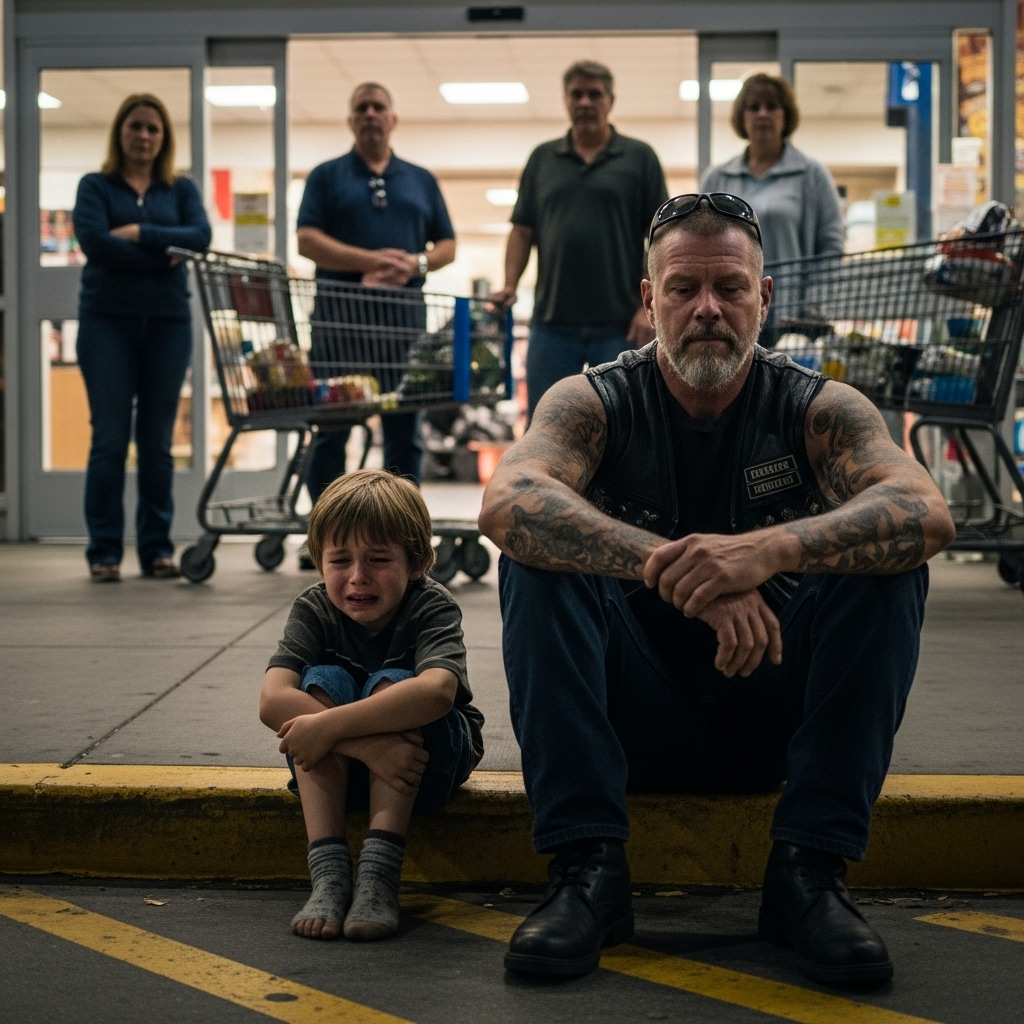
At nearly midnight, a small boy sat alone on the cold pavement outside a supermarket, crying so quietly it almost disappeared into the wind—until a motorcycle rolled in and stopped close enough to make several shoppers freeze.
The parking lot felt forgotten. One flickering streetlight buzzed overhead. A loose shopping cart rattled in the distance. The automatic doors sighed open and shut, spilling brief warmth and fluorescent light before sealing the cold back in.
The boy couldn’t have been older than six.
He sat pressed against the concrete wall, knees pulled tight to his chest, a thin hoodie drooping over his head. One sneaker lay a few feet away, its lace snapped like it had simply given up. His hands trembled as he wiped his cheeks again and again, trying to quiet himself.
People passed.
A couple walked by, their bags rustling.
A man unlocked his car, glanced once, then looked away.
Someone muttered, “Where’s his mom?”—as if asking was the same as helping.
The boy stared at the ground, whispering to himself. Every time the doors opened, he flinched, like he expected something worse than the cold.
Time stretched. Heavy. Uncertain.
Then came the sound.
Low. Mechanical. Near.
A motorcycle entered the lot, its headlight sweeping slowly across asphalt, carts, and finally—
The boy.
The engine cut.
Silence settled again.
The rider stepped off and removed his helmet.
No one knew him.
No one knew why he had stopped.
Only that he didn’t leave.
—
He didn’t approach right away.
That alone made people uneasy.
He stood beside his bike for a moment—tall, solid, wearing a sleeveless black shirt despite the cold. Tattoos traced his arms like old maps. Dark glasses hid his eyes, even at this hour. His boots were worn, firmly planted, as if he had nowhere else he needed to be.
A woman slowed as she exited the store.
“That doesn’t look good,” someone whispered.
Finally, he moved—but not toward the boy.
He walked past him and lowered himself onto the curb, leaving space between them. No reaching. No sudden gestures. Just… sitting.
The boy looked up, startled.
Their eyes met for a brief second.
Panic flashed across the child’s face. He scrambled backward, hands scraping the pavement. “I didn’t do anything,” he blurted. “I’m just waiting.”
The biker lifted one hand, palm open.
“I know,” he said softly.
That didn’t calm the others.
A store employee stepped outside, uncertain. “Sir, you can’t—uh—you shouldn’t—”
Someone pulled out a phone.
Another voice muttered, “Call the police.”
The biker said nothing.
He reached slowly into his pocket, pulled out a granola bar, and set it on the ground between them—still keeping his distance.
“You hungry?” he asked.
The boy nodded before he could stop himself.
The biker nudged the bar closer with his boot.
To the people watching, it still didn’t look right. A stranger. A biker. A child. Too quiet. Too unexplained.
“Hey!” a man called out. “Back away from him!”
The biker glanced up, calm and steady.
“I’m sitting,” he said. “So is he.”
Security was called. The manager alerted. Someone dialed 911 “just in case.”
The boy’s voice trembled. “Am I in trouble?”
The biker shook his head. “No.”
But no one else believed it.
The unease sharpened.
The night seemed to press closer.
—
Two employees hovered by the entrance now, watching carefully. The police hadn’t arrived yet, but everyone felt they would.
The boy nibbled the granola bar, still shaking. “My mom said she’d be right back,” he said suddenly. “She told me to stay.”
“How long ago?” the biker asked.
The boy shrugged. “It was still light.”
That answer landed harder than anything else.
A security guard stepped forward. “Sir, you need to move away from the child.”
The biker nodded once—and stayed exactly where he was.
“I’m not touching him,” he said. “I’m waiting.”
“For what?”
He reached into his pocket again.
The tension spiked instantly.
“Don’t—”
“Hands up—”
“Sir—”
He ignored the voices, pulled out his phone, and typed a short message. One line. Then he slipped it away.
He looked back at the boy.
“What’s your name?”
“Caleb.”
“Caleb,” he said, “we’re gonna sit right here. Okay?”
Caleb nodded.
That trust made the adults more uncomfortable than anything else.
The security guard spoke urgently into his radio. “We’ve got a situation.”
The doors opened again.
But this time, it wasn’t footsteps.
It was engines.
More than one.
Low. Approaching.
And no one was ready.
—
The sound came first—steady, controlled.
Then headlights.
One motorcycle entered the lot.
Then another.
Then two more.
They pulled in slowly, parking along the curb, engines shutting off one at a time until silence returned.
No revving.
No drama.
Just presence.
People stiffened. A woman gripped her bags tighter. Someone whispered, “Oh no…”
The riders dismounted calmly.
Men and women. Older. Weathered. Their clothing simple, worn. Nothing flashy. Nothing theatrical.
They didn’t rush forward.
They didn’t surround anyone.
They just stood, spaced out, watching.
The first biker remained seated beside Caleb.
An older man stepped forward—gray-haired, lined face, steady eyes. No patches. No show of authority. Just quiet weight.
“What’s going on?” he asked.
The security guard cleared his throat. “We’ve got a report of a man lingering with a child.”
The older man nodded and looked at Caleb. “That right?”
Caleb shook his head. “He just sat with me.”
The older man turned to the biker. “How long?”
“Forty minutes.”
The older man let out a slow breath.
A police cruiser rolled in, lights flashing once before dimming. The officer stepped out, scanning the scene—the bikes, the crowd, the child.
“What’s going on here?”
“Lost kid,” the older man said. “We’re waiting for his mother.”
The officer crouched in front of Caleb. “That true?”
Caleb nodded. “She said stay.”
“Got a number for her?”
He shook his head. “It’s in her phone.”
The biker stood up then.
Slowly.
Carefully.
He reached into his jacket and pulled out a folded receipt. “Found this near the carts,” he said. “Name’s on it. Time stamp.”
The officer took it, checked it, and spoke into his radio.
Minutes passed.
No one moved much.
Then—
Headlights cut sharply across the lot.
A car pulled in fast, tires crunching. A woman jumped out, frantic, scanning—
“Caleb!”
The boy stood so quickly he nearly stumbled. “Mom!”
She ran to him, dropping to her knees, pulling him close, her voice breaking with apologies. “I thought you came inside—I’m so sorry—I’m so sorry—”
The officer stepped closer. “Ma’am, you left your child unattended for quite some time.”
She nodded, shaken. “I know. I made a mistake.”
No one added anything.
No one needed to.
The tension dissolved—not with noise, but with relief.
—
The crowd began to thin.
People returned to their cars, quieter now. The manager slipped back inside. The security guard relaxed.
The bikers didn’t stay.
The older man exchanged a brief word with the officer, then stepped back.
No introductions.
No explanations.
Caleb’s mother looked at the man who had stayed with her son.
“I—thank you,” she said softly. “I don’t even know how to—”
He shook his head.
“He waited,” the biker said. “You taught him that.”
She blinked, holding back tears.
Caleb looked up at him. “You’re really big,” he said. “But you’re not scary.”
A faint smile touched the biker’s face.
“Good,” he said.
—
Engines started again, one by one, low and steady.
The motorcycles pulled away into the night, leaving the parking lot as it had been—dim lights, scattered carts, the quiet hum of a late-night store.
But something had shifted.
Everyone there had felt it—that quick judgment, that instinct to assume the worst, that fear disguised as caution.
And they had all been wrong.
No speeches followed.
No lessons were spoken.
Just a boy who wasn’t alone anymore.
And a man who never asked to be trusted—
only to be allowed to wait.
The pavement where they had sat stayed empty.
But for a long time after, it didn’t feel ordinary at all.