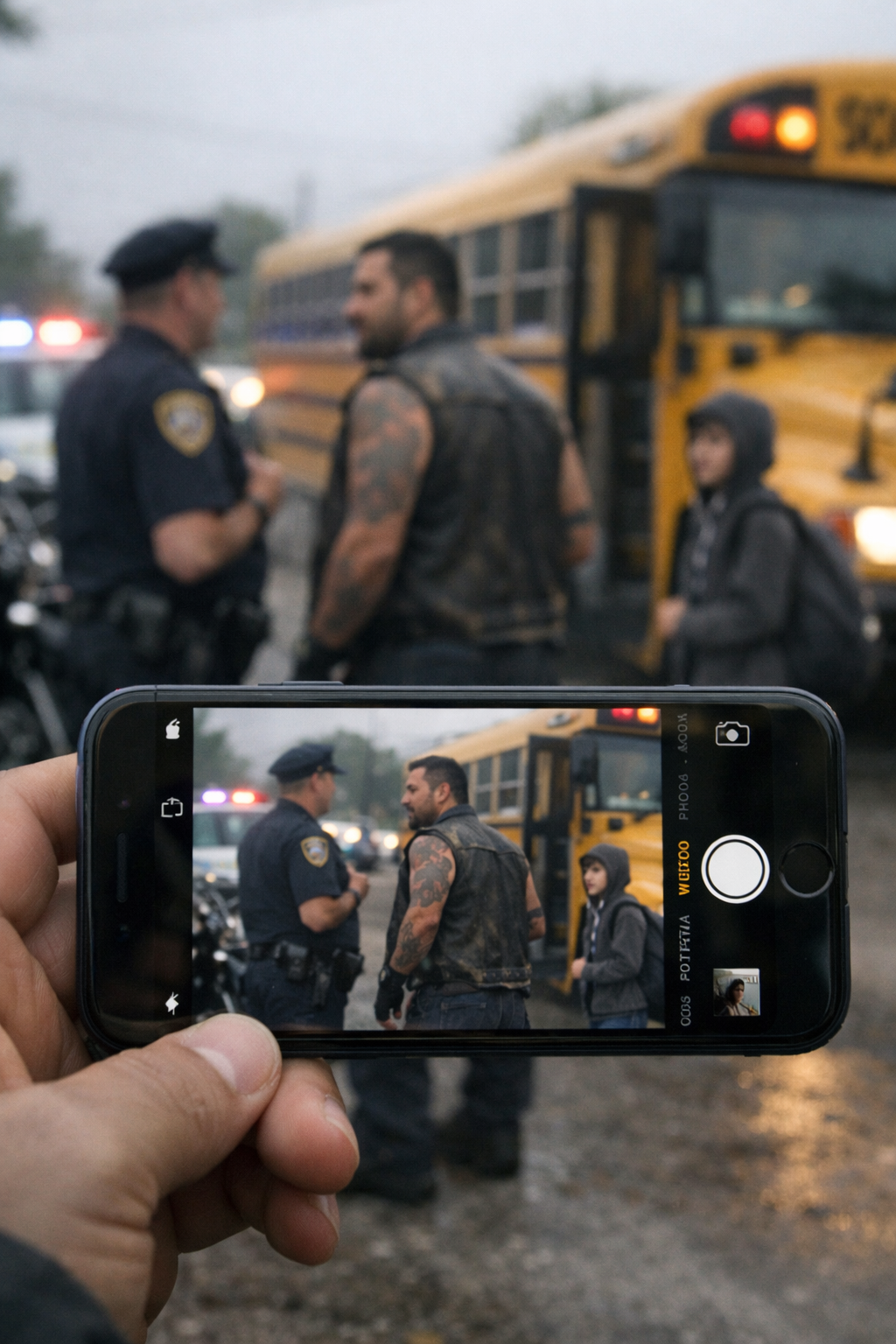
The bus doors slammed shut behind the boy.
Inside, a few students glanced back, then looked away. The driver didn’t. He shifted into gear, and the engine pulled the bus forward.
It was just after dawn in a small working-class town in Ohio—the kind of morning where your breath hangs in the air and backpacks look too big on narrow shoulders. Diesel fumes drifted from the yellow bus as it idled moments before, now fading into the cold.
Ethan was ten.
He stood on the sidewalk, gripping the straps of his backpack. His shoes were scuffed. His jacket was zipped to his chin, though the broken zipper kept slipping open. In his pocket, a crumpled note from his mother—I’ll pay Friday—pressed against his fingers.
But the driver had already made his decision.
“No pass, no ride,” he’d said. Flat. Final.
Ethan tried once more.
“My mom said—”
“Step off the bus.”
A few kids had watched. One stared at a phone. Another just looked, curious, like this was something to pass the time before school.
Then the doors hissed shut.
Now the bus was gone.
Ethan didn’t cry. Not yet. He just stood there, stunned, watching it disappear around the corner. The school was too far to walk, and the road ahead had no sidewalk—only a narrow shoulder and cars moving too fast.
He checked his phone.
No signal.
Being left behind is quieter than people expect.
That was when the sound broke through the stillness.
An engine.
Not the bus.
A motorcycle rolled to a stop near the curb. The rider wore a worn leather vest over a sleeveless shirt, tattoos visible despite the cold. His boots scraped lightly against the pavement as he steadied the bike.
He looked from the empty road… to the boy.
“Hey,” he called. “Why aren’t you on that bus?”
Ethan hesitated, then answered softly.
“They said I couldn’t ride.”
The biker’s gaze lifted toward the road where the bus had gone.
He didn’t say anything else.
He just turned the throttle.
The motorcycle surged forward, engine rising as it chased down the street.
From a distance, it didn’t look good.
A biker going after a school bus.
A man closing in on a vehicle full of children.
At a nearby corner, a woman froze. “Is he chasing the bus?”
Another person pulled out a phone. “Someone call the police.”
Inside the bus, the driver caught sight of the motorcycle in the side mirror and stiffened. He reached for the radio.
“Dispatch, I’ve got a biker following me. This doesn’t feel right.”
Students pressed against the windows.
“What’s he doing?”
“Is he mad?”
“Is he going to hit us?”
But the biker didn’t rush wildly. He kept his distance. Controlled. Intentional.
At the next stoplight, the bus slowed.
The motorcycle pulled alongside.
The biker raised one hand—not in anger, but to be seen.
The driver slammed the brakes.
“Stay back!” he shouted through the glass.
The biker shut off the engine, stepped off slowly, helmet under his arm, hands clearly visible.
“I’m not here to cause trouble,” he said evenly. “You left a kid behind.”
Cars began to stack up. Someone honked. A man leaned out his window.
“Hey! Get away from that bus!”
The biker ignored him, eyes fixed on the driver.
“He doesn’t have a pass,” the driver snapped. “That’s policy.”
“He’s ten,” the biker replied. “And it’s freezing.”
“Not my problem.”
Phones were out now. Recording. Whispering.
Why is a biker arguing with a school bus driver?
The biker exhaled, jaw tight, and stepped back.
“Fine,” he said quietly. “Call whoever you need.”
The distant wail of sirens began to rise.
The bus idled at the light. The children inside fell silent, sensing the shift in the air. The biker stood beside his motorcycle, posture open, deliberate—non-threatening.
A patrol car pulled up, lights flashing.
“Sir,” the officer called, hand near his belt. “Step away from the vehicle.”
The biker complied immediately.
“I just want the kid to get to school,” he said.
“Why were you following the bus?”
The biker reached into his vest pocket.
A ripple of alarm spread.
“Hey!” someone shouted.
He paused—then raised his other hand first, palm open.
“It’s my phone.”
Slowly, he pulled it out and turned the screen toward the officer.
A text thread. A name. A photo.
“I saw him get kicked off,” the biker explained. “I called his mom.”
The officer glanced at the screen, then toward the road.
“She’s on her way,” the biker added. “But that road isn’t safe for him.”
The driver crossed his arms. “Still doesn’t change the rules.”
The biker looked past him—back to where Ethan stood, small and alone.
Then he typed a message.
Sent it.
“Give me five minutes,” he said.
“For what?” the officer asked.
The biker didn’t answer.
The sound came next.
Low. Steady. Growing.
Engines.
More than one.
Heads turned. Conversations stopped. Even the officer glanced over his shoulder.
Motorcycles approached—not fast, not chaotic, but controlled. One after another, they lined the curb in a quiet formation. Riders dismounted calmly, helmets in hand, movements deliberate.
No one rushed forward.
No one shouted.
An older rider stepped slightly ahead.
“Morning, officer,” he said. “We’re here because a child was left on an unsafe road.”
“He didn’t have a pass,” the driver insisted.
The man nodded once. “We heard.”
He turned toward Ethan.
“Son,” he said gently. “You alright?”
Ethan nodded.
Then a car screeched to a stop nearby.
“Ethan!”
His mother ran to him, dropping to her knees, pulling him close, her voice breaking with relief.
The officer looked between them, then at the road—no sidewalk, traffic building.
He exhaled.
“Driver,” he said firmly, “you’re authorized to let him on.”
The driver hesitated. “Policy—”
“—doesn’t override safety.”
A pause.
Then—
The doors hissed open.
Relief spread, quiet but undeniable.
Ethan climbed aboard. At the steps, he turned once.
The biker met his eyes and gave a small nod.
Nothing more.
The truth didn’t need explaining.
The biker wasn’t reckless. He was part of a volunteer safety group—riders who stepped in when situations turned uncertain, when waiting felt more dangerous than acting.
The others had come because a message said a child was standing somewhere he shouldn’t be.
That was enough.
Ethan’s mother shook the biker’s hand. “Thank you,” she said.
He shrugged lightly. “Anyone would’ve done it.”
She glanced at the line of bikes, the quiet discipline.
“Not everyone,” she said.
The biker didn’t reply. He mounted his bike, waited until the others were ready, then started the engine.
They left the way they came—steady, controlled, unnoticed by anyone who wasn’t really paying attention.
Later, people would talk about a biker chasing a school bus.
Some would say it looked dangerous.
Some would exaggerate.
But Ethan would remember something different.
He would remember standing alone in the cold—
And the moment someone chose to stop.
To notice.
To act.
Because sometimes protection doesn’t look gentle at first.
But it always leaves you safer than before.