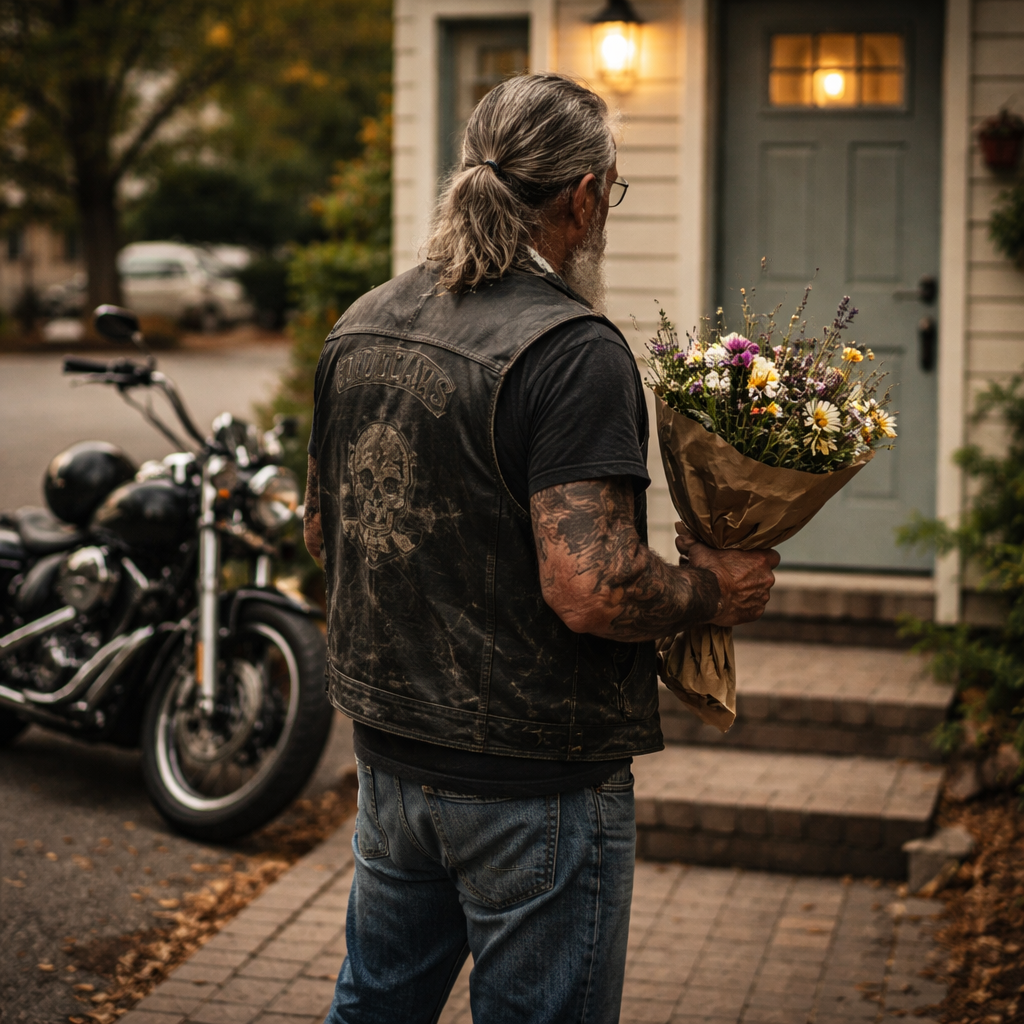
It started on a cold March morning. I opened my door to find a small bouquet of wildflowers tied with twine, resting delicately on my porch. A note lay on top, handwritten in careful cursive: “For the one who needs them most.”
I froze, unsure whether to laugh or panic. I didn’t know anyone in the city who might have sent them. I hadn’t ordered flowers, and the apartment number matched mine perfectly. I carried the bouquet inside, setting it on the kitchen table. The scent of daisies, lavender, and earth was so fresh it felt as if the flowers had been plucked that morning.
Days passed, and I dismissed it as a one-time mistake. But a week later, another bouquet arrived. This time, the note read: “Somewhere, someone remembers you. You are not alone.”
My curiosity turned to obsession. I began inspecting every bouquet, cataloging the notes, trying to find a pattern. Every month, like clockwork, the flowers arrived—always different, always vibrant, always accompanied by a cryptic note. Sometimes it was poetry: “The road bends but does not break; neither do you.” Other times, simple encouragement: “Keep going. I see you.”
I asked around the neighborhood, showed pictures to the local florist, even posted online. No one knew anything. Whoever was sending these flowers was meticulous, careful. Invisible. Ghostlike. And yet, their presence began to fill my lonely apartment with warmth. I looked forward to the small bursts of color and fragrance more than I cared to admit.
Then came the summer evening that changed everything.
I was sitting on the porch, watching the sun bleed into the horizon, when a deep rumble shook the street. The unmistakable growl of a motorcycle cut through the quiet. A black Harley-Davidson appeared, chrome gleaming, headlights cutting like knives through the dusk. The rider slowed, stopping at my porch.
He wore a leather vest adorned with patches of a biker club I didn’t recognize. A bandana covered the lower half of his face. His long hair was tangled, wind-blown, and his eyes… his eyes were storm clouds. A man who had lived life on the edge, someone whose world was danger, speed, and freedom, had pulled up to my doorstep.
Without a word, he handed me a bouquet. Lavender and wild daisies again, tied with rough twine. I could smell the wind and exhaust clinging to him, a sharp contrast to the softness of the flowers.
“Who… who are you?” I asked, my voice trembling.
He hesitated. Then, slowly, he lowered his eyes and said: “I’m the one sending the flowers.”
I laughed nervously, thinking it a joke. But his eyes didn’t smile. They were haunted.
“Why?” I whispered.
He took a shaky breath, revealing a scar running down his knuckle. “Because I promised her. Before… before she left. I promised her I’d keep her memory alive. She never got to see these streets, these flowers, these little things I wanted to share with her. And then… she was gone. I couldn’t stop sending them.”
I didn’t understand.
“My sister,” he continued, voice tight with emotion. “She was supposed to live here, in this apartment. She was supposed to grow up in a safe place. I failed her. I sent her flowers for years, hoping she’d feel loved. Then… she died. I thought… maybe you… someone else…” His voice broke.
The truth hit me like ice water. All this time, the flowers hadn’t been meant for me. They were for someone else entirely. And yet, in that accidental misplacement, grief had spilled into my life, reshaping it in ways I hadn’t expected.
I reached for his hand—rough, scarred, calloused from a life on the road. He flinched but didn’t pull away.
“I’m so sorry,” he said, almost to himself. “I didn’t mean to… make someone else’s heart grow attached to hers.”
I smiled through the ache. “You made it beautiful, even by mistake.”
For a long moment, we stood there in silence, the scent of wildflowers hanging in the humid summer air. The rumble of his bike seemed distant now, and I realized that a man who had known the sharpest edge of life—loss, grief, and the freedom of the open road—had brought me a small miracle without ever asking for anything in return.
I learned his name eventually: Ryder. The man behind the flowers was a well-known figure in certain circles, an outlaw biker who lived by the road and the code of his club. He wasn’t violent, not in the way the movies portray bikers. He was protective, loyal, and haunted by a past he couldn’t escape.
His sister, Amelia, had been the light of his life. She was a quiet girl with a love of nature, a laugh that could soften the hardest of hearts. But the world had been cruel. A car accident had taken her far too soon, leaving Ryder alone in a world that had never slowed down for him.
Sending flowers had been his ritual, a way to keep her memory alive, to let the world know she had existed. The twist of fate that sent them to me instead wasn’t just coincidence—it was a collision of grief and fate. And in that collision, something unexpected happened: he found someone who would listen to his story, who would understand his pain without judgment.
Over the months, Ryder became a regular presence—not intrusive, not demanding, but consistent. Sometimes he left flowers and notes, sometimes he just rode by, waving, a flash of chrome and leather in the sunlight. He never expected me to ask questions, never expected me to follow him into the world he inhabited. But slowly, I did.
He showed me the roads he loved, the places Amelia had dreamed of seeing. Highways that stretched endlessly, cliffs that overlooked rivers glowing with sunset, and hidden meadows where wildflowers grew like flames across the grass. Each place held a memory, each road a story. Ryder’s world was raw, untamed, and terrifying—but also beautiful in ways my city life had never been.
One autumn night, we sat by a riverbank. The air smelled of wet leaves and pine. Ryder took out a notebook, filled with sketches of flowers and notes about Amelia, and handed it to me.
“She wanted to see the world,” he said softly. “I wanted to show it to her, even if it was only in my mind now.”
I flipped through the pages. Each drawing, each note, was a tribute to a life lost but not forgotten. I realized then that Ryder’s grief wasn’t just about loss—it was about love, about memory, and about the small, fragile ways humans try to hold onto those they’ve lost.
By winter, the flower deliveries stopped, but our bond had grown. Ryder and I had become unlikely companions, two people brought together by misdelivered bouquets and the need to remember.
On the anniversary of Amelia’s death, Ryder returned to my porch one last time. In his hand was a bouquet unlike any before—white lilies and wild roses, tied with a ribbon that fluttered in the wind.
“For her,” he said. “And for you. You helped me carry her memory when I was too broken to do it alone.”
I didn’t know what to say. Words felt useless. I nodded, feeling the full weight of eleven months of mystery, grief, and unexpected beauty.
He mounted his Harley and revved the engine. The sound echoed down the empty street, a symphony of loss and freedom. As he rode away, I understood something profound: some people carry their grief like a road map across the world. Some gifts arrive for the wrong person. But occasionally, fate allows those roads to cross, and in that crossing, beauty blooms—messy, heartbreaking, and real.
Even now, when the wind carries the faint scent of wildflowers across my porch, I think of Ryder. Of Amelia. Of the roads we didn’t travel together, and the memories we shared anyway. And I realize that sometimes, love and grief can take the most unexpected forms—and that even a misplaced bouquet can change a life forever.