“Sign the petition, Elias. We’re doing this before dusk.”
Evelyn standard, my seventy-two-year-old neighbor with a spine made of iron and a tongue that cut like a filet knife, shoved a plastic clipboard under my nose. We were standing on my driveway in the late afternoon heat of the Magnolia Estates cul-de-sac. Magnolia Estates was the kind of neighborhood where a slightly overgrown lawn was a topic of conversation at the monthly HOA meeting, and the color palette of our stucco houses was strictly enforced as ‘Variations on Taupe.’
“Evict who?” I asked, looking down at the legal-sized document covered in names.
Evelyn pointed her arthritic index finger across the street, directly at the beige and tan corner house. “Him. The ruffian. The menace. The man with that disgusting machine that rattles the china every Tuesday night.”
She meant Silas. Silas was standard ‘bad news’ on paper. He stood well over six feet, built like an NFL linebacker, and was covered in tattoos that crawled up his neck and wound around his hands. He wore faded denim vests over sleeveless shirts and heavy black boots. Every night, around 8 PM, he would roar into the neighborhood on a monstrous, customized blacked-out Harley that the entire cul-de-sac, minus me, hated. He didn’t wave. He didn’t make small talk. He just rolled in, parked, and disappeared into his dark, high-fence compound.
“He hasn’t done anything, Evie,” I said, leaning my back against my sedan.
“He’s tanking our property values! This Magnolia Estates, Elias, not an outlaw compound. We have a standard to maintain! We’re going down to the Sheriff’s substation tonight with all of this. He’s running some kind of criminal enterprise in that house. I can feel it. Just sign.”
I looked down at the petition. I knew every name. The Thompsons, the Gables, Mrs. Davis. The sheer weight of suburban conformity. I looked over at Silas’s closed garage. Then I picked up the pen and scribbled my signature. I hated myself a little for it, but in Magnolia Estates, you either stood with Evelyn or you were the enemy.
The confrontation didn’t wait for the Sheriff. That very evening, around 7:45 PM, a dozen of us—led by an particularly aggressive Mrs. Thompson from the HOA—converged on Silas’s property. We stood in a semi-circle on his paved driveway, the collective scent of suburbia (lavender laundry detergent, expensive cologne, and anxiety) thick in the air.
Mrs. Thompson knocked on his door. A heavy, rhythmic thwack-thwack-thwack that seemed entirely too aggressive. The rest of us shuffled, checking watches, looking at each other for validation. I was standing next to Elias Gable, who kept muttering, “If that thing wakes up the baby, I’m gonna lose my mind.”
The door didn’t open. The garage door did.
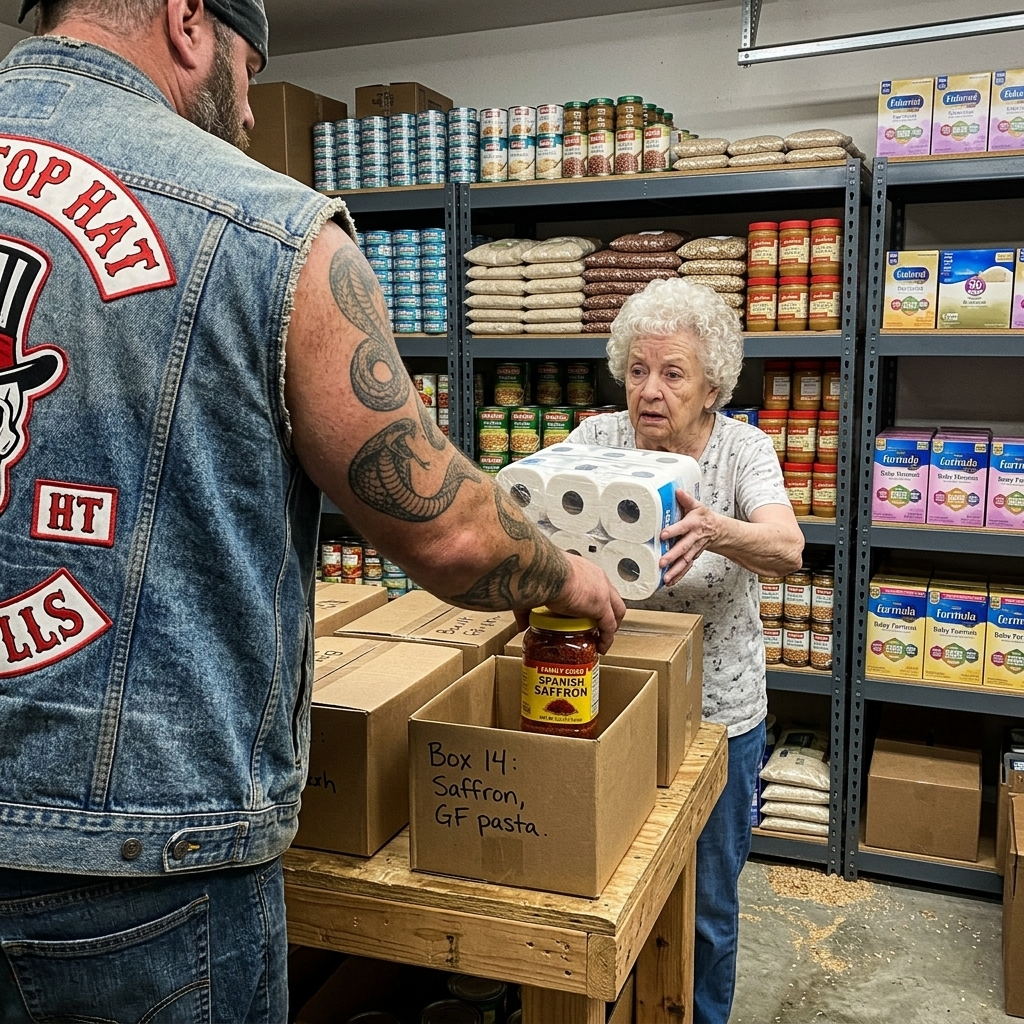
Silas stepped out. Up close, he was a physical nightmare. He was wearing his ‘Cut’ (the denim vest), which featured a massive white-and-red patch of a stylized skull wearing a top hat. The patch on his bicep was a detailed, coiled cobra.
“Something you need?” He growled, his voice a gravel-and-asphalt mix.
“We want to talk about your activities, Mr…. Mr. Silas,” Mrs. Thompson said, her voice wavering slightly. She clutched the petition like a shield. “Specifically, the menace of your motorcycle and whatever… operation you are running here. The neighborhood is… concerned.”
Silas didn’t say a word. He looked at us. One by one. His flint-green eyes counts the cost of our suburban entitlement. Then he sighed, a dry, grating sound.
“Concerned, huh? Follow me.”
He walked, a slow, rolling gait, back into his dark garage. We didn’t know what to do. Magnolia Estates etiquette dictates that when an intimidating man in a biker vest tells you to follow him into a dark garage, you politely decline. But the mob mentality won out. We shuffled in after him, a hesitant, anxious herd of taupe.
I was expecting… well, I was expecting a chop shop. Or maybe a meth lab. Or at the very least, a bunch of open tool chests and half-rebuilt engines covered in grease.
Instead, the garage was illuminated by harsh, overhead fluorescent lights. It was vast, immaculate, and smelled intensely of industrial cleaner, sawdust, and… fresh bread.
It wasn’t a criminal enterprise. It was a factory.
Tramp (Mrs. Gable let out a small, terrified gasp when she realized that was the name above the skull on his vest) had completely transformed the interior. Every available inch of wall space was dominated by heavy-duty metal shelving units.
They were stacked with food.
Not just standard non-perishables. The shelving units were arranged with the surgical precision of a grocery store. We’re talking industrial-sized cans of tomatoes, family packs of tuna, dried pasta, beans, lentils, shelf-stable milk, jars of peanut butter that were bigger than a human head, and sacks of rice that looked like they could be used as gym equipment.
And in the center of the garage, on massive, custom-built wooden work tables that Tramp had obviously constructed, were stacks of brown cardboard boxes.
Fifty boxes. All open. And all in various stages of being packed with balanced meals.
We stood, a silent, dumbfounded audience of Magnolia Estates suburbanites. The scent of taupe anxiety was replaced by the overwhelming, humbling scent of basic human need.
Tramp didn’t say anything. He walked to one of the work tables and picked up a sack of rice, placing it carefully into an open box.
“We’re doing our weekly outreach tomorrow,” he muttered, not looking at us. “Tuesday nights. It takes me five, six hours to get all fifty packed.”
I walked forward, past Mrs. Gable, who looked like she might faint. “Who are you packing these for, Silas?”
He finally looked at me. The gravel-and-asphalt voice was softer now. “The food banks in the county are dry, Elias. The inflation, the supply chain, the layoffs… the demand has tripled. They can’t keep up. So, my chapter, the ‘Top Hat Skulls,’ decided to step in.”
“Your chapter?” Evelyn Standard asked, her voice uncharacteristically small.
Tramp pointed to the massive, scary skull wearing a top hat on his back. “Yes. We’re a recognized non-profit outreach organization. My house is the main processing and distribution center for our chapter.”
He walked over to a stack of papers and handed one to Mrs. Thompson. It wasn’t the petition. It was a spreadsheet. It listed fifty families. Fifty addresses. And fifty specific, documented dietary needs—’Family of 6, gluten sensitivity.’ ‘Single mother of 2, need baby formula.’ ‘Elderly couple, require low-sodium options.’
“Every week,” Tramp said, “Fifty families. They’d starve without this. Tomorrow night, right around 8 PM, seven other brothers will roar into Magnolia Estates on their disgusting, china-rattling machines. They’ll pull right up to this garage, load five boxes each into their saddlebags and backpacks, and we’ll spend three hours running deliveries across the county.”
He looked at Elias Gable, whose face had gone completely pale.
“That 8 PM rattle that’s been bothering you? That’s the sound of breakfast for ten kids, Elias. It’s the sound of a senior couple not having to choose between medication and dinner. It’s the sound of our standard to maintain.”
The silence in that garage was absolute. It wasn’t the polite suburban silence of Magnolia Estates. It was a heavy, profound silence born of shame, judgment, and the absolute collapse of everything we thought we knew.
I looked at the boxes. The rice. The tuna. The formula. Then I looked down at the petition that Mrs. Thompson was now trying to hide behind her back. I felt like the smallest, most pathetic human being on the planet.
Evelyn Standard was the first to move. She took two slow steps toward Tramp. She didn’t look like an iron-spined old woman. She looked like a humbled matriarch. She raised her arthritic finger, not in a point, but to adjust her pearl necklace.
“Mr…. Mr. Tramp,” she said, her voice shaking. “We… we seem to have been terribly mistaken.”
Tramp just gave a short, grunted nod.
The neighborhood “confrontation” was over. We left the garage, moving with the sluggishness of people who had just had their worldview dismantled. As we walked down the driveway, I noticed Elias Gable was hanging back.
“Elias?” I asked.
“I have two weeks of formula that our son outgrew,” he said, not looking at me. “Do you think Tramp… do you think he can use it?”
Within forty-eight hours, the “Outlaw Biker Menace” of Magnolia Estates had vanished. It was replaced by something else entirely. Magnolia Estates had a new collective activity.
It started with donations. Elias Gable dropped off two weeks of expensive baby formula. Evelyn Standard arrived on a Wednesday afternoon, not with a petition, but with four family-sized packs of premium toilet paper and an industrial-sized jar of Spanish saffron (“You never know who might need it!”). The Thompsons, the HOA enforcers, drove all the way to a warehouse club and returned with a pallet of shelf-stable milk.
Our “Taupe Palette” became a collection point. By Friday, the metal shelving units in Tramp’s garage weren’t just packed; they were overflowing.
And on Tuesday night, at 7:55 PM, the cul-de-sac of Magnolia Estates didn’t just rattle; it vibrated. But nobody came out with clipboards or anxiety. Everyone came out to watch.
Seven massive, customized motorcycles, their engines roaring a primal, deafening victory, turned the corner. They didn’t sneak. They announced their arrival. Their riders, an imposing wall of leather and patches, pulled up to Tramp’s garage with standard-issue suburban efficiency.
Tramp stepped out, a small, weary curve touching his lips beneath that gray beard. He didn’t say anything, just tapped the skull on his bicep.
I watched from my driveway as Elias Gable and Mrs. Thompson stood side-by-side, carefully placing the packed boxes into the saddlebags of the other riders. The ‘Top Hat Skulls’ weren’t a meniscus; they were our logistics department. The sound of their engines wasn’t a threat; it was our gospel.
Tramp didn’t become a suburban darling. He still didn’t wave, and he still wore the vest. But he wasn’t evictable. We were his supply chain. We were his distribution team. Magnolia Estates, the standard of conformity, had found a new, gritty, unexpected purpose. We weren’t just neighbors; we were his brothers and sisters in dirt, grease, and the profound, beautiful work of keeping fifty families from starving. And every Tuesday night, when the rattle started, we didn’t check the china. We checked the schedule.