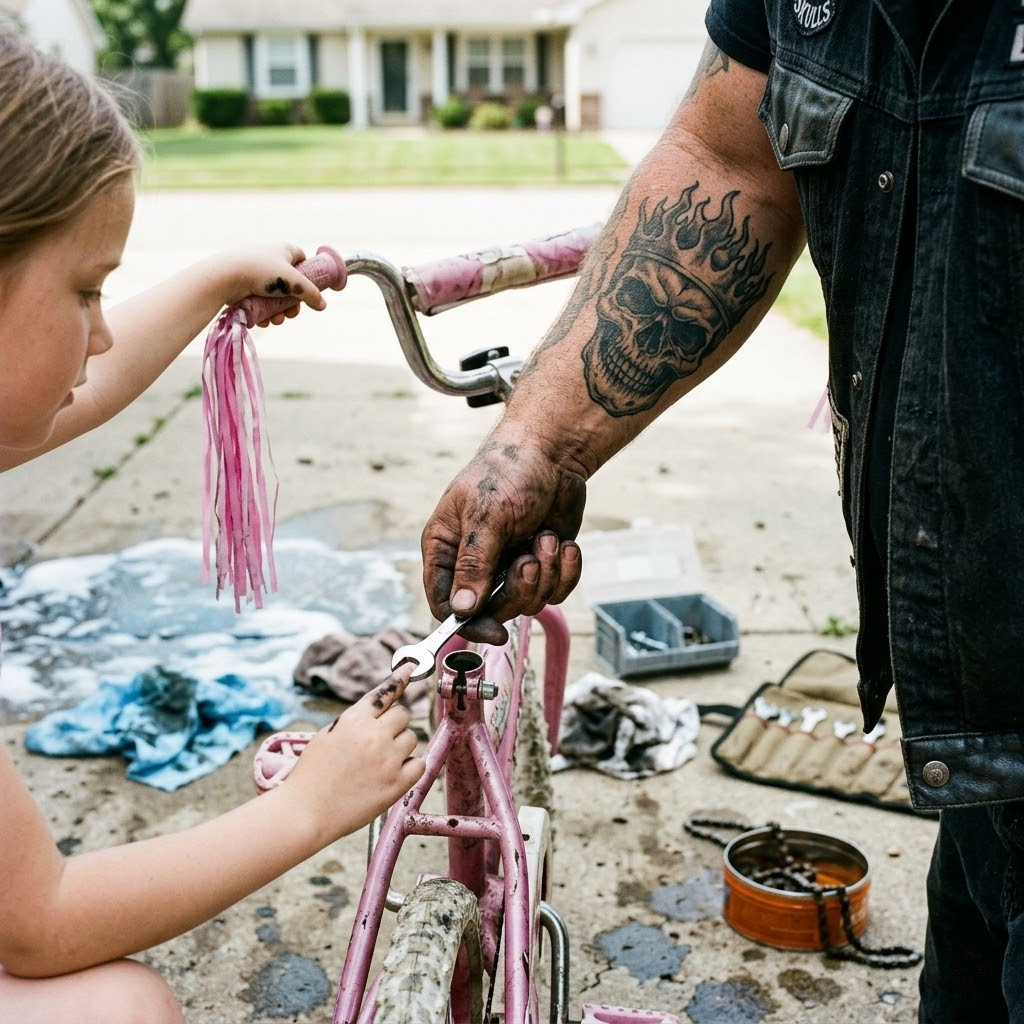
“What are you waiting for, princess? Kick it! HARDER!”
The voice wasn’t gentle. It was a guttural rumble that seemed to vibrate directly through the heat-baked pavement of my suburban driveway. My seven-year-old daughter, Lily, screwed up her face, her ponytail a mess of escaped strands sticking to her forehead. She put all twenty-five pounds of her weight behind her right sneaker and stomped down on the kick-starter of the battered, ancient pink bicycle that looked more like a rusted lawn ornament than a means of transport.
Screeeech. Thunk.
Nothing. Just the sound of metal protesting its existence. Lily’s shoulders slumped, her lower lip wobbling dangerously. The pink streamers on the handlebars drooped in solidarity.
“It’s broken,” she whispered, the tears threatening. “And Mr. Davis said it’s too old to fix.”
“Mr. Davis, eh?” The voice scoffed, a dry, grating sound.
I looked up from where I was sitting, defeated, on the bottom step of the porch, a roll of duct tape—my only idea—clutched loosely in my hand. He hadn’t been there five minutes ago. Now, a wall of faded denim and patched leather stood blocking the sun, casting a long, imposing shadow that almost touched my toes.
His name, or at least the name embroidered above the stylized, terrifying silver-and-white ‘Night Skulls’ skull on his back, was ‘Tramp’. Tramp was a masterpiece of intimidation. Standing well over six feet, built like a brick warehouse, his arms were a tangled forest of black ink—weaving dragons, coiled snakes, and, most prominently, a large, detailed human skull crowned in flames dominating his right bicep.
His beard was a grizzled gray and black thicket that looked like it might house small animals, and his eyes, visible beneath a grease-stained beanie, were hard, cold flints that seemed to count the cost of everything. The heavy scent of wet oil, stale tobacco, and high-octane fuel rolled off him in waves.
He shouldn’t have been here. Our quiet cul-de-sac, typically a sanctuary of manicured lawns and the hum of electric lawnmowers, had seen a surge in ‘out-of-towners’ since the new highway off-ramp opened up three miles away. To the neighbors, he was ‘the biker menace’. To me, struggling to get through the month on a single income with a broken garbage disposal, a leak in the roof, and a daughter desperately missing the feeling of riding her bike, he was just… terrifying.
Lily flinched, retreating a step behind me, clutching my thigh. “Who are you?”
Tramp didn’t look at me. He looked at Lily. “I’m the guy who’s gonna tell you that Mr. Davis is an accountant, not a mechanic. And he has no business talking about what can and can’t be fixed.”
He walked, a slow, deliberate rolling gait, toward the broken pink bike, which was leaning drunkenly against the mailbox. The pavement sighed under his heavy boots. As he approached, I felt the immediate, protective maternal instinct surge. This man could snap both Lily and the bike in half.
I stood up, the duct tape forgotten. “Excuse me… sir. We’re fine. Thank you for…”
Tramp didn’t even acknowledge my existence. He stopped in front of the bike, loomed over it, and poked the sagging front wheel with one enormous, grease-covered finger. The wheel groaned.
“Chain’s gone,” he announced, his voice like grinding gears. “Tires are dry-rotted. Sprouting rust where the paint used to be. Wheel bearings are probably shot. Cables are frayed. Freewheel is rusted solid. Seat post is welded to the frame.” He looked at Lily, his expression an inscrutable mask beneath the gray beard. “It’s a garbage heap, princess.”
A single tear escaped Lily’s eye. The duct tape felt incredibly heavy in my hand.
Tramp took off his worn leather gloves and shoved them into his back pocket. He uncrossed his arms, the massive skull tattoo flexing in the light. He looked at me for the very first time, his green eyes hard and analyzing.
“Get me a couple of buckets of water, some dish soap, and a whole lot of rags. Old towels, if you got ’em.”
I blinked. “I’m sorry?”
“You heard me, mama. Water. Soap. Rags. And don’t give me that dish soap you use on the good china. I mean the stuff that can cut grease. The original formula. The blue stuff. Dawn.”
“We…” I swallowed the lump in my throat. This wasn’t a request. This was a command. He seemed to hold the physics of my driveway in his hands.
“Go.”
It was a soft word, but it had the weight of a freight train.
The next six hours disappeared. They became a blur of blue soap suds, the scent of industrial-strength degreaser, the sharp click-clack of sockets engaging, and the relentless, patient work of a man who moved like a slow, inevitable force.
We started with the cleaning. Tramp made me scrub the entire frame with Dawn and an old bath towel until my arms ached. “Don’t just wipe it. Work it! Get into those nooks. Rust doesn’t care about your feelings, mama. It only cares about attention.” Lily watched, silent and wide-eyed, fetching clean water whenever he grunted for it.
He then pulled an oiled canvas tool roll from a saddlebag on his massive, blacked-out Harley that was parked like a brooding sentinel at the curb. The roll was immaculate—each tool, from the tiny screwdrivers to the heavy metric wrenches, was shiny, organized, and smelled faintly of lavender oil. It was the most disciplined thing I had ever seen.
He began to dismantle the pink bike with a surgical precision that was hypnotic. He didn’t rush. He didn’t curse. He didn’t even sweat, despite the humid air. He just… worked.
He soaked the rusted freewheel in a small tin of the industrial-strength degreaser that smelled like orange peel and turpentine, promising, “We’re gonna wake this sleepy head up.” He carefully unlaced the broken spokes on the front wheel, examining each one as if it were a fragile artifact. He cleaned and re-packed the wheel bearings using grease that looked like radioactive green jelly. He scraped the dry-rotted rubber off the tires with a knife that looked far too large for delicate work.
Lily, typically an exploding bundle of energy, was paralyzed. She stood by his side, handing him tools—”No, the 8-mil socket, not the wrench, princess! Stay focused!”—and watching with total reverence.
Around the two-hour mark, I summoned the courage to speak again. “Sir… Tramp. I… really appreciate this, but… how much is this going to cost? I don’t know if I have…”
He paused, a wrench hovering over a recalcitrant bolt. He looked at me, and for the second time that afternoon, I saw his expression soften. It wasn’t gentle, but it was less… predatory.
“I don’t need your money, mama. You just keep the suds coming and make sure your princess knows what an adjustable wrench looks like.”
He didn’t speak again for another hour. He didn’t ask for a drink, a snack, or to use the bathroom. He just focused on making that dilapidated metal sing again.
He found new tubes in another saddlebag, muttering, “Came in handy, I guess. Thought I’d be patchin’ the hog, but pink streamer bikes take priority, I suppose.” He replaced the frayed brake cables. He un-welded the seat post by applying heat from a small butane torch he pulled from his pocket, freeing it with a satisfying pop.
But the hardest part was the chain. It was a solid, rigid orange bar. Tramp refused to replace it. “New chain is $20. Money doesn’t grow on trees, mama. We’re gonna save this one. Build character.”
He spent ninety minutes doing nothing but manually flexing, soaking, and lubricating every single individual link on that chain. One. By one. He used a toothbrush to clean the grit out, a tiny file to smooth the edges, and a special chain lubricant that smelled like honey. His thick, tattooed fingers moved with a delicacy that made my breath hitch. This wasn’t mechanics. This was love.
Neighbors started to notice. Mrs. Gable, the self-appointed block captain, ‘happened’ to be out watering her flowers four times. The Thompsons slowed their sedan to a crawl as they drove by, staring at the skull on his back, their faces tight with anxiety. I could practically hear the neighborhood group chat exploding with phrases like ‘outlaw biker gang’ and ‘safety concerns’.
I felt a wash of anger. They didn’t see the man who had spent forty minutes teaching a seven-year-old the difference between a Presta and a Schrader valve. They didn’t see the man who, when the bike chain snapped back and grazed his knuckles, didn’t flinch, just muttered, “A little sting means it loves ya, princess!” They didn’t see the man who was rebuilding my daughter’s entire world.
He was focused. When Lily got impatient and tried to rush the reassembly, he held up a hand. “No shortcutting. If you rush, you break something else. The bike doesn’t care about your bedtime. It cares about being put together right. You gotta show it respect if you want it to carry ya.”
It was the most profound advice she had ever received.
As the sun began to dip below the roofline, casting the driveway in long, golden shadows, Tramp stood up. He wiped his hands on a filthy rag that was now predominantly oil and grease. The gray beanie had slid back slightly.
The pink bike was standing upright, the mailbox forgotten. It wasn’t perfect. The paint was still scratched. The streamers were still faded. It still had that ‘thrift store special’ vibe.
But the chrome—the handlebars, the wheel rims, the sprocket—was shining, reflecting the sunset like a beacon. The tires were inflated and firm. The chain, lubricated and pristine, ran smooth and silent. The brakes engaged with a quiet, efficient snick. The seat was aligned.
Lily stood in front of it, her hands on the grips, trembling.
“Well?” Tramp grunted. His voice was lower now, tired.
Lily looked up at him, then at the bike. She took a deep breath. She didn’t stomp this time. She just applied firm, even pressure to the kick-starter.
Vroom… Thump-thump-thump.
It was the quiet, confident purr of a restored engine. Lily let out a sob, a loud, pure explosion of joy. She hopped on the seat, her sneakers catching the pedals. She didn’t wobble. She didn’t screech. She just… pedaled.
She rode down the driveway, the streamers on her handlebars now a vibrant, flying victory, and she sailed past the gaping neighbors. She was riding the lightning.
Tramp watched her for a moment, a faint, almost invisible curve touching the edges of his mouth beneath that grizzled gray beard. He then rolled up his canvas tool roll with the same disciplined organization as he had unpacked it. He shoved his gloves back on.
I walked toward him, the emotions warring inside me. Gratitude, relief, and profound shame for my own judgment. I was also terrified of the bill I couldn’t pay.
“Sir… Tramp. I… I have no words. I don’t know how I can ever repay you. This is…”
I reached into my pocket, ready to offer him whatever cash I had, knowing it wouldn’t even cover the degreaser. “I have about $40 on me… I know that’s not…”
He held up an enormous, grease-stained gloved hand. He looked at me, and the flint in his green eyes was gone, replaced by a weary, profound sincerity.
“Mama, your daughter gave Mr. Davis the finger, even if she didn’t know it. That’s payment enough for me. And princess?” He looked at Lily, who had stopped her victory lap and was walking her bike back up the driveway, beaming.
He knelt down, bringing his massive, tattooed form to eye-level with the seven-year-old.
“You took your lumps today. You worked hard. You respected the machine. And now, you own that ride. Nobody can ever take that away from you. You remember that. Hard work and a little oil save everything.”
Lily nodded, total awe written on her face. She looked at his arm, at the massive, fierce skull tattoo in the fading light.
“Tramp?” she whispered.
“Yeah, princess?”
“I think your skull tattoo is beautiful.”
The silence in the driveway was absolute. I hold my breath.
Tramp didn’t say anything for a long moment. He just looked at the tattoo on his arm, the one the neighborhood was so afraid of. Then, he looked at Lily. He slowly reached out with his gloved hand and gently, so gently, tapped the end of her nose with his index finger. It left a tiny, temporary smudge of gray grease.
“So do I, princess. So do I.”
He stood up, the old outlaw demeanor sliding back into place like a protective shell. He walked toward the Harley-Davidson sentinel, swinging his massive leg over it, the engine roaring to life with a primal, deafening noise that silenced every gossip in the cul-de-sac. He looked back one last time, a brief nod, and he was gone.
I stood in the driveway with my daughter and her beautiful, restored pink bike, the tiny grease smudge on her nose a marker of the afternoon the neighborhood menace showed us what hard work, respect, and unconditional kindness really looked like. I clutched my duct tape roll, knowing I would never use it again. We weren’t just fixing a bike; we were building character.