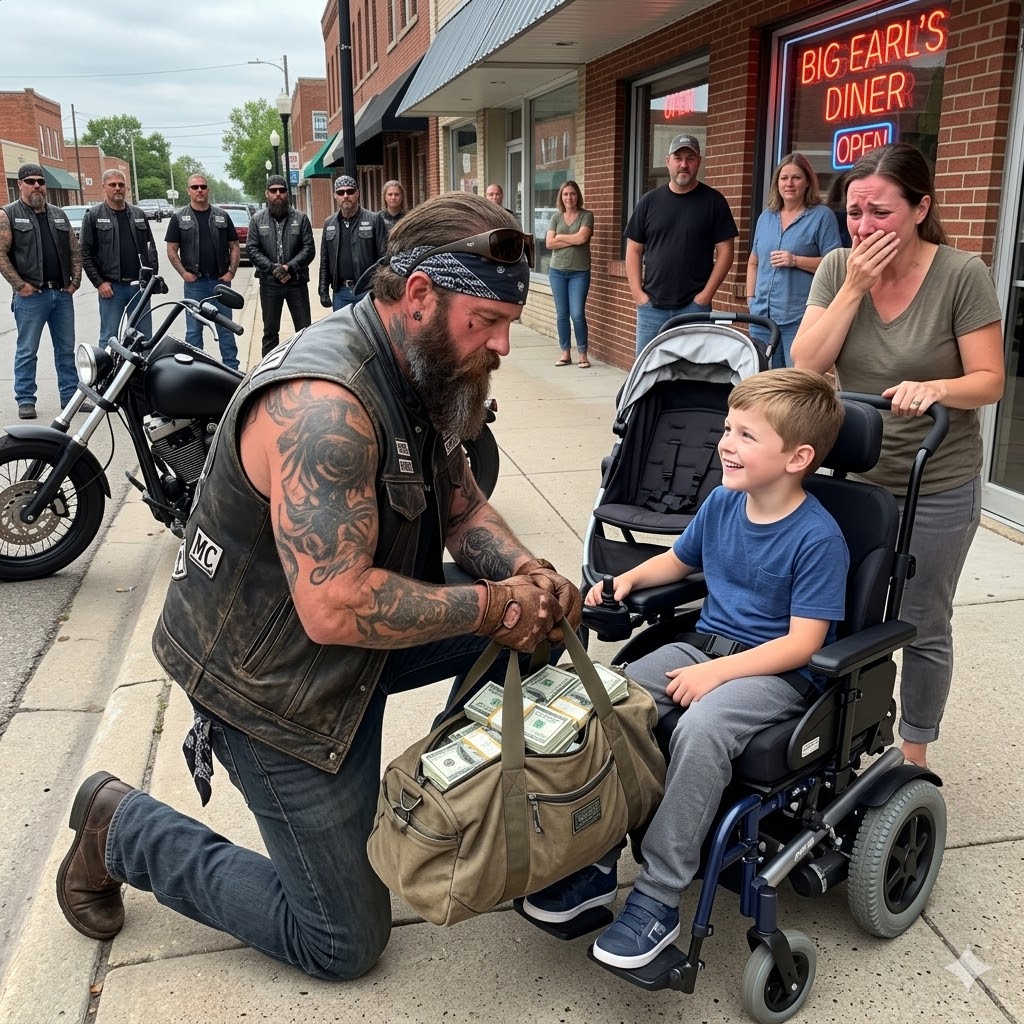
The rumors about Elias Thorne swirled through our small town like exhaust smoke—acrid, clinging, and impossible to ignore. They called him “The Ghost” or “Ajax,” and his reputation as the president of the Iron Skulls motorcycle club was legendary, built on whispered accounts of fierce loyalty, unspoken rules, and an unspoken potential for violence that radiated from him like heat from asphalt in July.
To me, Sarah Miller, a single mom juggling two jobs and an ocean of medical bills, Elias Thorne was simply the terrifying figure who rumbled past my house most evenings on a custom-built, matte-black chopper that sounded like a approaching thunderstorm. I caught glimpses of him: a towering figure clad in scarred leather, his arms a tapestry of dark ink, his face mostly hidden by a thick beard and dark aviator sunglasses. He was a force of nature I navigated around, much like the economic hurdles that threatened to overwhelm me.
The center of my universe, however, was my eight-year-old son, Leo. Leo was bright, inquisitive, and possessed a laugh that could illuminate the darkest corners of my exhaustion. He also lived with Spinal Muscular Atrophy (SMA), a progressive neuromuscular condition that required him to use a power wheelchair and needed increasingly specialized equipment we struggled to afford.
Our immediate mountain was the Quantum Mobility Chair. Leo’s current chair was outdated and rapidly becoming insufficient for his changing needs. The Quantum chair represented independence—superior suspension for navigating uneven sidewalks, a standing function to help with bone density and circulation, and customizable controls that would adapt to Leo’s strength.
The price tag was a cool $47,000. It might as well have been a million. Our insurance had denied coverage, deeming it “medically convenient” rather than “necessary,” a bureaucratic phrase that stung worse than any physical injury. My fundraising efforts, bake sales, and GoFundMe page had slowly raised about $3,000—a drop in the ocean of our need.
The situation was growing desperate. The stress was exacerbated by Mr. Henderson, the aggressive representative from a medical supply company we owed money to. He had escalated his calls from polite reminders to thinly veiled threats, and his last visit to our house had left me shaking.
The first time Leo and Elias crossed paths was purely accidental. It was a Saturday morning, and Leo and I were navigating the sidewalk near Big Earl’s Diner. We were heading to the library, Leo powering his aging chair carefully. As we passed the diner’s parking lot, Elias was leaning against his motorcycle, speaking in low tones to another club member.
Leo, completely lacking the filter of fear that inhibited adults, stopped his chair. He stared intently at the gleaming chrome and intricate engine work of Elias’s bike.
“Excuse me,” Leo piped up, his voice small but clear. “Is that the fastest motorcycle in town?”
I froze, my breath catching. Elias stopped talking mid-sentence. He turned slowly, looking down at the small boy in the wheelchair. He slowly pushed his sunglasses up onto his forehead, revealing eyes that were surprisingly sharp, yet not immediately hostile. They were the color of flint.
He looked from Leo to me, and back down to Leo. “It’s faster than most,” Elias rumbled, his voice like grinding stones.
Leo grinned, unfazed. “My wheelchair can go six miles per hour. That’s pretty fast, too. But your motorcycle is much cooler.”
Elias’s beard twitched slightly—the nearest I’ve ever seen him come to a smile. “Maybe. But your wheels look like they have better suspension.”
He gave Leo a slow nod and pushed his sunglasses back down. I quickly ushered Leo away, murmuring an apology for the interruption, but Elias just turned back to his conversation, seemingly indifferent.
But he wasn’t indifferent.
Over the next few weeks, I began to notice things. Our deteriorating front steps were suddenly repaired with fresh lumber. A bag of high-quality groceries anonymously appeared on our porch. When our ancient van, essential for transporting Leo, sputtered and died on Main Street, a large tow truck arrived within minutes, the driver claiming the service had “already been handled.”
It was hard not to connect these sudden strokes of good fortune to the silent, intimidating figures often seen loitering near the Iron Skulls clubhouse, a few blocks away. My skepticism, born of financial hardship and single motherhood, wrestled with a cautious, burgeoning sense of gratitude.
The tension broke one rainy Tuesday. Leo was at an appointment, and I was home alone, attempting to navigate another frustrating call with Henderson’s company. Suddenly, a forceful knock boomed on the door. Thinking it might be a delivery, I opened it, only to find Henderson himself standing there, looking slick in his cheap suit, completely out of place in our modest neighborhood.
“Mrs. Miller,” he sneered, stepping inside without an invitation. “We’ve been patient. But patience doesn’t pay the bills. Your account is months past due. If we don’t receive a significant payment by Friday, we’ll be forced to initiate legal proceedings and pursue repossession of the equipment we have provided.”
I felt sick. “Legal proceedings? Henderson, you know the situation! I’m doing everything I can! Leo’s chair is failing! We’re trying to raise money for the new one!”
He laughed, a harsh, dismissive sound. “A GoFundMe? Sarah, be realistic. This isn’t a charity case for the community. It’s business. Friday. Or we send the marshals.”
He turned to leave, but stopped. “And don’t think you can hide behind that tough guy image of your biker neighbor, either. He won’t care about a suburban mom and her kid when the lawyers get involved.”
He slammed the door behind him. I collapsed onto the sofa, the tears finally coming, overwhelming me with hopelessness. The $47,000 need felt like an impossible weight.
The next morning, I was outside, loading Leo into the newly repaired van for school. My eyes were still swollen, and my movements were robotic.
“You look like you didn’t sleep,” a voice rumbled.
I jumped. Elias was leaning against the fence between our properties, having seemingly materialized from the morning mist. He wasn’t on his bike; he was just standing there, an intimidating presence in the quiet morning.
I tried to regain my composure. “It’s fine, Mr. Thorne. Just… a difficult week.”
He pushed his sunglasses up. His flint-like eyes seemed to search my face, assessing the exhaustion, the stress.
“The guy yesterday,” he said. “He seemed… pushy.”
I was stunned he had noticed. I hesitated, then the whole hopeless story spilled out. The debt collector, the threats of lawsuits, and, most importantly, Leo’s urgent need for the Quantum chair and the impossible $47,000 price tag. I spoke of the insurance denial, the slow fundraising, and my crippling fear for Leo’s independence.
Elias listened in silence, his expression unreadable behind his thick beard. When I finished, the silence stretched, heavy with my vulnerability.
“$47,000,” he repeated, flatly.
I nodded, looking down at Leo’s aging chair in the van.
Elias pulled his sunglasses back down. “Get your boy to school, Sarah.”
He turned and walked back toward his house without another word. I left for the school run, feeling a profound sense of disappointment and self-consciousness for dumping my problems on someone I barely knew—especially someone with his reputation.
Friday arrived, the day of Henderson’s deadline. I was terrified. Every phone call made me flinch; every car that pulled into the driveway sent my heart racing.
I had decided to take Leo out for lunch—perhaps our last lunch with his current chair—before Henderson’s threatened actions commenced. We went to Leo’s favorite pizza place. Leo was telling me about a science project, oblivious to the sword of Damocles hanging over us.
As we were leaving the pizzeria, navigating the sidewalk back to the van, the low rumble of motorcycles echoed down the street. It wasn’t just one bike; it was a chorus of roaring engines.
The Iron Skulls MC came into view, ten riders strong, led by Elias. They didn’t ride past. They pulled up in a formation directly onto the sidewalk, blocking our path to the van, their engines idling like hungry beasts.
People stopped. Diners peeked out of windows. The air crackled with a sudden, intense tension.
Elias sat on his black chopper, center frame. He looked terrifying, flanked by his leather-clad club members. He was holding a large, heavy-looking, canvas duffel bag across his handlebars.
He cut his engine, and the other riders immediately followed suit. The silence that rushed in was deafening.
Elias dismounted his bike, moving with a surprising, fluid grace for a man of his size. He walked slowly toward us. Leo stared at him with wide, curious eyes, completely unfazed by the intimidating presence.
Elias stopped a few feet from us. He held up the heavy duffel bag.
“$47,000,” he said, his voice carrying clearly in the quiet air.
He placed the bag directly on Leo’s lap.
I couldn’t move. My mind went blank. The world seemed to tilt. “$47,000?” I whispered, my voice cracked and barely audible.
Elias slowly pushed his sunglasses up. He looked directly at me, his eyes surprisingly soft for the first time.
“I had a brother,” he rumbled, his voice thick with a vulnerability I hadn’t thought possible. “He used a chair. Duchenne Muscular Dystrophy. He never got the wheels he needed. Independence… it mattered. He died when he was twelve.”
He reached out and gently bumped his closed knuckles against Leo’s small, fragile fist. “Get the wheels, Leo. Keep going fast.”
He looked back at me, the flint returning to his eyes, but this time it was protective, not hostile. “The guy from the medical company… Henderson. He won’t be bothering you again. We took the liberty of paying a visit to his superiors this morning. We explained the… ethical implications of his collection methods.”
Elias gave a sharp nod, then turned and walked back to his bike. He kick-started the engine, the roar shattering the emotional silence. The other Iron Skulls followed his lead, and within moments, the formation rumbled away, leaving me standing on the sidewalk, shaking uncontrollably, with $47,000 in cash resting on my son’s lap.
The thrilling climax came two hours later. Leo and I were back home, the duffel bag secured inside, and I was on the phone, a blurred memory of numbers as I confirmed the order for the Quantum chair.
Suddenly, Henderson’s car pulled violently into the driveway. He stormed up to the door, looking disheveled and agitated.
“Mrs. Miller! What did you do? Who are those… those monsters?”
Before I could answer, the low, powerful rumble of Elias’s chopper sounded again. He pulled up right behind Henderson’s car, effectively boxing him in. This time, he was alone.
He dismounted slowly, pulling his sunglasses down. He didn’t say a word. He just stood there, arms crossed over his leather vest, staring at Henderson.
Henderson visibly paled. He sputtered, taking a step back. “Look, Mr. Thorne… I was just… checking in… everything’s been handled… the account is settled…”
Elias just kept staring. He didn’t need to speak. His reputation, his physical presence, and the memory of the club’s visit to Henderson’s superiors spoke for him.
Henderson practically scrambled back into his car. He had to reverse onto the lawn to get around Elias’s motorcycle, narrowly avoiding my rose bushes. He sped away, his tires squealing in a terrified exit.
Elias watched him go, then turned his gaze to me, standing in the doorway. A infinitesimal twitch of his beard was the only indication of amusement. He got back on his bike and roared away.
Life shifted dramatically after that day. The Quantum Mobility Chair arrived six weeks later. It was everything we had hoped for and more. To see Leo operating it—elevating to speak to adults eye-to-eye, navigating the standing function with a look of pure joy, easily clearing obstacles that had previously been insurmountable—it was heartwarming in a way I cannot put into words.
The town’s perception of Elias Thorne and the Iron Skulls didn’t change overnight. The whispers about their MC activities continued, the fears didn’t vanish entirely. But something shifted. The community began to acknowledge that the boogeyman in leather possessed a depth and capacity for compassion that defied simple categorization.
For me, Elias Thorne was no longer “The Most Feared Biker In Town.” He was Caleb, the man who had loved his brother enough to see my son, the man who believed that independence was worth $47,000. He wasn’t a guardian angel in leather—I’m sure his club’s moral compass was still heavily skewed by their world—but he was a man who, when faced with the pure, deserving need of a child, had chosen to keep a promise made to the memory of his brother. He had given my child not just $47,000 dollars, but the freedom to navigate the world on his own terms. And that was a story that truly warmed the heart.