The phone call came early on a Tuesday morning, too early for my usual routine. My father had been calling me relentlessly for the last few weeks, but I’d ignored every single one. I couldn’t deal with it anymore—the stories about his life as an outlaw biker, the endless talk about his club, the motorcycle repairs that always needed money, the wild rides that seemed to mean everything to him and nothing to me. I was tired of hearing it. I had my own life, my own problems, and I was just too busy to listen.
But that morning, I answered. His voicemail had lit up my phone with a number I hadn’t saved but still recognized. It was his. I hadn’t heard his voice in months, not since we’d fought over his “lifestyle” at Thanksgiving last year. I’d yelled at him for not being able to “just be normal” like the fathers of my friends. His tattoos, his leather jackets, his grimy, oil-stained garage—it all disgusted me. I was embarrassed by him.
But now, the voicemail sat there, a stubborn reminder that I hadn’t forgiven him.
“Hey, kid, it’s me. Your old man,” he said, his voice shaky. He sounded different this time—tired, defeated. I didn’t know why it took me so long to hit play on that voicemail. Maybe it was pride. Maybe it was shame. Whatever it was, I deleted it without listening. I never once thought to check what he needed or why he had called so many times.
I let it go. Again.
That was the last time I heard his voice.
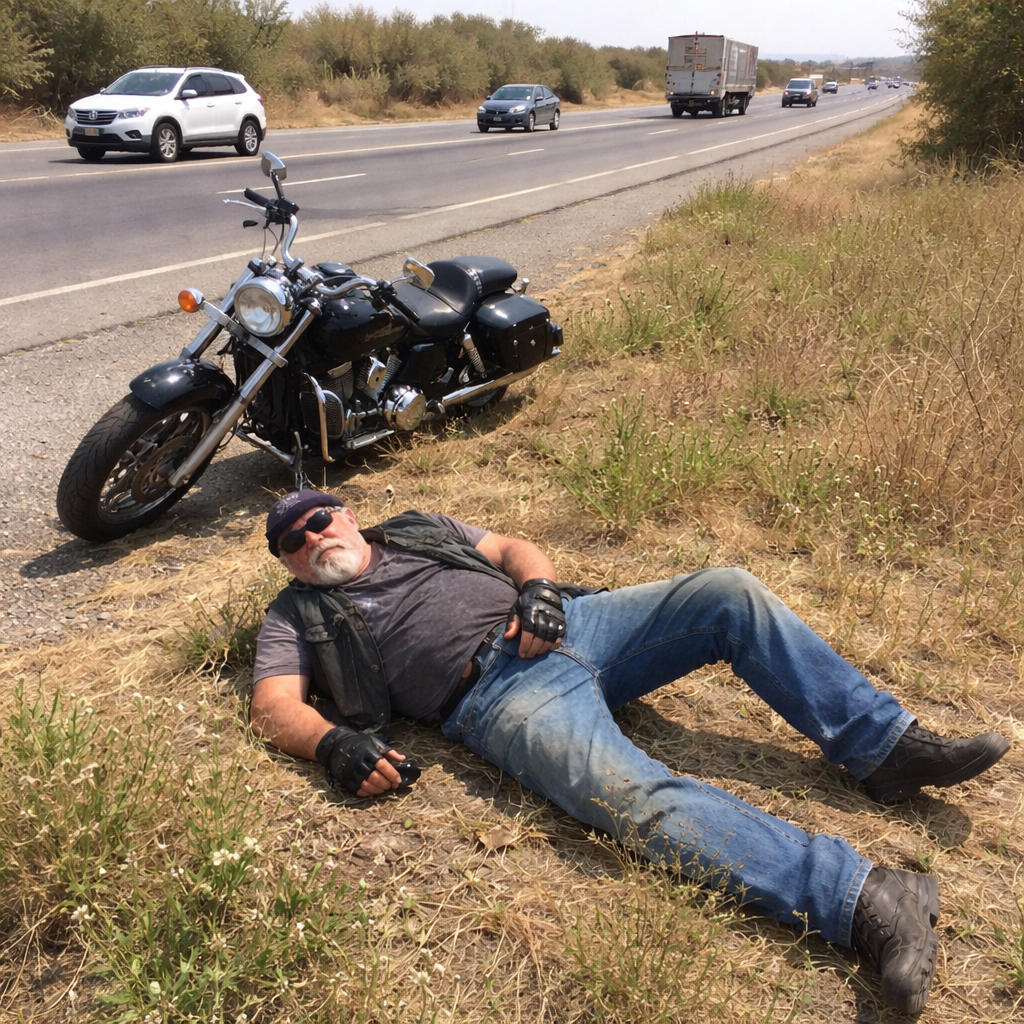
A week later, the news came. My father was dead. He had died alone on the side of a highway.
The coroner told me it had been hours before anyone found him. He’d been waiting for me, they said. His beloved Harley had broken down on Highway 49. And he’d been sitting there—waiting, just waiting for his daughter to come for him, to answer his calls. I didn’t know it then, but I’d already made the mistake of assuming he would always be around. That he’d always be there for me, even when I treated him like a joke.
“Too busy,” I had said. Too busy for him.
I hadn’t even bothered to check his voicemail. I had erased it without a second thought.
When I finally made it to the scene, there was nothing left but the aftermath. My father’s beloved Harley, still leaning against the rough asphalt. The front tire flat and the engine dead. The sun had baked the whole stretch of highway until the heat could only be described as unbearable, but he hadn’t made it to safety. He’d collapsed against his bike, clutching his phone, waiting. His body was found by a pair of his club members, who rode the long, dusty roads looking for their missing brother.
When I arrived at the funeral home, I was still in shock. I couldn’t believe he was gone. I couldn’t believe he had waited for me, that he had died with a picture of me in his wallet—one I had never known existed.
And then I saw it. The letter.
A single piece of paper, faded and creased. My father’s last words to me, written with shaking hands, stained with what I could only guess was his sweat or tears.
“My darling daughter,” it began, “If you’re reading this, it means I couldn’t wait any longer. I’ve tried to reach you for weeks, but I guess you were too busy for me again. I get it. I wasn’t the father you wanted me to be. I didn’t live the life you thought I should. But I want you to know something before I go. Everything I did, everything I am, was for you. I know you never understood why I chose this life—why I was an outlaw, why I kept riding, why I couldn’t just settle down and be like other fathers.
“But after your mother died, I had nothing. Nothing but the road, the wind, and the roar of my Harley. It kept me alive, baby girl. It kept me going. Every mile I rode was another mile I didn’t have to think about how lost I was. The club, the brothers I rode with, they kept me from dying inside. I couldn’t leave them. But more than that, I couldn’t leave you. I wanted to be the father you needed. I’m sorry I failed.”
I couldn’t read anymore. The paper blurred in front of me. I had always dismissed his love for me as just another part of his biker delusion. But here, in his last words, I saw the truth of it all. It had been real. Every ride, every second he spent on that bike, he was carrying me with him.
He had loved me.
When I arrived at his house later that evening, I expected to find a mess. I expected to see a man who had never been capable of creating anything meaningful, anything lasting. But instead, I found something different. His garage was pristine—tools hung in order, meticulously placed on the walls. His workbench was filled with the half-restored 1947 Knucklehead, a motorcycle that had been a labor of love for him. The years of work, the countless hours he had spent piecing it together, all for a dream that was never realized. But here it was, unfinished, as if he had been waiting for a chance to show me what he had done.
And then I found the leather jacket. The one he had bought for me.
I hadn’t known about it, but there it was, still new, still wrapped in its tag. It was a beautiful riding jacket, purple accents on the soft leather. I didn’t even want to touch it at first. It was too much—too much of him, too much of everything I had rejected. But when I put it on, it fit perfectly. It was as if he had known me better than I had known myself.
That was when I realized the depth of my mistake. I hadn’t seen my father for what he was. I had only seen what I wanted him to be. I had chosen to hate the parts of him I couldn’t understand, to mock his lifestyle, to push him away because it didn’t fit with my version of success.
But the club members—the very men I had once dismissed as nothing but troublemakers—had been the ones who came through for him when he needed them. They were the ones who found him, the ones who helped me with the funeral arrangements, the ones who told me stories I had never heard before about the man I had called my father.
Tiny, a 300-pound biker with tattoos covering every inch of skin, took me aside at the funeral. He spoke gently, as if trying to explain something that had taken me years to grasp.
“Jack wasn’t just some biker, kid. He was a brother to all of us. He didn’t just fix bikes. He fixed lives. He helped me when no one else would. You’re right about one thing, though—he wasn’t perfect. But he did what he thought was right. And he loved you more than anything. Don’t forget that.”
I didn’t know what to say. How could I have forgotten? How could I have been so blind to all the love he had given me? The man I had called “the deadbeat biker” had been the only one who had ever truly given without asking for anything in return.
The funeral was a revelation in itself. Hundreds of bikers showed up, each one honoring my father with a small token, something that spoke to their shared history with him. They had loved him, and they mourned him like family. And that was when it hit me—this was what he had lived for: brotherhood, loyalty, love. He had never been the man I thought he was. He had been more.
I couldn’t help but think about that last voicemail I had deleted. The one I never listened to. The one that might have been his final plea for reconciliation, for forgiveness, for connection. It was gone, overwritten in the system, just like my chance to make things right.
A week later, I decided to take the plunge. I signed up for motorcycle lessons. My instructor, Diane, was a member of my father’s club, and when I told her I wanted to learn to ride, she handed me a notebook filled with my father’s handwriting. It was his plan for me—a step-by-step guide to teaching me how to ride. Every note was a reminder of everything I had missed: “Remember, she’s scared of speed but loves control. Start slow. Build confidence.”
I cried through every lesson. I cried because I was learning everything my father had wanted me to know, everything he had tried to teach me all those years ago. But I was learning it too late.
It took me two months, but I got my motorcycle license. I went to my father’s grave to tell him. “I did it, Daddy,” I said. “I know it’s too late for our ride to the lake, but I did it.”
The bikers, the brothers who had been there for my father, had pooled their money together and bought me a bike. It wasn’t fancy, just a small Honda Rebel, but it was mine. They had painted it purple, just like the jacket my father had bought for me.
“Jack would have wanted you to have your own bike,” Tiny said. “He never gave up hope that you’d come around.”
The next day, I took the bike to the lake, the same lake where my father had taught me to fish. I sat there on the shore, my bike beside me, remembering him. I was riding now, just like he had always wanted. And as I sat there, I knew one thing for sure: I would never forget him again.
He had been the father I never understood. The man I had judged, the man I had rejected, was the one who had loved me the most. And I had missed it all.
But I would carry him with me, always. Riding, just like he had.
Because now I understood.