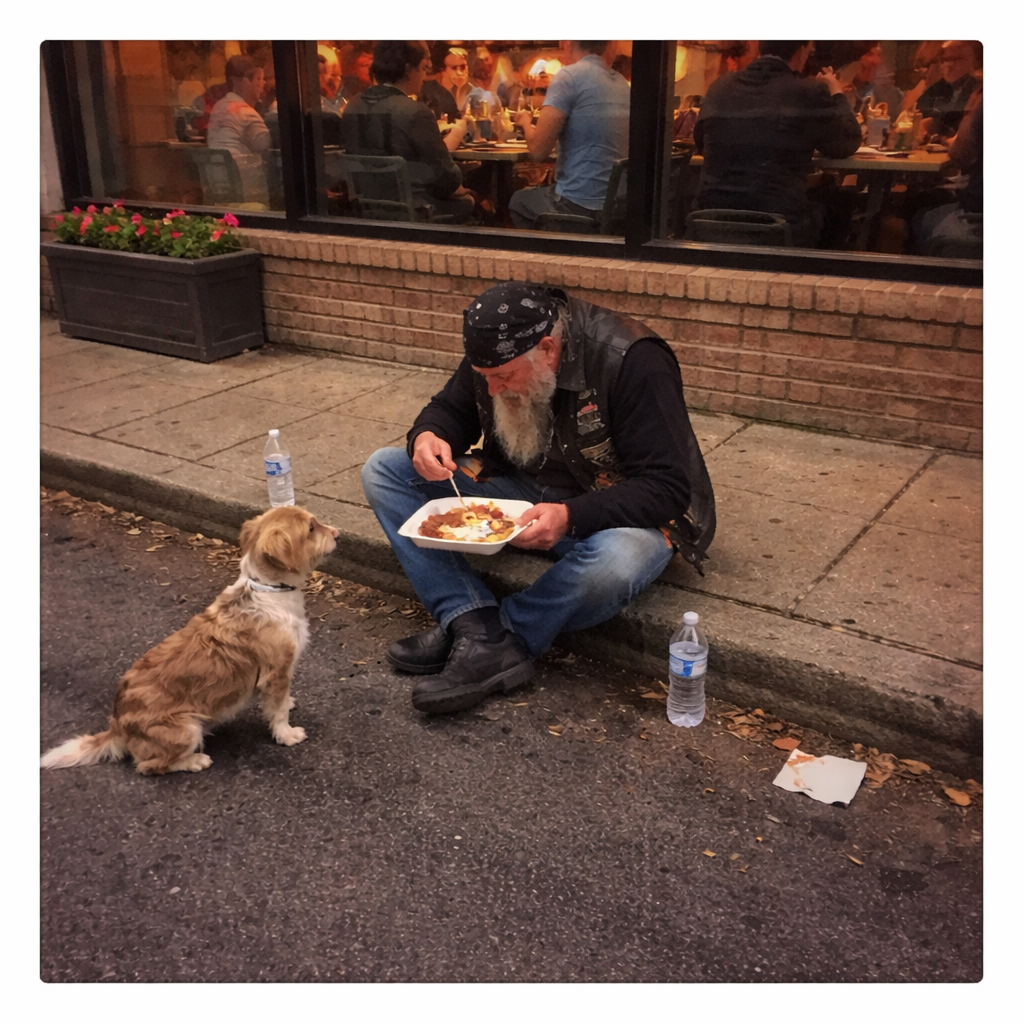
It was a typical Tuesday afternoon, and I found myself at the local coffee shop, sitting at a window booth with my usual—a black coffee and a blueberry muffin. The place was busy, as always. People chattered about their days, the low hum of conversations blending with the sound of the espresso machine. I was just there to relax, to escape the stresses of work for a brief moment, when it happened.
A man walked in.
I noticed him immediately. He was tall, disheveled, wearing a thick jacket that had seen better days. His hair was long and unkempt, and his shoes looked like they’d been through a lot. He didn’t look homeless, but he certainly wasn’t polished either. Still, he carried himself with a quiet sort of dignity. As he approached the counter, I heard the barista speak up.
“I’m sorry, sir, we don’t allow pets in here.”
The man looked down at the floor, and I followed his gaze. A small dog, its fur matted and brown, was standing next to his feet. The dog seemed harmless enough, and I could see that the man had a leash in his hand. He looked up at the barista, his face calm but his eyes tired.
“It’s not a pet,” he said softly. “It’s a service dog. She helps me.”
The barista, a young woman with a hint of annoyance in her voice, shook her head. “I don’t care. No pets, no exceptions.”
I watched as the man’s face fell. I could see him trying to explain further, but the barista was already walking away, ignoring him. The man stood there for a moment, looking at the counter, then glanced around the room. People looked away. No one spoke up. I, too, kept my eyes on my muffin, not wanting to get involved. After a few moments, the man turned and left, the small dog following him out the door.
I felt a pang of guilt in my chest, but I didn’t act. I didn’t say a word. I didn’t ask the barista to reconsider. I just stayed silent, pretending I hadn’t seen the injustice unfold before me.
Days passed, and the incident stayed with me. I couldn’t shake the image of the man, standing there in front of the counter, his eyes filled with a quiet pain. But I didn’t think much more of it. It was just one of those things, I told myself. Life goes on.
Then, three days later, I bumped into an old friend from high school, Luke. He and I had never been particularly close, but we shared some memories. He looked different now—older, a little heavier, but there was something about his face that told me he’d lived a life that wasn’t easy.
“Hey, long time no see!” he said, grinning as he shook my hand.
We exchanged pleasantries and caught up on the usual stuff—jobs, mutual friends, all the small talk that fills the silence when two people haven’t seen each other in years.
But then Luke paused, looking at me more intently.
“Hey, you wouldn’t happen to know a guy named Mark Wells, would you?” he asked.
I froze. Mark. I remembered the name from a few years ago, but it wasn’t until that moment that it clicked—Mark was the man from the coffee shop. The man with the service dog.
“I know of him,” I said, hesitant. “Why?”
Luke’s face softened. “He’s my brother. Well, half-brother. We didn’t grow up together, but I’ve been getting to know him better these past few years.”
He leaned in a little closer. “You might not know this, but Mark was a Marine. He served in the Gulf War. He was injured—severely. Lost his leg in a roadside bomb. He’s been struggling with PTSD for years. The dog he was with? Her name’s Daisy. She’s trained to help him through his panic attacks.”
I felt a lump form in my throat. I’d never known. I had no idea.
Luke continued. “Mark’s been through a lot. A lot of people don’t get it. They look at him and think he’s just some guy who’s down on his luck, that he’s just… broken. But he’s trying. He’s trying so hard. And Daisy? She’s the one thing that keeps him going.”
I felt the weight of my silence from the coffee shop pressing down on me. I had watched that man—Mark—being treated with cruelty, and I had done nothing. I had stood by while a person who had fought for his country, who had sacrificed so much, was humiliated over something as simple as a dog at his side. And I hadn’t spoken up. I hadn’t defended him.
I was ashamed. And angry. At myself.
“I saw him, Luke. I saw him at the coffee shop. The way they treated him. And I didn’t do anything,” I said, my voice thick with regret.
Luke gave me a sad smile. “I know. Mark told me about it. He’s used to it, unfortunately. People don’t understand what he’s been through. But I can tell you, that’s not what hurt him the most. It’s the way people just let it happen. The silence.”
I swallowed hard. Luke’s words hit me like a ton of bricks. I had been part of that silence. I had been complicit.
“I have to fix this,” I said, more to myself than to Luke. “I have to make it right.”
The next morning, I went back to the coffee shop. I didn’t know if Mark would be there, but I had to try. When I walked in, I noticed the barista was on shift again. I made my way to the counter and stood there, waiting for her to notice me.
“Can I help you?” she asked, her tone cold.
I didn’t waste time. “I want to talk to you about what happened the other day. With the man and his service dog.”
She raised an eyebrow. “What about it?”
“I watched you turn him away,” I said, my voice steady. “I didn’t speak up. I didn’t do anything. And I should have. What happened was wrong, and I want you to know that.”
She looked at me for a long moment, her expression unreadable. Then, to my surprise, she sighed.
“I know,” she said quietly. “I didn’t want to turn him away, but I was just doing my job. It was a policy I was told to follow.”
“It’s not just a policy,” I replied. “It’s about treating people with respect, no matter what they look like or what they’re going through. We all have a responsibility to stand up for each other, even when it’s uncomfortable.”
She nodded slowly, a small shift in her demeanor. “You’re right. I should have handled it differently.”
I left the coffee shop feeling a little lighter, but I knew I couldn’t stop there. I found Mark’s contact information through Luke and sent him a message, apologizing for what I’d witnessed and promising to do better.
A few days later, I received a reply.
“Thanks for reaching out. It means a lot. Maybe we can grab a coffee sometime.”
I smiled. A small gesture, but it was a start.
I didn’t expect everything to be fixed overnight. But I had learned something important: standing up, even in small ways, can make all the difference. The silence I had once accepted was now something I refused to live with. And from that day on, I vowed to always speak up, to always stand for what was right—even when it felt uncomfortable.
Because sometimes, doing nothing is the hardest thing of all.