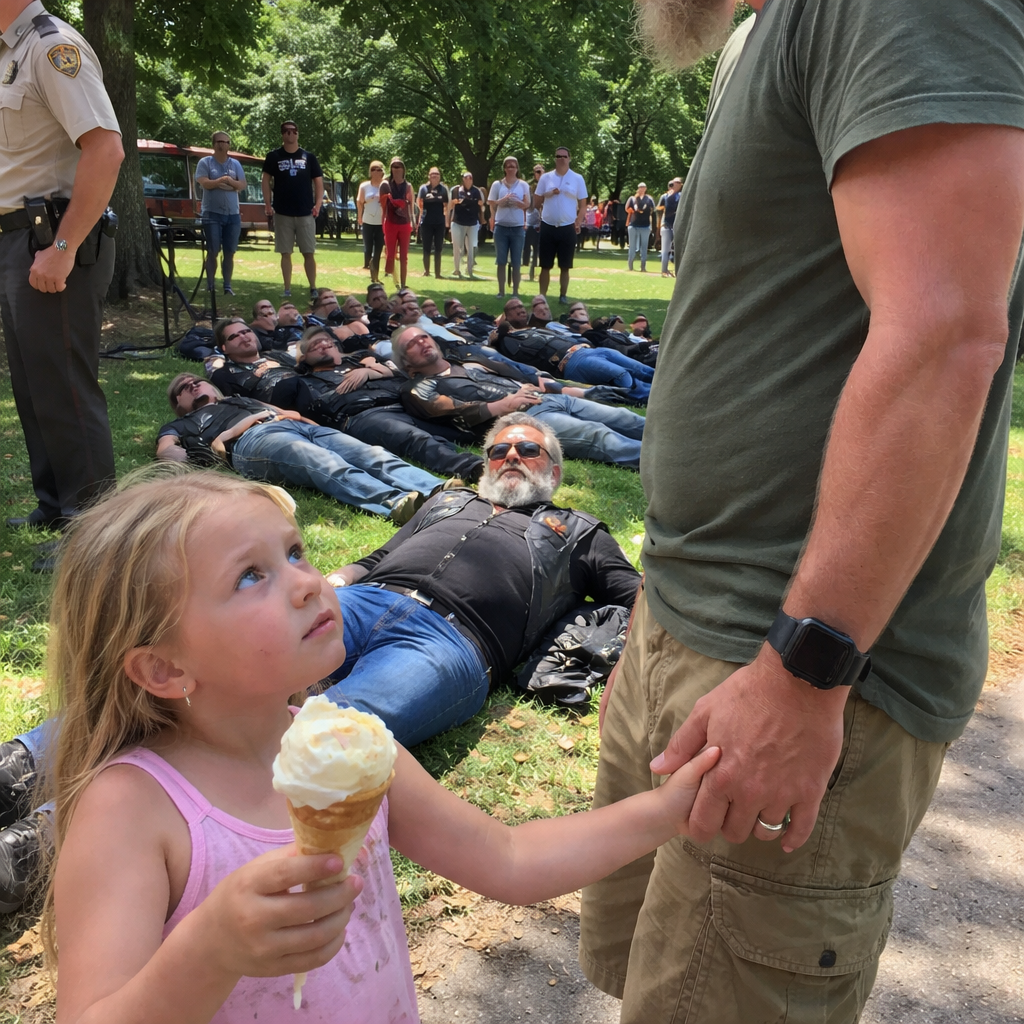
The sun hung low in the sky, casting a golden haze over the park as families lingered, children laughed, and the warm scent of summer clung to the air. It should’ve been a peaceful scene. A perfect, idyllic Saturday afternoon.
But it wasn’t.
A little girl clutched a melting ice cream cone in one hand, the cold drips staining her fingers, her innocent face twisted in a question that lingered in the still air. She looked up at her father, her small voice quiet but piercing.
“Daddy, why are they here?”
The father didn’t answer. Instead, he tightened his grip on her hand, looking up at us with wide, fearful eyes. I could see the panic swirling in him. His gaze darted toward the officer and then back at us—thirty bikers, sprawled across the grass, clad in leather vests and tattoos, all sprawled out like some menacing shadow. We had come in numbers. A silent, formidable wall of black leather and muscle.
But we weren’t here to start trouble. We weren’t here to cause a scene. We were here to rest.
I stayed still, lying back against the cool grass, staring up at the sky. The kind of sky that makes you feel small but safe at the same time. I spoke loud enough for the officer and the crowd to hear.
“We’re just resting,” I said, my voice steady. “Same as that kid on the bench this morning before you moved him along.”
The officer paused. His hand hovered near his belt, fingers twitching, but he didn’t move. “He was loitering,” he said, his voice crisp with authority. “Vagrancy laws are clear. Especially in a family park.”
“Is that so?” I replied, sitting up slowly, my leather vest creaking under the movement. Around me, the others followed suit, sitting up in unison like a slow-motion wave of hardened resolve. Thirty bikers, every inch of us draped in years of stories, of battles fought on roads long and winding.
I stood up, feeling the weight of the moment press on my shoulders. The officer’s eyes darted between us, the massive biker men, and the kid standing in the corner of the park, clutching a hoodie that was too big for his small frame.
“See, we heard this park was for everyone,” I continued, my voice soft but unwavering. “But it seems it’s only for people who look like they belong. If a kid with a backpack sleeps here, he’s a ‘vagrant.’ If thirty bikers lie down here, we’re a ‘threat.’ So we figured we’d test the math.”
The boy in the oversized hoodie shifted uncomfortably, his eyes wide, nervous. He wasn’t listening to us. He wasn’t looking for trouble. He just wanted to be seen.
I pointed toward him, watching as his face paled further.
“That boy over there,” I said, “he’s not ‘loitering.’ He’s homeless. His name is Leo. His mom died in February. The foster system lost track of him three weeks ago. He’s not looking for trouble. He’s just looking for a place where his feet don’t hurt and the world feels still for an hour.”
The park fell silent. A silence that wasn’t cold or hostile. No, it was a silence of recognition. The woman who had called the cops lowered her phone, the man in golf shorts shifted his eyes from his shiny shoes to the boy, his face a picture of discomfort.
Hank, our Sergeant-at-Arms, stood up. He was a towering figure—six-foot-four, inked from neck to knuckles, with stories etched into his skin. But he wasn’t here to intimidate. He was here to protect. Hank walked over to Leo, knelt down in front of him, and without saying a word, pulled a ham sandwich wrapped in foil from his vest pocket and a cold bottle of water.
“Lunch is served, kid,” Hank said, his voice gentle, a stark contrast to the man he looked like.
The officer looked at Leo, and then back at us. His gaze softened, but only for a moment. “He can’t stay here tonight,” the officer muttered, his tone drained. “You know how it is. If I don’t move him, someone else will.”
I stood tall, wiping the dirt from my chaps. “He’s not staying here,” I said, my voice firm. “He’s coming with us. We’ve got a clubhouse with a spare room, a kitchen that’s always got a pot of chili going, and thirty guys who know how to make sure nobody gets ‘moved along’ ever again.”
Leo’s eyes met mine, hesitance flickering there for a second. But when he looked at the line of bikes, something shifted in him. He didn’t look like a kid waiting for a blow anymore. No, he looked like a kid who’d just been given something bigger than a room or food. He’d been given a place in the world. A home.
We weren’t just giving him a roof over his head that night. No. That afternoon, we’d started a fund—passed around hats and pockets. The parents who had once been afraid of us dug deep into their wallets, moved by the quiet power of what we were doing. We didn’t just make sure Leo had a safe place to sleep. We made sure he had a chance.
By the time we revved our engines to leave, Leo was sitting on the back of my bike, gripping the sissy bar like it was his last lifeline. His eyes were wide, but this time they were filled with something new—hope. He wasn’t a criminal. He wasn’t a lost cause. He was a kid.
The sound of our engines echoed through the park as we roared out of there, but it wasn’t the usual thunder. This time, it wasn’t noise. This time, it was a reminder.
Sometimes, you have to lay down in the dirt just to show someone else how to stand up.
And sometimes, just sometimes, a group of bikers can remind the world that the only thing that matters is that we see each other.