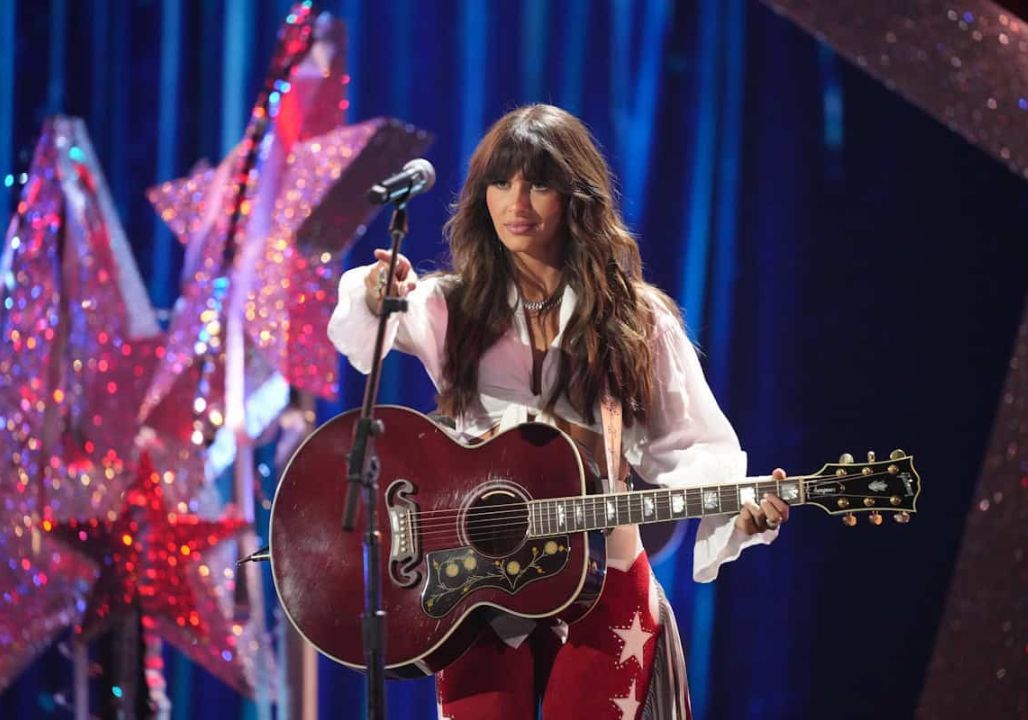
KNOXVILLE, Tenn. — There were no fireworks. No choreographed lights. No glittering costumes cutting through smoke and strobe. On the stage of the historic Tennessee Theatre, there was only Ella Langley, a worn acoustic guitar, and a voice carrying more truth than any spectacle ever could.
What unfolded wasn’t a show built for distraction. It was a confession, offered one lyric at a time.
Langley, just 26, stepped into a roar of applause that quickly dissolved into silence when she spoke. “Tonight, I’m not here to distract you,” she said quietly. “I’m here to tell the truth in the only way I know how.”
The crowd of nearly 2,000—veteran country fans shoulder to shoulder with first-time listeners—had come expecting a lively set of familiar anthems. Instead, they were drawn into something far more intimate. With every chord, Langley moved effortlessly between heartbreak and resolve, letting the songs breathe without rushing them.
Midway through the set, she paused to introduce an unreleased track, simply titled “Knoxville Blue.” The opening notes were slow and unsteady, her fingers brushing the strings like someone turning diary pages in real time. Then came the line that stopped the room cold:
“I learned love from a distance… and goodbye up close.”
A quiet gasp rippled through the theatre. The lyric landed heavy, unmistakable.
Langley’s voice cracked—not from fragility, but from honesty. She didn’t pull back from the emotion or soften the edges. Her eyes glistened as she stayed with the ache, and the vulnerability transformed the grand theatre into something smaller, closer, almost sacred.
When the song ended, there was no immediate applause. Not because the audience wasn’t moved—but because they were. The silence stretched for several long seconds before the room exploded with cheers, whistles, and applause usually reserved for encore finales, not stripped-down acoustic ballads.
The reaction wasn’t sorrowful. It was electric. Langley had done something rare: she turned pain into connection, and connection into momentum.
“She didn’t sing for Knoxville,” concertgoer Mason Hale said afterward. “She sang from it. And somehow, she made it feel like our story too.”
There were no illusions that night. No distractions to hide behind.
Just a young artist, her guitar, and the courage to tell the truth out loud—creating a moment that didn’t simply move Knoxville.
It woke it up.