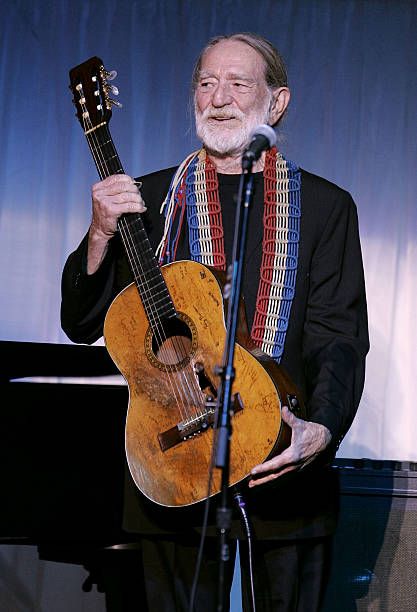
When “Trigger” is finished, Willie Nelson says he’ll be finished too.
In a world full of legendary musicians, few instruments carry a story as rich—or as inseparable from their owner—as Willie Nelson’s guitar, Trigger. More than a tool, it has become an extension of the man himself. Since 1969, the same weathered Martin acoustic has been in Willie’s hands, shaping decades of music, memories, and moments that helped define country music.
The story of Trigger begins not with nostalgia, but with necessity.
In the late 1960s, as Willie was still fighting his way toward lasting recognition, his main guitar was destroyed by a drunk, unruly fan during a show at John T. Floore’s Country Store in Helotes, Texas. Suddenly guitar-less and with a performance still ahead of him, Willie needed a replacement—fast.
That’s when he heard about a nearby Martin guitar for sale, priced at $750. Today, that figure might not raise an eyebrow. But in 1969, it translated to more than $5,500—an enormous gamble for a struggling musician. Willie took it anyway. In hindsight, it may be one of the greatest investments in music history.
Spread across more than five decades, that purchase breaks down to roughly $13 a year. And that doesn’t begin to account for the countless songs written, recorded, and performed on Trigger—songs that returned that investment many times over.

The day Willie bought the guitar, he named it after Roy Rogers’ horse, Trigger. From that moment on, it rarely left his side. The bond grew so strong that when a house fire destroyed nearly everything Willie owned, he ran back inside to save only two things: his guitar and a small stash of marijuana. Everything else was replaceable.
Over time, Willie Nelson and Trigger became inseparable—almost interchangeable in the public imagination. The guitar’s scarred top, worn-down frets, and gaping hole worn by decades of picking are instantly recognizable. Other musicians know exactly what it means to touch it. Billy Strings has spoken about the reverence of playing even a single song on Trigger, fully aware he was holding a piece of living history.
Yet many musicians insist the magic isn’t just in the guitar itself. Jazz guitarist Bill Frisell once explained to The New Yorker that the true sound comes from Willie’s hands.

“You can hear the sound of his voice in what he’s playing,” Frisell said. “If I gave him one of my guitars, it would sound like Willie Nelson. It wouldn’t sound like me.”
That chemistry—between man and instrument—is rare. Guitars are built to last, but even the best usually endure 20 to 30 years of regular use. Exceptional ones might survive 50. Trigger is now 56 years old and shows every mile it has traveled. The wear isn’t hidden or repaired away; it’s displayed proudly, like wrinkles earned through a long, meaningful life.
It’s battered. It’s fragile. And somehow, it still sings.
For Willie Nelson, that matters more than longevity or value. Trigger isn’t just how he plays music—it’s how he is music. And when that guitar can no longer be played, Willie has made it clear: he won’t replace it.
When Trigger is done, Willie Nelson will be too.