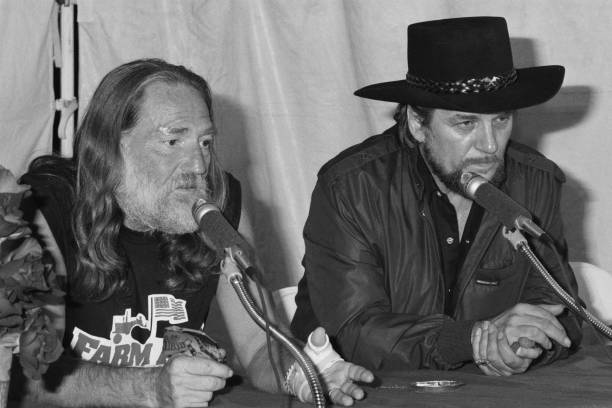
In the early 1970s, the conventional wisdom in the polished, monolithic world of Nashville’s Music Row was that Willie Nelson’s career as a recording artist was over. He was a known quantity, and that quantity wasn’t selling. Sure, he was a genius songwriter, the man who had penned “Crazy” for Patsy Cline and “Hello Walls” for Faron Young, hits that defined the era. But as a performer, he was seen as a commercial failure, an oddball with a strange, behind-the-beat vocal style that didn’t fit the slick, string-laden mold of the “Nashville Sound.” His records for RCA had fizzled. They said he was finished, destined to be a historical footnote—a brilliant writer who just didn’t have the star power to make it himself.
Fast forward fifty years to September 2025. A 92-year-old Willie Nelson is standing on stage in front of a sold-out amphitheater, a beloved global icon leading a multi-generational crowd in a joyous singalong. The career they said was over is now one of the longest, most successful, and most culturally significant in American history. His journey from a Nashville “has-been” to an enduring living legend is not just a comeback story; it is perhaps the greatest testament to artistic perseverance and radical authenticity the music world has ever seen. It is the story of how Willie Nelson proved them all wrong.
The Nashville Cage: A Career on the Brink
To understand the magnitude of his comeback, one must first understand the depth of his perceived failure. In the 1960s and early 70s, Nashville was a factory, and that factory had a very specific formula for success. Stars were clean-cut, their songs were produced with lush orchestral arrangements, and their vocals were powerful, direct, and right on the beat. Willie Nelson was none of those things.
His genius was universally acknowledged in the writing rooms. He could craft a song with the emotional complexity of a short story and the melodic sophistication of a jazz standard. But when he stepped up to the microphone, producers were baffled. His voice was reedy and unconventional. His phrasing was a puzzle they couldn’t solve, as he floated over and around the rhythm in a way that felt more like a conversation than a performance. RCA Records, his label at the time, tried their best to package him for the mainstream. They put him in suits and sport coats and surrounded his unique voice with the same syrupy strings and background choirs they used for everyone else.
The result was a series of albums that, while containing flashes of brilliance, felt artistically neutered. The records didn’t sell, and the perception hardened: Willie was a writer, not a star. The frustration mounted. He was creatively stifled, broke, and disillusioned with a system that seemed determined to sand down every interesting edge he possessed. The end of his Nashville chapter was perfectly, tragically symbolic. After a late-night party, his Tennessee house caught fire. As the flames consumed his home, he famously ran inside to rescue two things: his guitar, Trigger, and a pound of his favorite Colombian weed. With the Nashville part of his life literally in ashes, he took it as a sign. He packed what was left and headed home to Texas, his career as a recording artist seemingly over before it had ever truly begun.
The Austin Rebirth: The Outlaw Revolution
That retreat to Austin was not an act of surrender; it was a declaration of war on the very idea of what a country music star could be. In the freewheeling, counter-cultural haven of Austin, Willie Nelson didn’t just find a new audience; he found himself. He shed the Nashville costume—the suits, the short hair, the artistic compromises—and embraced the Texan he had always been. He grew his hair long, adopted his now-iconic bandana-and-braids look, and surrounded himself with a community of hippies, bikers, and traditional country fans who cared only about one thing: authentic music.
His sound transformed. The strings and choirs were replaced by a raw, stripped-down, roadhouse-ready band. His music became a potent brew of country, rock, blues, and folk. He signed with a new label, Atlantic Records, that gave him something Nashville never would: complete creative control. The albums that followed, like 1973’s Shotgun Willie and 1974’s Phases and Stages, were gritty, personal, and unapologetically him. They weren’t massive hits, but they were the sound of an artist reborn, and they laid the groundwork for the masterpiece that would serve as his ultimate vindication.
In 1975, Willie delivered Red Headed Stranger to Columbia Records. It was a sparse, minimalist concept album about a preacher on the run. The label was horrified. They thought it sounded like a collection of unfinished, underproduced demos. But Willie, now empowered by his new-found artistic freedom, refused to change a note. He released it as is, and the world responded. The album’s haunting, quiet single, “Blue Eyes Crying in the Rain,” became a massive crossover hit. Red Headed Stranger went multi-platinum.
It was a seismic moment. Willie Nelson, the man whose career was supposedly over, had just released one of the most successful and artistically important country albums of the decade by breaking every single rule Nashville had ever written. He had proven them all wrong. The “Outlaw Country” movement was solidified, and Willie was its spiritual leader.
The Last Laugh: From Comeback to Icon
That incredible comeback was not a fleeting moment of success; it was the beginning of an unprecedented five-decade run. He followed Red Headed Stranger with hit after hit, crossed over to the pop world with his legendary album of standards, Stardust, became a movie star, and formed the supergroup The Highwaymen. He transitioned from a country music star to a universally beloved American icon.
Today, more than fifty years after the Nashville establishment wrote him off, his career is not only alive; it is thriving. At 92, he is still on the road, playing to sold-out crowds of devoted fans who weren’t even born when his “comeback” happened. The career they said was finished has outlasted trends, technologies, and entire generations of critics. SOURECE HERE 👉🏻 LINK
Willie Nelson’s story is a powerful lesson in the relentless power of authenticity. His greatest achievement was not just the timeless music he created, but his stubborn, unshakable belief in his own vision. He proved that the most successful thing an artist can be is themselves. For a man they said was finished, he’s having the longest, most beautiful last laugh in music history.