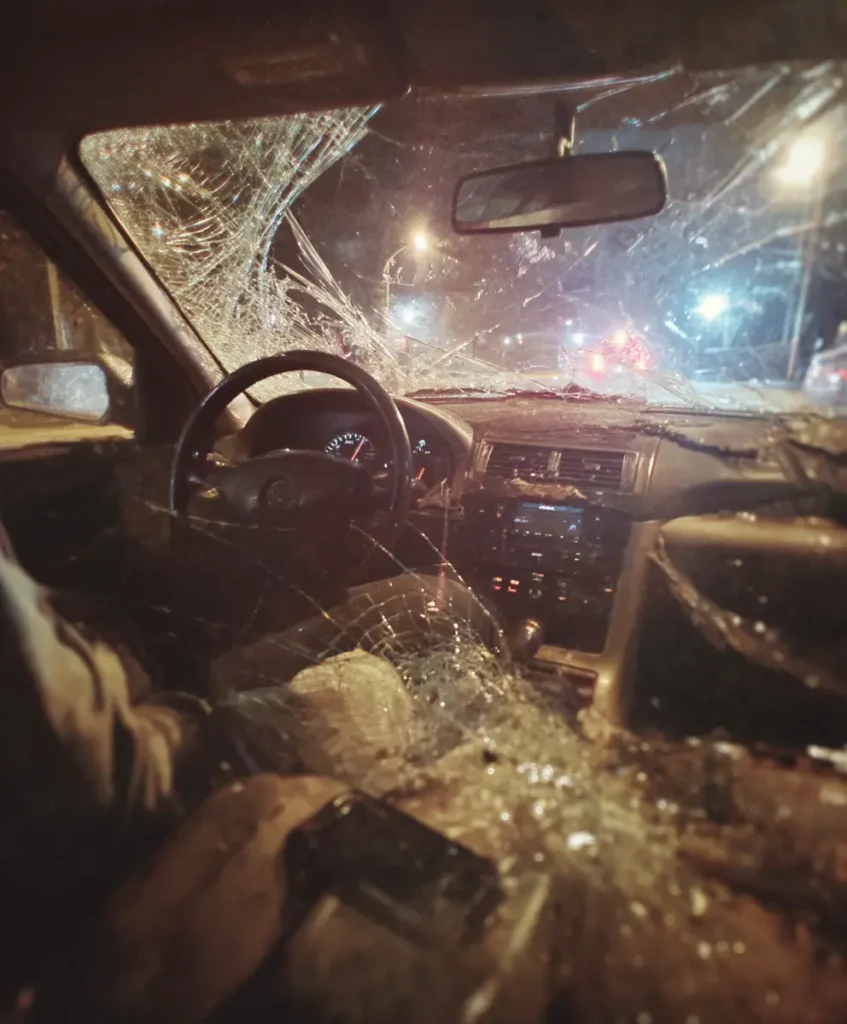
“These bikers are going to finish me off while I bleed out.”
That was my last coherent thought at 3:17 a.m. as I sat pinned behind the wheel of my brand-new BMW, its crumpled hood wrapped around a guardrail like a tin can. The airbag had shattered my nose. A jagged piece of the guardrail had punched straight through the door and into my gut. Blood was everywhere. I could feel it soaking the leather seat, warm and sticky, and the world kept tilting sideways.
I’d spent the last five years making sure everyone in Lakeside Estates knew exactly how I felt about the motorcycle club that rumbled through our gated community every Sunday morning. Noise complaints. Snide posts on the neighborhood app. I even stood up at the town council meeting and called them “a rolling public nuisance.” I’d looked the bearded guy who lived three doors down right in the eye at the coffee shop once and muttered, “Trash like you doesn’t belong here.”
Now that same bearded guy was kneeling at my shattered window, his face lit by the dying glow of my dashboard lights.
“Lawrence, stay with me. Penetrating abdominal trauma—don’t move.” His voice was steady, almost gentle. Leather vest, faded patches, the whole stereotype I’d hated. But his hands were already gloved, already pressing a thick pad against the hole in my side. “Mike Henderson. Trauma surgeon. We’ve got you.”
A woman with silver-streaked hair and ink crawling up both arms leaned in from the other side. “Pressure’s tanking. Starting a line.” She moved like she’d done this a hundred times in worse places than a dark roadside.
I recognized them both. The club. The ones I’d tried to ban. And here they were, working on me like I was family while I lay there remembering every ugly thing I’d ever said about them.
I woke up three days later in the ICU with tubes in my throat and Dr. Michael Henderson standing at the foot of my bed in a crisp white coat, silver at his temples, reading glasses low on his nose. No leather, no bandana—just the quiet authority of a man who’d just spent hours putting my insides back together.
“Welcome back, Mr. Keller. You tried to die on us. We declined the invitation.”
I croaked something that might have been an apology. He offered me ice chips and walked me through the damage: liver laceration, spleen repair, four broken ribs, broken nose, concussion. Professional. Detached. Like I hadn’t spent years trying to run his club out of town.
When the room finally cleared, I forced the words out. “You knew it was me on that road.”
He didn’t blink. “Yes.”
“Then why stop?”
He set the chart down and looked at me the way a father looks at a kid who just broke the rules and still doesn’t understand why. “Because you were dying, Lawrence. Everything else was irrelevant.”
Shame hit me harder than the guardrail had.
Over the next weeks he stayed my surgeon. Never brought up the past. Never rubbed it in. But I couldn’t stop thinking about it. Every time he checked my incisions, every time he explained the next procedure, I remembered the coffee-shop insult, the council-meeting rant, the way I’d sneered at their Sunday rides.
One afternoon my wife Jennifer showed me the community newsletter on her phone. “Blood drive in the hospital lobby. Organized by the Veterans Healing Road Club. For you.”
I stared at the screen until the words blurred. They’d already given me their blood—literally—and now they were refilling the bank on their day off.
When Mike made rounds the next morning I could barely look at him. “The blood drive… after everything I did to you people…”
He actually pulled up a chair—the first time he’d ever sat down in my room. “You want to know why I ride?” he asked quietly.
I nodded.
“Three tours as an Army surgeon in Afghanistan. Came home with nightmares that wouldn’t quit. One night a buddy dragged me onto the back of his bike. First time in years my brain shut up. The road forces you to be present. The engine vibrates the panic right out of your bones. The wind… it clears the ghosts.” He gave a small shrug. “Five of us started the club. All veterans. All in medicine or emergency services. Now we’re sixty strong. We ride for PTSD programs, for families who lost someone, for VA patients who never get visitors. Those Sunday mornings you hated? We were on our way to sit with guys who have no one else.”
I felt sick in a way no painkiller could touch.
“I’ve been an ass,” I said.
“Yeah,” he answered, but there was no anger in it. “You have. But you’re still a neighbor. Still a human being who needed help.”
Two days later the room filled with club members in civilian clothes. The silver-haired woman—Lisa, a retired combat nurse—checked my vitals out of habit. Carlos, a high-school principal, cracked a joke about my “impressive hood ornament.” Margaret, the top real-estate agent in the county, handed me a card with the club’s info. None of them looked like the monsters I’d invented in my head. They just looked like people who’d chosen to stop for a stranger who’d spent years trying to erase them.
I apologized to every single one. They accepted it the same way they’d accepted my blood-soaked body on the roadside—without fanfare, without conditions.
Three months later I stood in my driveway on a bright Sunday morning, still moving a little stiff but finally off the heavy meds. Jennifer held my hand. At nine o’clock sharp the familiar rumble rolled down our street. This time I wasn’t reaching for my phone to call the police. I was waiting for them.
Mike pulled into the driveway at the head of the pack. I shook his hand, then nodded toward the garage. Carlos helped me wheel out the matte-black cruiser I’d bought two weeks earlier—my first bike, still with the new-leather smell.
Mike raised an eyebrow. “You’re sure?”
“Medical clearance in three weeks,” I said. “I already signed up for your club’s beginner safety course. And I withdrew every noise complaint. The council’s voting next month to officially recognize the club’s charity work.”
Jennifer added, voice still a little shaky but determined, “I’m taking the passenger course too. Figured if I can’t beat them…”
Mike’s laugh was deep and real. “First Saturday of every month. You’re both welcome.”
As the group idled at the curb, flags snapping in the breeze, I asked the question that had haunted me since the accident.
“That night… you knew exactly who I was. Did you ever think about just riding past?”
Mike looked me dead in the eye. “The vest doesn’t make the man, Lawrence. What’s underneath does. None of us ride past someone who needs help. Not ever.”
He fired up his engine. The rest of the club fell in behind him. As they rolled away toward the veterans’ hospital, Jennifer squeezed my hand.
“Our neighbors are going to lose their minds when they see that bike in the driveway,” she said.
I smiled. “Let them. Maybe they’ll learn something too.”
The crash that should have killed me had done the opposite. It ripped away the blinders I’d worn for years. Dr. Michael Henderson hadn’t just saved my body—he’d handed me the chance to save my soul. And soon I’d feel it for myself: the therapy of the open road, the freedom that had healed the very man who refused to let me die.
I finally understood what the leather and the chrome had been trying to tell me all along.
Sometimes the people you’re determined to hate are the only ones willing to save you.