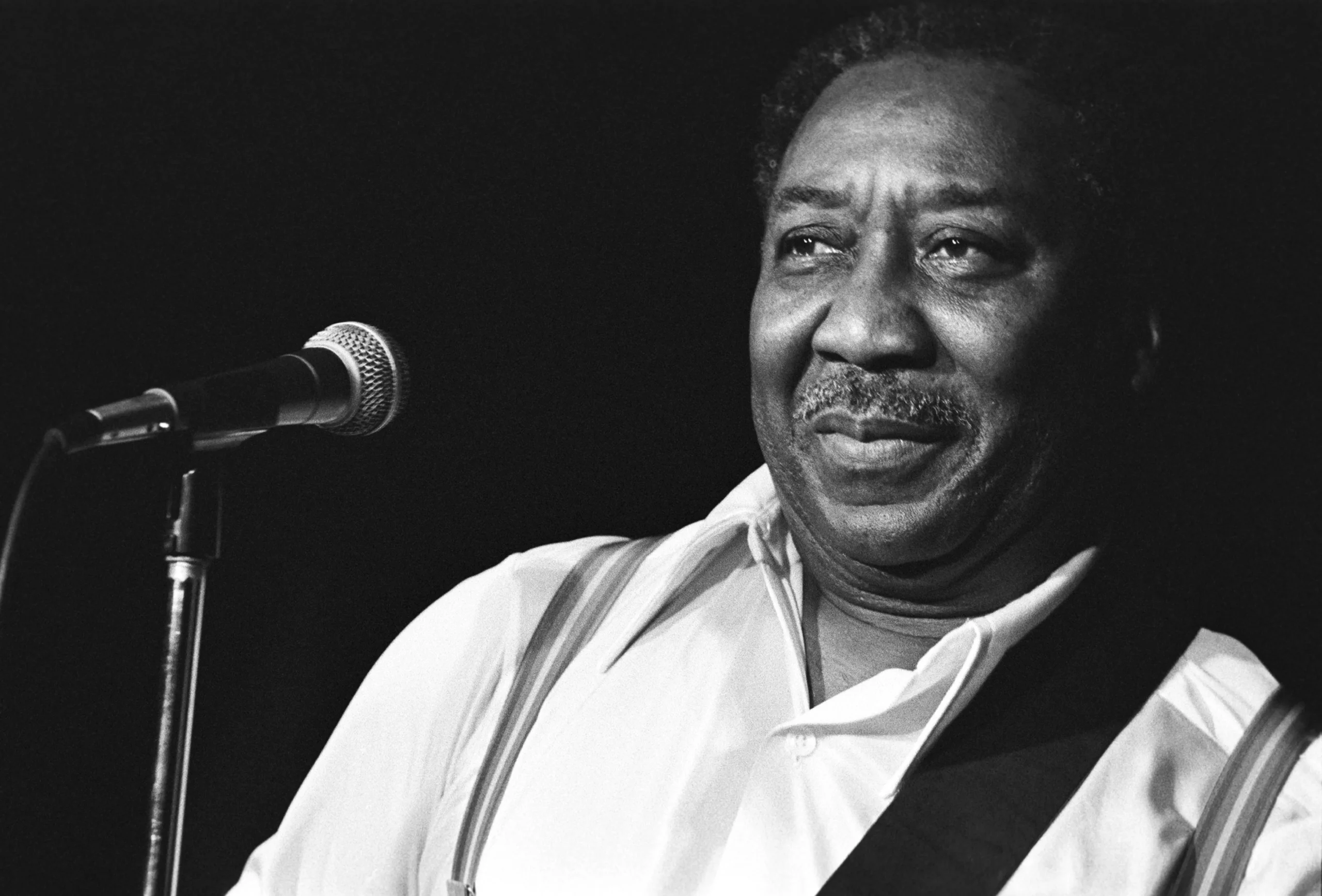
Muddy Waters is the man from whom the most important music of the twentieth century flows — not metaphorically, but in the specific documented sense of a traceable line from his recordings at Stovall’s Plantation in Mississippi in 1941 and his Chicago recordings of the late 1940s and early 1950s to the Rolling Stones, Led Zeppelin, the Beatles, Eric Clapton, Jimi Hendrix, and essentially every significant figure in British and American rock for the following four decades.
The Stones took their name from his song. They recorded his songs on their debut album. Keith Richards has said he wanted to be Muddy Waters. Clapton learned to play guitar by studying Waters’s recordings. Jimmy Page heard him and understood something about the electric guitar that the instrument’s previous applications had not demonstrated. John Lennon covered him. Bob Dylan cited him. The list of musicians who were formed by Waters’s specific approach to the electric blues — the slide guitar, the band configuration, the specific quality of urgency in his vocal delivery — is effectively a list of everyone who mattered in rock music between 1963 and 1980.
Waters came to Chicago from Mississippi in 1943 — part of the Great Migration that transformed American culture by moving millions of Black Americans from the rural South to the industrial North. He carried with him the Delta blues tradition he had learned from Son House and Robert Johnson, and in Chicago he plugged in. The electric guitar amplified what had been intimate into something that filled a room, and what Waters did with the amplification produced a sound that had not previously existed.
Rollin’ Stone — recorded in 1950 — is the single recording from which the most branches grow. It gave the Rolling Stones their name. It gave Bob Dylan a song title that became the most significant rock lyric of the 1960s. It appears in Jimi Hendrix’s influences in ways that are traceable in his approach to the electric guitar. It is the ur-text of British and American rock in a way that nothing else from the same period matches.
Waters recorded it for Chess Records and was paid session fees that bore no relationship to the royalties the subsequent use of his work generated. The Chess Records story — how Leonard and Phil Chess managed the careers and compensated the artists who made the label’s catalog — is one of the most documented examples of exploitation in the music industry, and it is documented most thoroughly in the specific language of musicians like Waters who had the opportunity to speak about it later in their careers when the commercial power relationship had shifted enough to make speaking possible.
The British musicians who built their careers on Waters’s foundation have addressed their debt to him with varying degrees of specificity and generosity. The Stones performed with him. Clapton recorded with him. Page acknowledged his influence. But the specific commercial relationship — the question of what was owed to the man whose recordings were the source material for billions of dollars of subsequent commercial success — was never resolved in any way that adequately compensated the person at the beginning of the chain.
Waters died in April 1983 — rich enough, by the end of his life, to not be poor, but not rich in proportion to what his music had generated for the people who built on it. He was 68. The posthumous acknowledgment of his foundational status has been more consistently generous than the acknowledgment that came while he was alive, which is the specific form of tribute that the music industry offers to its most essential figures and that the figures themselves would have preferred to receive on a different schedule.