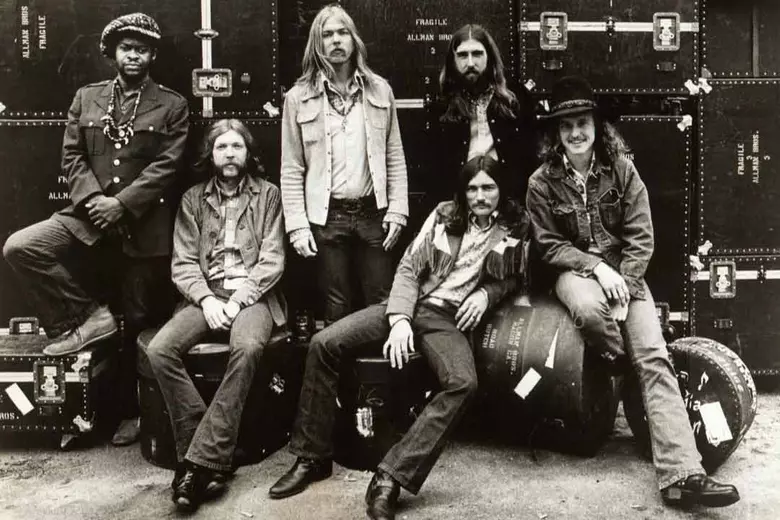
The Allman Brothers Band’s relationship with extended live performance was not a commercial calculation or a theatrical choice — it was an expression of a specific philosophy about what music was for and what a concert was supposed to do, a philosophy that Duane Allman articulated in interviews with the precision of a man who had thought carefully about what he was doing and why. Music, for Duane, was not a product delivered to an audience. It was an experience shared between performers and listeners — an experience that had a different quality when it was given time to develop, when the musicians were allowed to follow where the music wanted to go rather than where the set list told them to go, when the audience was willing to go there with them.
The seven-hour performance — documented in partial form in the bootleg recordings that circulate among Allman Brothers devotees and that have been the subject of discussion and analysis in the years since — happened at the Fillmore East in New York in 1971, during the residency that produced the live album that many serious musicians consider the greatest live rock recording ever made. The Fillmore East performances across those nights were the peak of what the band was in its classic configuration — with Duane and Dickey Betts on guitars, Berry Oakley on bass, Gregg Allman on keyboards and vocals, and the twin drum configuration of Butch Trucks and Jai Johanny Johanson that gave the band its specific rhythmic foundation.
The seven-hour night was not a single performance in the conventional sense — it was an evening that began with a scheduled set and continued past the scheduled ending because the music had not finished, and the audience had not left, and the band had not found a place where stopping felt appropriate. The Fillmore’s management has been described as increasingly uncertain as the hours accumulated, and the band as entirely unaware of or indifferent to the uncertainty.
Duane has described the specific experience of playing past the point where conscious musical decision-making was the primary mode of playing — the specific state that extended improvisation produces when it goes on long enough that the analytical mind stops directing and starts observing, when the music begins to come from somewhere that is not the deliberate choices of individuals but something that the individuals are participating in rather than generating. This is the experience that jazz musicians describe in the language of flow states, that gospel musicians describe in theological terms, and that Duane described in the specific vocabulary of someone who had encountered it regularly and who understood it as the most important thing that music could produce.
He said the seven-hour night was the night he understood what music was for — not in a new intellectual sense but in a direct experiential sense, in the way that understanding something by living through it is different from understanding it by reasoning about it.
Duane Allman died on October 29, 1971 — four months after the Fillmore East residency — when his motorcycle was struck by a truck in Macon, Georgia. He was 24 years old. The live album from the Fillmore East was released that same year and received the critical response that established it as something permanent — a document of what was possible when four to six musicians gave music the time and the space it required, and an audience was willing to go where the music went.
The seven-hour night is in the bootleg recordings. The Fillmore East album is the official document. The thing Duane said he understood that night is in both, and it is the thing that the musicians who have studied the Allman Brothers most seriously return to when they want to explain what the band was trying to do.