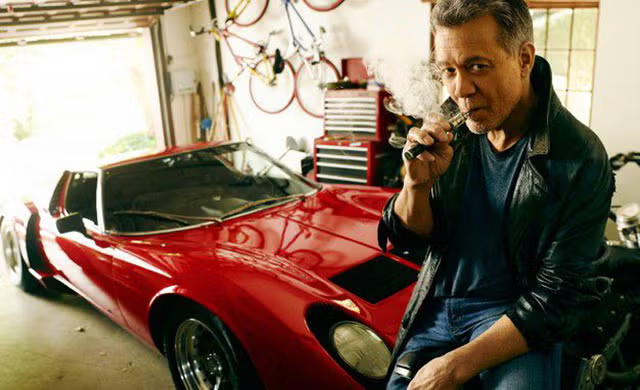
Eddie Van Halen is the guitarist who most completely changed what rock guitar was understood to be between 1978 and 1984 — not by discovering something new about the instrument, because the techniques he used had existed in various forms before him, but by combining those techniques with a melodic sensibility, a sense of humor, and a joy in the playing that made what had been considered technically extreme suddenly seem like the most natural thing in the world. He did not make guitar playing look difficult. He made it look like the most fun a human being could have, which is a far more dangerous thing for other guitarists to witness.
The techniques he deployed — the two-handed tapping that produced the introduction to Eruption, the harmonics, the whammy bar innovations — had been used by other guitarists in isolated ways. What Eddie had that the other guitarists did not have was the specific combination of technical facility and genuine musical intelligence that made the techniques serve the song rather than the other way around. He did not play technically difficult music. He played music that was technically difficult to play, which is an entirely different thing.
The recordings made for Van Halen III in 1998 and A Different Kind of Truth in 2012 — the latter the band’s final studio album, made with David Lee Roth restored to the singer’s position — were made in the context of health circumstances that the people around Eddie during those periods have described with increasing specificity in the years since his death. He had been diagnosed with tongue cancer in 2000, treated with surgery and radiation that affected his playing ability in ways that the available evidence suggests he worked to overcome rather than accommodate. He had undergone hip replacement surgery. He had other health challenges that he managed with the same privacy he brought to everything personal.
1. Panama (1984)
The most perfectly constructed piece of Van Halen’s classic period — a song that demonstrates every element of what made the band extraordinary in a three-minute statement that has no wasted element. Eddie has said in interviews that the riff arrived so completely that he was unsure whether he had invented it or remembered it from somewhere, which is the specific quality that the best riffs produce. The song is about a car. The energy is transcendent. The relationship between these two facts is the most concise summary of what Van Halen understood about rock and roll.
2. Eruption (1978)
The two-minute and five-second guitar solo that appeared as a track on the debut album — unprecedented in conception, a piece of technical showmanship that functioned simultaneously as a musical statement and as an announcement that the vocabulary of rock guitar had just been expanded. Eddie has said he almost did not include Eruption on the album — that he considered it an exercise rather than a song and that the decision to include it was someone else’s. The guitar world’s response to its release established a before and after in the history of the instrument that has not been revised in forty-six years.
3. Jump (1984)
The keyboard-driven song that became the band’s biggest commercial hit and that Eddie has described with the specific ambivalence of someone whose commercial success arrived through a medium that his technical reputation was not built on. He wrote the keyboard riff. He played it on synthesizer. He made one of the great pop songs of the decade by deploying the instrument that his identity as a guitarist had not prepared anyone to expect him to use. He has said Jump is the song that surprised him most in his own catalog.
4. Hot for Teacher (1984)
The drum introduction that Alex Van Halen plays before the guitar enters is one of the most kinetically exciting openings in rock history — it creates a specific expectation that Eddie then exceeds. Hot for Teacher is the most complete expression of what Van Halen was as a live band — the sense of barely controlled energy, the humor that never compromised the technical seriousness, the specific quality of joy in the playing that was the band’s most distinctive characteristic and the one that no imitator has been able to reproduce.
5. You Really Got Me (1978)
The debut album’s opening track — a cover of the Kinks song that had defined British Invasion rock in 1964 and that Van Halen transformed into something that made the original sound like a sketch for what the song could become. The decision to open with a cover rather than an original was itself a statement — a declaration that what Van Halen was doing was not outside the tradition but the fullest possible expression of it, the place where the tradition had been heading all along.
Eddie Van Halen died on October 6, 2020, of throat cancer. He was 65. He had been managing health problems for twenty years with a privacy and a commitment to continuing to play that the people around him have described as the most complete expression of who he was — a man for whom the guitar was not a profession but a way of being, and whose relationship with the instrument was the thing that made every other difficulty manageable. The recordings he left are the most complete account of what that relationship produced.