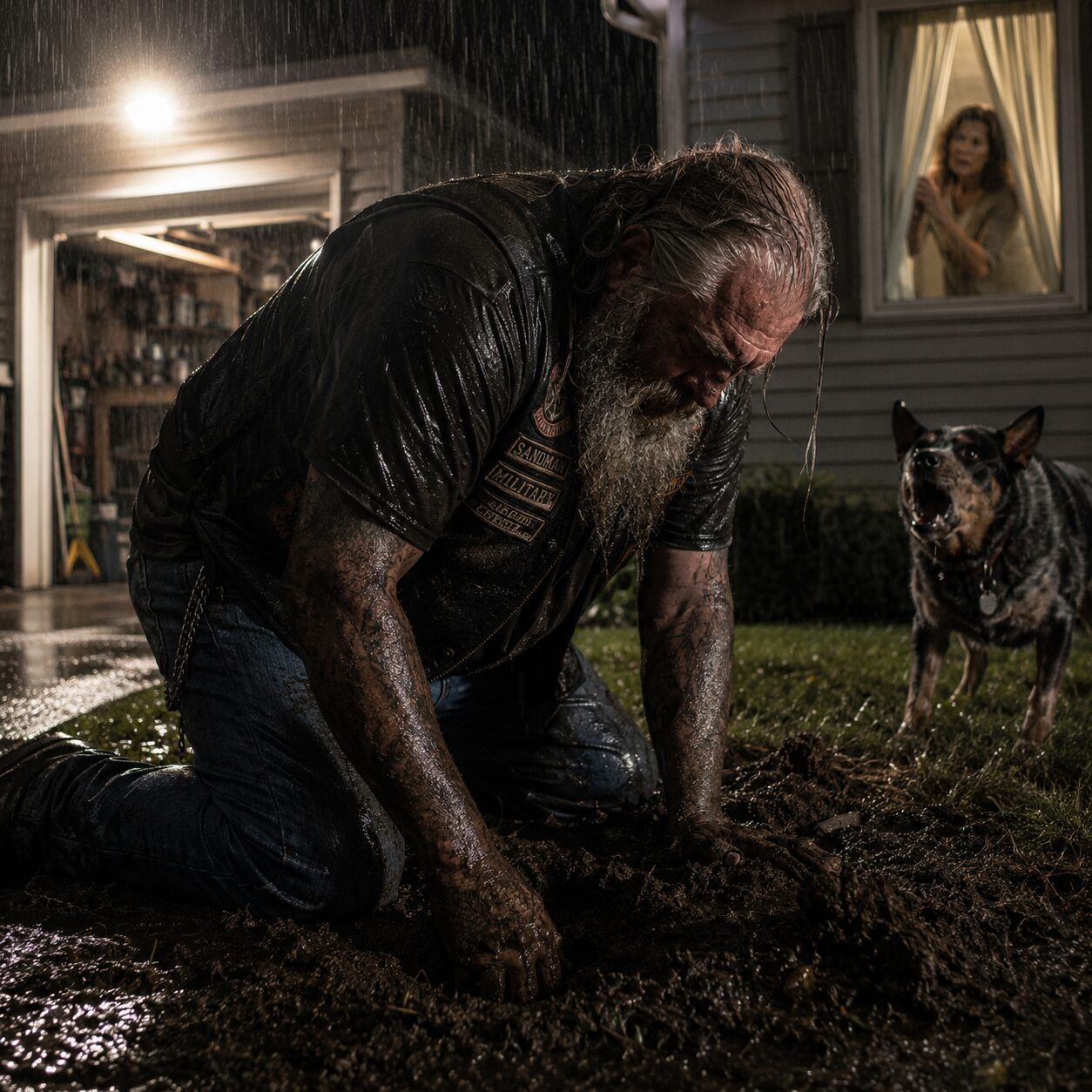
The storm didn’t just break over the county that night; it tore at the earth.
By 2:00 AM, the rain was coming down in sheets so dense it turned the windows into opaque, violently vibrating mirrors. I only woke up because Silas, our blue-heeler mix, wasn’t just barking—he was letting out a low, vibrating growl from the deepest part of his chest, his nose pressed white against the glass of the living room window.
I pulled myself from the sheets, cold air biting at my bare ankles, and walked into the dark hallway. “Silas, quiet,” I hissed, reaching out to pull back the heavy linen curtain.
The floodlight over the garage hummed, cutting a fragile wedge of yellow light through the torrential downpour. And there, right in the center of our lawn, drowned in the mud, was a silhouette that didn’t look human at first.
It was a man. He was massive, his broad shoulders squared against the wind, clad in a heavy, grease-darkened leather vest. He wasn’t moving. He was kneeling upright in the grass, his head tilted slightly downward, letting the freezing deluge hammer his skull like a statue awaiting execution.
A chill, sharper than the draft, raced up my spine.
I bolted back to the bedroom, throwing my weight onto the mattress. “Mike. Mike, get up. There’s someone on the property. Right on the lawn.”
Mike groaned, the fog of a deep sleep clinging to him, but as I dragged him by the arm toward the window, his posture changed. He parted the curtain. The instant his eyes locked onto the giant kneeling in the mud, the air left his lungs in a sharp, rattling gasp.
I have been married to Michael Vance for thirty-one years. I watched him bury his parents without dropping a tear; I held his hand through an emergency triple-bypass surgery where his pulse stopped for four seconds, and he woke up cracking jokes at the surgeon. He was iron.
But looking out that window, every drop of blood drained from his face, leaving his skin the color of skim milk. His jaw went slack, his eyes wide and vacant, reflecting the distant flash of sheet lightning.
“I’m calling the sheriff,” I said, my fingers already frantically scrambling over the nightstand for my phone.
Before I could touch the screen, Mike’s hand clamped down on my wrist. His grip was fiercely tight, his palm cold and sweating.
“No,” he whispered. The voice didn’t belong to my husband. It was thin, reedy, suffocating under some sudden, catastrophic weight. “No police, Carol. Do not touch that phone.”
“Mike, he’s giant, he’s out there in a storm at two—”
“Stay inside. Lock the deadbolt behind me.”
He didn’t grab a jacket. He didn’t even put on shoes. In nothing but a faded gray t-shirt and his boxers, my husband threw open the front door and stepped directly into the freezing, driving gale.
The Gathering of Ghosts
Driven by pure panic, I didn’t lock the door. I threw it open and stood on the porch, the overhang offering miserable protection as the wind whipped the rain sideways, soaking my nightgown within seconds.
Mike walked down the wooden steps, his bare feet sinking into the saturated, freezing mud of the lawn. He stopped exactly four feet from the kneeling figure.
For ten agonizing seconds, neither of them moved. The biker slowly lifted his head. Beneath the yellow glare of the floodlight, I saw his face. He was an older man, easily mid-sixties, with a massive, tangled gray beard that was plastered flat against his collarbone by the water. Deep, violent lines were etched into his forehead, and his eyes—even from the porch, I could see them—glittered with a terrifying, unhinged intensity.
The biker’s lips moved. The wind howled, swallowing the first few syllables, but then the storm hit a brief, eerie lull, and the words sliced through the dark.
“Thirty years, Vance,” the man growled, his voice a gravelly, rusted engine. “Thirty years I kept the secret. Thirty years I took their blood money. But the dark is closing in, and I ain’t going into the fire alone.”
What happened next made my knees go weak. Mike—the proudest, most unyielding man I had ever known—staggered backward as if he’d taken a physical blow to the sternum. He looked at the old man, his lips trembling, and then, without a word, he collapsed forward, dropping straight into the mud on his knees, facing the stranger like a penitent at an altar.
“Mike!” I screamed, breaking my paralysis. I ran down the steps, the mud swallowing my feet, the cold shocking my system as I threw myself between them. “What is this? Who is he?”
The biker didn’t look at me; his gaze remained locked on Mike. “He hasn’t told you a single thing, has he? Typical Vance. Carrying the cross until his spine snaps.” The man grunted, his joints popping like dry twigs as he forced himself to stand. Up close, he was a mountain, easily six-foot-four, smelling of old motor oil, wet leather, and something bitter and clinical.
“My name is Dale Kircher,” he said, wiping the rain from his eyes with a fist the size of a mallet. “Thirty years ago, your husband and I worked the midnight line at Hartwell Steel. Before he met you. Before the world forgot what happened to the East Floor.”
Hartwell Steel. I remembered the name on old tax returns from the early nineties, a defunct foundry that had burned to the ground in a catastrophic industrial accident. Mike had never spoken of it. Not once.
“Let’s go inside,” Mike pleaded from the mud, his voice cracking as he pushed himself up. He looked broken, his chest heaving. “Please, Dale. Let’s just… get out of the storm.
The kitchen was blindingly bright compared to the yard. Dale sat at our linoleum table, a massive, dripping specter, leaving a pool of dark water on the floor. Silas, who usually lunged at strangers, walked straight over to the giant, sniffing his mud-caked boots before resting her chin quietly on his denim-clad knee.
I stood by the counter, my hands shaking so violently I could barely pour the coffee.
“Tell her, Michael,” Dale said, his voice dropping into a menacingly quiet register. “Tell her about the summer of ’94. Tell her why you live in this quiet town and why you can’t look at a furnace without shaking.”
Mike stared into his mug, his knuckles white. “There was an explosion,” he said softly. “A high-pressure molten line ruptured on the East Floor. The safety valves had been pinned open by management to force a double yield. The whole sector turned into an incinerator in six seconds. Everyone ran. The smoke was thick as tar. I made it out to the loading docks.”
Mike stopped, a tremor passing through his jaw.
“But someone was screaming behind the collapsed fire wall,” Dale interrupted, leaning forward, the leather of his vest creaking. “Me. A three-ton structural beam had dropped across my legs. I was pinned in the dark, watching the ceiling melt. The foreman stood at the emergency doors with a megaphone, threatening to fire anyone who went back in because the main gas main was about to blow.”
Dale pointed a thick, scarred finger at my husband. “This lunatic didn’t look back. He ran straight into a literal hell. He found me by the sound of my bones cracking under that iron. He lifted a beam that took three paramedics to hoist off me later. He dragged me two hundred feet through a rain of sparks, and the roof came down exactly thirty seconds after we cleared the threshold.”
I looked at Mike, tears blurring my vision. “You saved his life… why would you hide that from me? Why hide a miracle?”
“Because it wasn’t a miracle, Carol,” Mike snapped, his voice suddenly sharp with an old, jagged agony. “It was a crime scene.”
The room grew suffocatingly quiet.
“The company—Hartwell Conglomerate—knew the line was defective,” Mike explained, his eyes fixed on the table. “Three men died in that fire. Young Petey Hollins was only twenty-two; his body was never recovered. The executives needed a clean slate for the insurance payout. They offered every survivor a check. A massive one. In exchange, we had to sign an affidavit stating the fire was an act of God—an unpredictable accident.”
Mike looked up at me, his eyes bloodshot. “We had just started dating, Carol. You were broke, coming out of a brutal divorce, and I was terrified I couldn’t provide for you. They put five years’ worth of salary in front of me on a single piece of paper. All I had to do was lie.”
“But you didn’t,” I whispered, knowing the soul of the man I loved.
“No. I refused. I took the stand at the federal inquiry. I brought the maintenance logs I’d smuggled out in my boot. I destroyed them in court,” Mike said. “But I was the only one.”
He turned his gaze slowly toward Dale.
“Every other man took the money,” Dale said, his voice dripping with thirty years of accumulated self-loathing. “Including me. I had a mortgage, crippled legs, and a family to feed. I signed their lie, took their corporate blood money, and watched them blackball your husband from every union job in the state. I let the man who pulled me out of the fire starve so I could be comfortable.”
The realization hit me like a physical punch. The two years early in our marriage where we survived on nothing but generic rice and prayer—the car repossessions, the grueling eighteen-hour shifts Mike took pulling security for pennies—it wasn’t bad luck. It was the price of his integrity.
“I didn’t want you to carry the bitterness, Carol,” Mike said softly, reaching for my hand. “If you knew we were starving because of a choice I made alone, I was afraid you’d grow to hate the truth. So I buried it.”
“So why now, Dale?” I asked, looking at the giant stranger. “Why break thirty years of silence in the middle of the night?”
Dale didn’t answer with words. Instead, he unzipped the front of his leather vest and pulled out a thick, legal-sized envelope sealed inside a heavy-duty Ziploc bag to protect it from the storm. He slammed it onto the kitchen table. It made a heavy, sickening thud.
“Because the ledger is closing,” Dale said grimly. “Pancreatic cancer. It’s eating its way through my spine. The doctors gave me until the end of summer; I’m already living on borrowed time and pure spite. I tried to live with the guilt, Vance. But a dying man can’t sleep with thirty years of stolen money under his mattress.”
Mike stared at the plastic-wrapped package as if it were a coiled viper. “What is that?”
“It’s the settlement,” Dale said, his chest heaving as he fought back a sudden, agonizing wave of physical pain. “Every single cent of the hush money. I put it in a blind trust the day I cashed it. I never touched it. Couldn’t stand the sight of it. With thirty years of compound interest, there’s over four hundred thousand dollars in there.”
Dale pushed it closer to Mike, his eyes pleading, almost wild. “Take it. It belongs to you. You earned it by starving for my cowardice. Let me clear my name before I meet Petey Hollins on the other side.”
Mike stood up so fast his chair screeched against the floor. “I told you thirty years ago on the courthouse steps, Kircher—I don’t trade lives for paper. Slide that back across my table or I swear to God I’ll throw it in the fireplace right now.”
“Mike, please!” Dale roared, standing up to meet him, two old men squaring off in a brightly lit kitchen while the storm raged outside. “I am dying! Look at me! I am going to dust in a matter of weeks! Do not leave me with this weight!”
The tension in the room was electric, vibrating with decades of unspent rage, guilt, and pride. I watched my husband, his chest rising and falling, looking at the hollowed-out cheeks of the man he had once dragged through the flames.
Slowly, the fury left Mike’s shoulders. He took a deep, shuddering breath and walked around the table, stopping inches from the dying giant.
Instead of shouting, Mike reached out, grabbed Dale by the leather lapels of his vest, and pulled the massive man into a fierce, desperate embrace.
“You want to square the ledger?” Mike muttered into his shoulder. “Then you show up here next Sunday. And the Sunday after that. Carol makes a breakfast that’ll test whatever stomach you’ve got left. You sit at my table, you drink my coffee, and we talk about the old trucks we used to build before the world went to hell. You give me my brother back for whatever time is left. That’s the only currency that clears the debt.”
Dale froze, his massive arms hanging at his sides for a split second, before he completely collapsed into the embrace, sobbing with a violent, racking grief that shook his entire frame.
Dale Kircher didn’t miss a single Sunday.
For four months, the roar of his vintage Harley-Davidson would echo down our quiet country road every Sunday at precisely 8:00 AM. Silas would sit by the gate, waiting to guide him up the porch steps. At first, he ate like a wolf, laughing with Mike about old floor managers and long-forgotten union strikes.
By October, the bike was gone; his son had to drive him in a pickup truck. By November, Dale was so frail his son had to carry him up the wooden steps in a wheelchair. His skin had turned a terrible, translucent yellow, but his eyes remained sharp, locked onto Mike’s face across the kitchen table.
They never mentioned the fire again. They didn’t need to. The silence between them had been replaced by something durable and clean.
He passed away on a bitter Tuesday morning in early December.
At the service, the church was packed with iron-clad bikers from three different states. Mike stood at the pulpit, his voice echoing off the vaulted ceilings as he finally told the world the true story of the 1994 Hartwell fire. He spoke of Barrett. He spoke of Suou. He spoke of young Petey Hollins. And he spoke of Dale Kircher—not as a man who had faltered, but as a man who had possessed the immense, terrifying courage to seek out a doorway in the dark and set his burdens down.
The envelope remained on our mantle for exactly one week after the funeral. Mike never broke the seal.
Instead, we hired a private investigator to track down the descendants of the three men who had perished in the smoke. We split the trust down to the penny, sending three anonymous cashier’s checks to the families, accompanied by a typed note containing a single sentence: This belongs to you, thirty years late, courtesy of Dale.
A few weeks later, we received a letter from Petey Hollins’ surviving younger sister. She wrote that the money had arrived on the exact anniversary of the fire. She said her family had spent three decades believing the world had forgotten her brother’s name in the rush to rebuild the town. She wrote that the check didn’t matter, but knowing someone had carried the truth for thirty years had finally allowed her elderly mother to sleep through the night.
Sometimes, when a storm rolls in past midnight and Silas whimpers at the glass, I look out onto the dark front lawn. I don’t see a threat anymore. I see the place where an old ghost finally found a piece of ground holy enough to lay his weapons down.