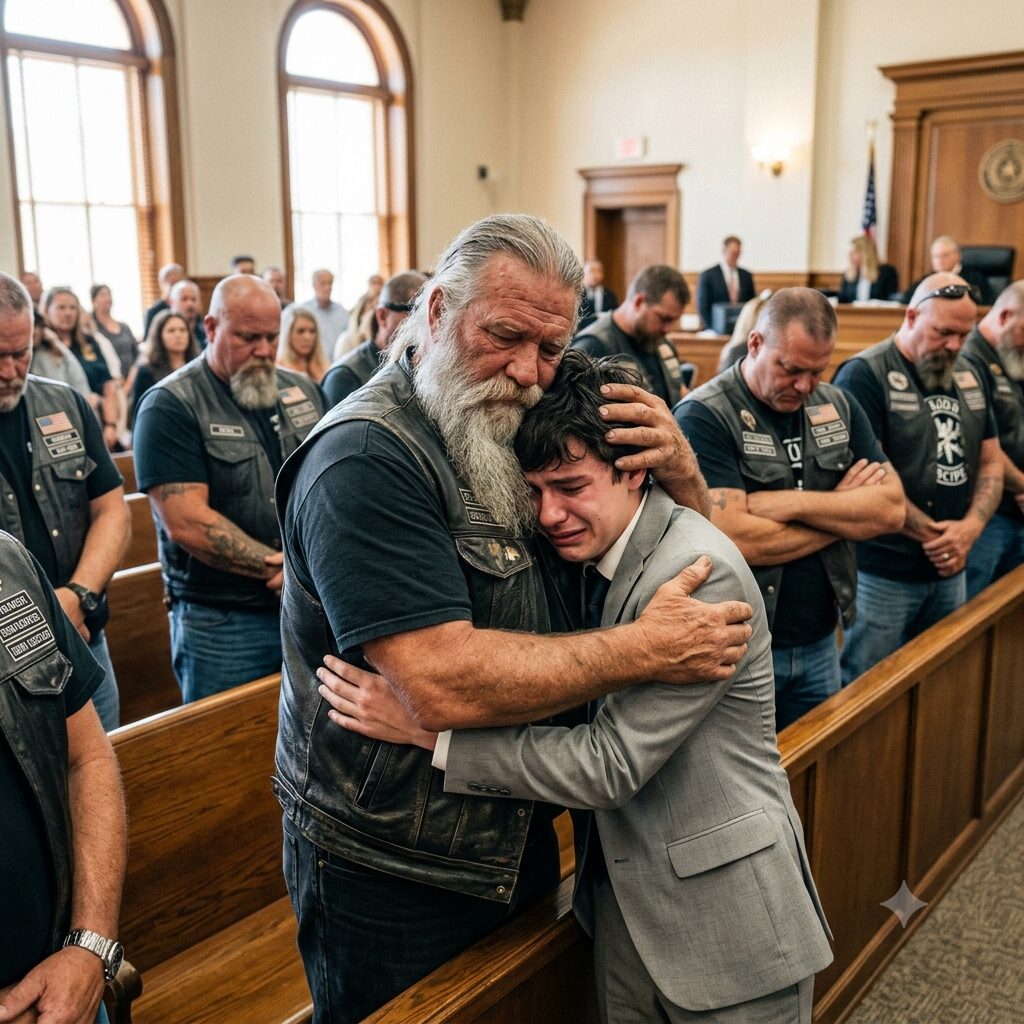
The oak benches of the courtroom didn’t creak when they sat down; they groaned under the collective weight of twenty men clad in heavy leather, denim, and road dust.
When the double doors at the back of the room swung open, the murmuring gallery died instantly. The air grew dense, heavy with the scent of stale oil, highway rain, and an unspoken promise of retribution. Everyone in the room—the bailiffs, the court reporter, the spectators who had come for the morning’s drama—knew exactly who they were. The patches on their backs read Iron Disciples.
I didn’t look back. I didn’t need to. I could feel the heat of their stares pressing against the nape of my neck like the midday Texas sun. They had filled the back three rows, sitting with their arms crossed over their chests, twenty pairs of eyes drilling holes straight through my spine.
I was nineteen years old, drowning in a suit my mother had bought off the clearance rack at Foley’s, and I knew I deserved whatever they wanted to do to me. I had killed Donna.
My defense attorney, a sharp-eyed public defender named Miller who had tried his desperate best to save me from myself, leaned over and whispered, “Keep your eyes on the flag, Leo. Don’t look at them. Don’t look at him.”
To understand why twenty bikers had ridden through the night to watch a teenager get locked away, you have to understand the specific kind of exhaustion that bleeds into the Texas panhandle in October.
The wheat fields outside Amarillo had already been harvested. For miles in every direction, the earth was nothing but dry stubble and pale dust, waiting for a winter that was still weeks away. I had landed a job at a distribution warehouse—twelve-hour shifts loading commercial pallets onto freight trailers. It was backbreaking, mind-numbing work, but it paid twelve dollars an hour, which was a fortune to a kid trying to scrape together enough tuition for the local community college.
That Tuesday, a guy on the night shift called out sick. The floor manager looked at me, offered me time-and-a-half, and I took it without thinking. By the time I punched my timecard and walked out to my beat-up ’98 Chevy Silverado, I had been awake for twenty-two consecutive hours.
I told myself I was fine. I told myself that the cold air rushing through the rolled-down window would keep the fog at bay. I turned the radio up until the speakers rattled.
The human brain doesn’t give you a warning when it shuts down from exhaustion. There is no dramatic fading of the lights, no gradual drift into sleep. One second I was watching the dashed white lines of Route 287 flicker beneath my high beams, and the next, there was a sound like a small explosion—the sickening crunch of fiberglass yielding to steel, the shatter of laminated glass against my teeth, and the violent, spinning disorientation of a ditch taking hold of a two-ton truck.
When the world stopped spinning, the silence was louder than the crash.
I crawled out through the shattered driver’s side window, leaving one of my work boots caught under the crumpled brake pedal. I stood on the cold asphalt in my socks, the smell of anti-freeze and burnt rubber filling the night air.
Fifty yards back, lit by the single flickering headlight of my ruined truck, a vintage Harley-Davidson lay on its side, its rear wheel still spinning lazily in the dirt, sending up small, rhythmic showers of sparks.
And there, in the center of the lane, was Wallace.
He was on his knees. He was holding a woman in a leather jacket against his chest, rocking her back and forth on the cold road. He was making a low, guttural sound—a primitive, agonizing wail that didn’t sound like it could come from a human throat.
Her name was Donna. She was sixty-one. They had been married for more than three decades, and they were riding home from their granddaughter’s birthday party in Dumas. Later, during the discovery phase of the legal process, I would read the police report and learn that Donna had been holding a small, foil-wrapped piece of leftover birthday cake against her jacket when the impact occurred. The frosting had smeared across the leather. That detail alone was what finally broke my sanity in the months that followed.
When the paramedics arrived twenty minutes later, Wallace wouldn’t let them near her. He kept his massive arms wrapped around her body, shielding her from the flashing red lights, as if he could keep her alive by sheer force of will. But she was already gone.
The district attorney wanted an example. The local papers ran editorials about the recklessness of youth, and a prominent column implied that I was receiving leniency because of some imagined local connections. The truth was far more mundane: I had no criminal record, there wasn’t a drop of alcohol or drugs in my system, and the state’s own investigators concluded it was a tragic case of extreme sleep deprivation.
The charge was eventually settled at criminally negligent homicide. The state’s guidelines suggested a suspended sentence, heavy probation, and a revoked license.
But while the legal system ground along through two years of continuances and procedural delays, I carried out my own sentence.
I stopped leaving the house. I withdrew my applications for college. The warehouse job was gone—you can’t load freight when the sight of a truck makes your chest tighten until you can’t breathe. I moved back into my childhood bedroom, staring at the ceiling for eighteen hours a day while my mother stood outside the door, listening to my silence, helpless and terrified.
The worst part wasn’t the fear of prison. I actually found myself wishing for a cell. A cell would have been simple; it would have been a physical currency I could pay to square the ledger. The real torment was the absolute imbalance of reality: Donna was gone, her family was ruined, and I was still eating breakfast, still breathing air, still existing without having earned the right to do so.
Now, the two years were over. The morning of reckoning had arrived.
“Does anyone wish to address the court before sentencing is passed?” Judge Evelyn Alvarez asked, her eyes scanning the quiet room.
I braced myself. I assumed the district attorney would present a statement from the family, a written catalog of grief designed to ensure I received the maximum allowable probation terms.
Instead, the bench in the third row creaked.
Wallace stood up.
He was a mountain of a man, well over six feet, with a thick, silver-streaked beard that reached the center of his chest. He wore the colors of his club, and you could see the grime of the highway embedded in the creases of his leather vest. He looked like he hadn’t slept in forty-eight hours, having ridden hundreds of miles across the state line to make the docket.
The courtroom fell into an unnatural, vacuum-like silence. The only sound was the heavy, rhythmic thud of his engineer boots against the linoleum floor as he walked toward the front bar.
My mother began to weep softly behind me. My lawyer put a firm hand on my forearm, anchoring me. Everyone in that room—myself included—believed we were about to witness a man demand the absolute destruction of the kid who had taken his wife.
Wallace reached the podium. He didn’t look at the judge. He didn’t look at the prosecutor. He turned his massive frame around and looked directly into my face. His eyes were bloodshot, surrounded by deep, dark hollows of exhaustion and grief.
He reached into the breast pocket of his denim shirt and pulled out a single sheet of lined paper, yellowed slightly at the edges and folded into a neat square.
“I’ve spent two years thinking about what I was going to say when I finally stood in this room,” Wallace began. His voice was incredibly deep, like rocks tumbling down a dry riverbed, but on the very first syllable, it cracked with an ancient, heavy sorrow. “For eighteen months, I didn’t want justice. I wanted vengeance. I wanted this boy to know what it felt like to have your lungs torn out while you’re still breathing.”
He held up the paper between two thick, grease-stained fingers.
“Donna kept journals,” he said, looking down at the page. “Forty years of them. After the funeral, I locked them in a cedar chest in the garage. I couldn’t bring myself to look at her handwriting. It hurt too much to see her thoughts alive when she wasn’t. But three months ago, I opened the last volume. And I found an entry dated exactly two weeks before the night on Route 287.”
The judge didn’t interrupt. The bailiff stood frozen near the wall.
Wallace put on a pair of wire-rimmed reading glasses, his large hands shaking so noticeably that the paper fluttered in the air. He cleared his throat and began to read.
“Wally’s going to complain if he ever reads this, but I need to put it down where it stays. I’ve been having a feeling lately. Not a bad feeling, just an awareness. When you spend as much time on the blacktop as we do, you learn that the road doesn’t have a heart. It doesn’t care who you love or who’s waiting for you at home. If my time comes while we’re out on the bikes, I want it known right here: I don’t want anyone carrying the weight of it. Not Wally, not the girls, and most of all, not whatever poor soul happens to be on the other side of the yellow line. You ride long enough, the road takes what it takes. I made my peace with that when I was twenty-seven years old, and I’m not changing my mind now. Whoever is out there, whatever happens, let it be the road’s fault. Don’t waste your remaining good years hating a stranger for an appointment I already had with the highway.”
Wallace lowered the paper. He took off his glasses and let his arms fall to his sides. The tears were clear now, cutting bright tracks through the dust on his weather-beaten face.
“She wrote that,” Wallace said, his voice dropping to a whisper that carried to every corner of the silent room. “Two weeks before you ever left that warehouse shift. She knew the risks of the life we chose, and she knew the capacity of the human heart to poison itself with hatred.”
Before my attorney could stop me, I was on my feet. My legs felt like water, and the room tilted slightly, but I couldn’t remain seated.
“I’m sorry,” I choked out, the words tearing at my throat. “I am so incredibly sorry. I would give you my life if it changed anything. I know it’s not enough. I know saying sorry is empty.”
“It’s not empty,” Wallace said.
He moved away from the podium. He didn’t walk toward the judge; he walked right past the prosecution table, through the gate, and stood directly in front of me. The bailiff took a sudden step forward, his hand instinctively resting on his holster, but Judge Alvarez raised a single, commanding hand from the bench, signaling him to hold.
Wallace stood so close I could smell the stale tobacco, the diesel exhaust, and the heavy, oiled leather of his vest. He looked down at me, his massive hands reaching out to grip my shoulders. His palms were rough as sandpaper, but his grip wasn’t violent. It was steadying.
“I hated you, son,” he murmured, his voice meant only for me and the immediate tables. “Hating you was the only engine I had left. It got me out of bed, it kept me drinking, it kept me alive. But if I keep hating you, I’m telling my Donna that her last wishes didn’t matter. And I loved that woman far too much to disrespect her memory like that.”
He pulled me forward. It wasn’t a formal gesture; he gathered me into a massive, crushing embrace against his leather vest. And right there, in the middle of a county courtroom, a nineteen-year-old boy and a sixty-one-year-old biker wept together over the ghost of a woman who had loved them both enough to leave an exit strategy for their grief.
Behind us, the twenty men of the Iron Disciples stood up as one. They didn’t move toward the front. They simply stood in the rows, their heads bowed, offering their presence as a shield for their brother’s grace.
The judge followed the state’s minimum recommendation: five years of intensive probation, three hundred hours of community service, and a long suspension of my driving privileges. Wallace had spoken to the bench directly, asking for leniency, and when a surviving spouse asks for mercy, the state rarely demands blood.
But the actual sentence began out in the gravel parking lot after the paperwork was signed.
I was walking with my mother toward her car when I saw Wallace standing by his heavy touring bike. He was pulling on a pair of worn deer-skin riding gloves. The rest of the club was already mounting their bikes, the low, rhythmic thrum of twenty V-twin engines vibrating through the soles of my shoes.
I walked over to him, my hands buried deep in my pockets.
“Mr. Wallace,” I said, “I don’t know what to do now. I don’t know how I’m supposed to live a normal life after this. I don’t know how to earn what you did in there.”
Wallace adjusted the strap on his helmet and looked out across the flat Texas horizon.
“You don’t earn it, Leo,” he said simply. “That’s the whole point of grace. If you could earn it, it would be a paycheck. But it’s a gift. And the only thing you do with a gift like that is carry it forward. Somewhere down the line, ten, twenty, thirty years from now, someone is going to do something to you that breaks your world. You’re going to have every right in the world to hate them, to ruin them, to let that anger burn your house down.”
He swung his leg over the massive saddle of the motorcycle, the engine roaring to life beneath him with a deep, mechanical growl.
“When that day comes,” he shouted over the noise, “you choose the road. You do what Donna did. That’s how you pay me back. That’s the only currency we accept.”
Before he pulled away, he looked down at me one last time. “We hold a memorial ride for her every April. Out through the hills near Tucumcari. I want you there next year. Not as the kid from the truck. As a friend of the family.”
It has been eleven years since that morning in the Amarillo courthouse.
I took the long way around, but I finished school. I got a degree in logistics, and eventually, I did something that many of my relatives thought was crazy: I went to work as an over-the-road commercial driver. I spend my weeks behind the wheel of a semi-truck, hauling freight across the interstate system.
Some people think it’s strange, even morbid, given how my life was redefined by a highway crash. But I look at it differently. I respect the road more than anyone else out here. I know its price. I know its indifference. I have never once driven a mile while tired; if my eyes feel heavy, the truck parks, no matter what the schedule or the dispatcher says. The road doesn’t get a second chance from me.
I ride now, too. Wallace himself helped me pick out my first cruiser—a heavy, blacked-out metric bike that runs smooth and loud. I wear the patch of the Iron Disciples as an honorary member, a younger brother to a group of gray-haired men who chose to see a path forward rather than a dead end.
Every October, on the exact anniversary of the night on Route 287, I pack my saddlebags and ride six hundred miles from my home out to Wallace’s small ranch in New Mexico. It’s the same distance he rode through the dark to find me in that courtroom. It felt only right to make the mileage even.
Wallace is seventy-one now. The silver in his beard has gone entirely white, and his joints are stiff from decades of cold morning starts on the highway. We sit on his covered porch, drinking black coffee out of tin mugs, and he tells me stories about Donna—about the time she made him fix a flat tire in a hailstorm outside of Denver, or how she could out-cook any restaurant in Amarillo using nothing but a hot plate and a cast-iron skillet.
During my last visit, as the sun was dipping below the red mesas and lighting the sky in shades of deep amber and violet, Wallace reached into his pocket and handed me a small, framed piece of paper.
It was the original journal entry. The blue ink was faded, and the edges were worn thin from years of being unfolded and read in the quiet hours of the night.
“I want you to take it home, Leo,” he said, his hand resting over mine, closing my fingers around the frame. “I’m getting closer to the door myself, and my girls have their own memories. But you… you’re the living proof that her words meant something. You’re where her forgiveness landed. This belongs on your wall.”
It hangs right next to my front door now. I read those faded lines every single morning before I pick up my keys and head out to my truck.
A woman I never truly met forgave me before she ever knew my name, simply because she knew the road was long and human beings are fragile. And an old man rode through the Texas night to make sure I didn’t die of the guilt before I had a chance to live.
The least I can do is spend every mile I have left trying to be worth the gift.