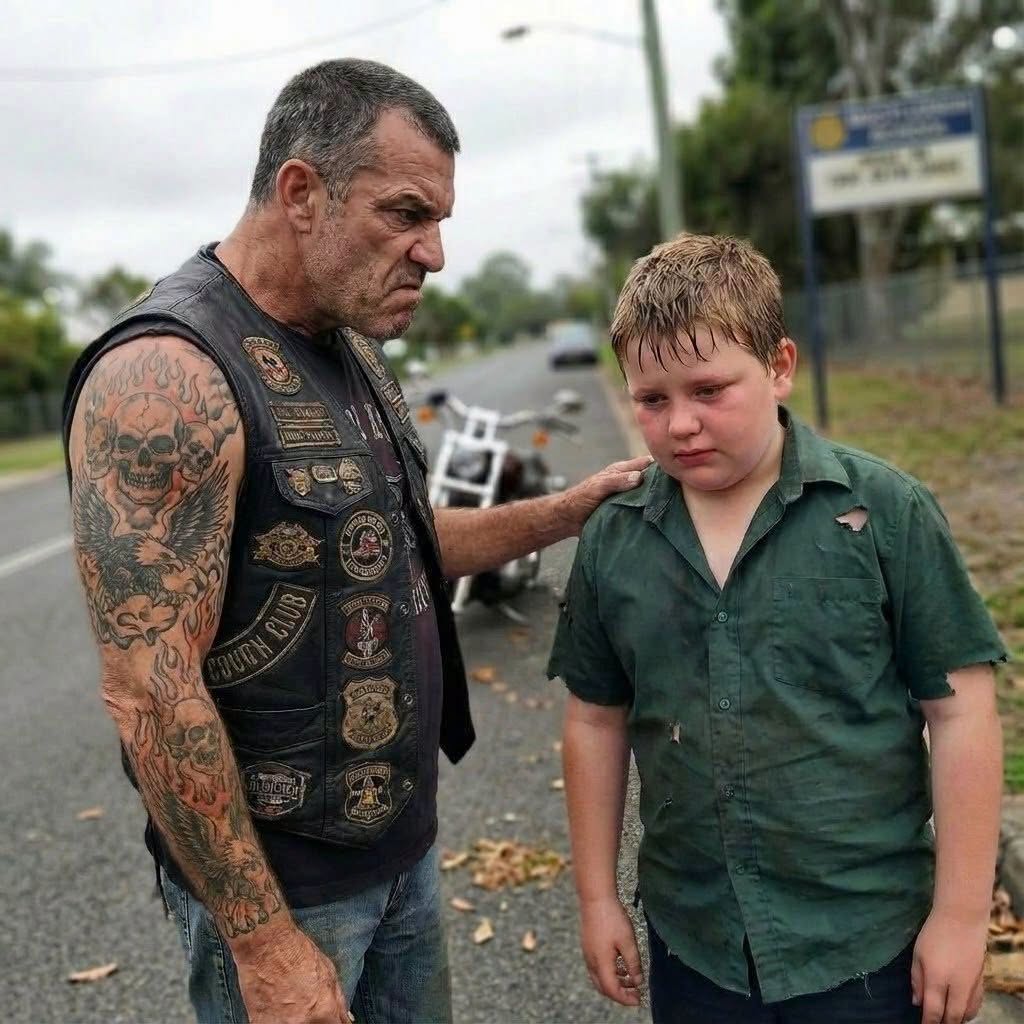
The silence that followed was heavy, broken only by the rush of a semi-truck passing us at sixty miles an hour, shaking the weeds along the ditch. I looked down at Ethan’s small hands still clutched around the leather of my sleeve. His knuckles were raw, caked with dry Rural Route 12 dust, but his grip was iron. He was terrified of the bullies, sure, but he was completely paralyzed by the thought of breaking his mother’s heart.
“Listen to me, Ethan,” I said, putting my hands on my knees so he could see I wasn’t reaching for him. “I’m not going to do anything that makes your mom cry. I promise you that. But you aren’t walking four miles in the ditch today.”
He looked at my bike—a heavy, matte-black Indian Chief with a custom sissy bar—and then back at my gray beard. “Is that yours?”
“Yeah. Her name’s Daisy. She looks mean, but she rides smooth.” I stood up slowly, giving him space to adjust to my height again. “My name’s Big Mike. How about we get you cleaned up a bit, and I give you a lift home? We’ll think of a good story for the torn shirt. Something about a rogue tree branch or a clumsy trip over the bleachers. Deal?”
Ethan hesitated, looking down the long, empty stretch of asphalt, then nodded.
I pulled a clean bandanna and a bottle of water from my saddlebag, letting him pour it over his scraped knuckles to clean out the gravel. I helped him brush the worst of the ditch dirt off his jeans. When he climbed onto the back of the bike, he looked so small he barely took up half the passenger seat.
“Hold onto my vest, buddy. Tight,” I told him over the rumble of the starter.
We rode the four miles to his place in silence. Home turned out to be a small, weathered trailer park tucked behind a grove of pine trees off the main highway. The paint was peeling on his unit, but the small porch had a neat pot of plastic geraniums and a clean welcome mat. His mom’s old sedan wasn’t in the gravel drive; like he said, she was working.
I waited until he got safely inside the door, watched him wave through the screen, and then I turned Daisy around.
But I didn’t head home. I headed straight for the clubhouse of the Reapers MC.
PART 3 – THE REAPER PROTOCOL
The clubhouse was a converted warehouse near the old rail yard, smelling heavily of stale beer, welding smoke, and tire rubber. When I walked in, six of the guys were sitting around the pool table, debating a cylinder head layout.
“You look like you just chewed on a lemon, Mike,” said ‘Preacher,’ our club president, not looking up from his cue stick.
“We got a problem out on Route 12,” I said, slamming my helmet onto the bar. The room went quiet. When a guy my size uses that tone, the jokes stop.
I told them about Ethan. I told them about the two years of dirt, the stolen bus money, the torn shirt, and a ten-year-old kid begging a stranger not to tell his exhausted mom because she already cried every night. By the time I finished, Preacher had set his cue down flat on the green felt. ‘T-Bone,’ a six-foot-four ex-Marine who usually handled our charity runs, was white-knuckling a wrench so hard his tattoos distorted.
“Fifth grade,” Preacher said, his voice dangerously soft. “Which means they’re at Oak Creek Middle.”
“Yeah,” I replied.
“What’s the protocol, boss?” T-Bone asked, leaning over the table. “We going to talk to the principal?”
“Principal won’t do a damn thing but hand out a three-day suspension, and then those punks will catch the kid behind the grocery store on Friday,” Preacher said, walking over to the map on the wall. He looked at me. “Mike, you said he takes the 7:45 AM bus from the corner of the county road?”
“Every morning.”
Preacher turned to the room. “Call the whole chapter. Tell ’em tomorrow morning, we ride early. No colors missing. I want forty bikes at that bus stop by 7:30.”
PART 4 – THE ROADBLOCK
The next morning was crisp, the October fog hanging low over the soybean fields along Rural Route 12.
Ethan stood by the yellow bus sign at 7:35 AM, his hands stuffed deep into the pockets of a jacket that was a size too small. He looked exhausted, his eyes darting toward the horizon where the school bus usually appeared. He was waiting for the three eighth-graders who usually got off the high school transfer bus just to torment him before his own arrived.
Then, the fog began to vibrate.
It started as a low, synchronized growl that grew into a deafening roar. Ethan spun around, his eyes going wide as a wall of chrome and black leather broke through the mist.
Forty motorcycles. Riding two-by-two, headlights cutting through the gray morning like searchlights. We didn’t speed; we rolled in like a disciplined battalion, the thunder of our exhausts filling the empty country air.
I led the pack, pulling Daisy right up to the curb where Ethan stood. Behind me, thirty-nine of the biggest, meanest-looking men in the county kicked down their kickstands in perfect unison. The sudden silence when forty engines died at once was louder than the roar.
Ethan looked terrified for a split second, until I pulled off my sunglasses and gave him a wink. “Morning, Ethan.”
Before he could answer, the orange school bus rumbled around the corner and screeched to a halt behind our wall of bikes. The doors folded open. The bus driver, an older woman named Martha, took one look at forty Reapers standing in a semicircle and went pale, her hand hovering near the emergency radio.
But we weren’t looking at Martha.
Three older boys—thirteen or fourteen, big for their age, wearing oversized sports hoodies—were sitting near the front of the bus, laughing. Their laughs died the instant they looked out the window. One of them actually dropped his phone onto the floorboard.
Preacher walked up to the bottom step of the bus. He didn’t cross the line into the vehicle, but he leaned in just enough so the three boys could read the patch on his chest.
“Morning, boys,” Preacher said, his voice echoing inside the metal frame of the bus. He pointed a massive, scarred finger directly at the three of them. “We know who you are. We know what you’ve been doing to our little brother Ethan here for the last two years.”
The lead bully tried to look tough, but his bottom lip was visibly trembling. “We didn’t do nothing—”
“Shut up and listen,” Preacher interrupted, his tone shifting into something ice-cold. “From today on, Ethan is an honorary member of the Reapers MC. That means if you touch his bag, if you step on his shoes, if you even look at him funny on the playground, you aren’t dealing with a fifth-grader anymore. You’re dealing with all forty of us. We will be at this bus stop every single morning. We will be here when he gets off in the afternoon. Do we understand each other?”
The three boys nodded frantically, their faces entirely drained of color.
Preacher stepped back and looked at Ethan. “Get on up there, brother. Your ride’s waiting.”
Ethan straightened his shoulders. For the first time in two years, his head wasn’t down. He walked past the wall of bikers, his chin up, and stepped onto the bus. As the doors closed, every single kid inside was pressed against the glass, staring in absolute awe.
PART 5 – THE UNEXPECTED GUEST
We kept our word. For three weeks, ten of us rotated shifts, ensuring that whenever that yellow bus pulled up to the corner of Route 12, there was a row of Harleys waiting to receive it. The bullying stopped instantly. In fact, Ethan became the most popular kid in the fifth grade, with half the class asking if they could come over to his house just to see the bikes.
But the real test came on a rainy Friday evening.
I was at the clubhouse helping T-Bone rebuild a carburetor when the front door opened. The rain was drumming hard against the tin roof.
A woman stood in the doorway. She was small, wearing a faded nurse’s assistant uniform, her hair damp from the storm. She looked incredibly tired—the deep dark circles under her eyes told the story of the two jobs Ethan had mentioned. In her hand, she held the silver Reaper challenge coin I had slipped into Ethan’s pocket on that first day.
Behind her, Ethan peeked out from under her arm, looking incredibly nervous.
The room went quiet. T-Bone set his tools down. I wiped my greasy hands on a rag and stepped forward. “Ma’am? Can we help you?”
She looked around the room, taking in the leather, the skulls on the wall, and the large men staring back at her. Her jaw trembled, and for a second, I thought she was going to scream at us for interfering with her son.
Instead, she walked straight up to me, stopped three inches from my chest, and looked up.
“Ethan told me everything,” she said, her voice shaking with an emotion she’d been holding in for years. “He told me about the bruises he hid. He told me about the miles he walked. And he told me what he said to you… about me crying at night.”
I swallowed hard. “Ma’am, we didn’t mean to overstep—”
“He was trying to protect me,” she interrupted, tears finally spilling over her cheeks. “My ten-year-old boy was carrying the weight of this whole world on his back because he thought I couldn’t handle it. And I didn’t even know.”
She reached out and took my large, grease-stained hand between both of hers.
“For two years, I’ve felt completely alone in this town,” she whispered, her grip surprisingly tight. “I thought nobody cared if we drowned out here on the route. But my son came home three weeks ago and told me he had forty big brothers watching his back. I haven’t seen him smile like this since his father left.”
She looked back at Ethan, who was now grinning, before looking back at me.
“I don’t have much,” she said, pulling a large plastic container from her tote bag. “But I baked three dozen cinnamon rolls before my shift started. I wanted to bring them to the men who gave my son his childhood back.”
T-Bone let out a loud, booming laugh, stepping forward to take the container. “Sister, you just became the most popular woman in this clubhouse. Come on in out of the rain.”
That night, the warehouse didn’t feel like a biker garage. We cleared off the pool table, poured her a cup of fresh coffee, and listened as she told us about her schedule and her struggles. By the time she left, the Reapers had already quietly organized a schedule to fix the leaky roof on her trailer, rotate the tires on her sedan, and ensure that Ethan had a sponsored spot in the regional youth baseball league next spring.
As they walked out to their car under the Portland rain, Ethan turned back and gave me a sharp, military-style salute. I returned it, watching the tail lights disappear into the fog.
A lot of people think riding in a club is about the noise, the asphalt, and the freedom of the open road. But standing there on the porch, watching that little car drive away, I knew the truth. Sometimes, the best reason to ride twenty years down the same stretch of road is just to be there at the exact moment one little boy needs a wall of iron to stand between him and the dark.