The Legacy in the Leather
The sun always hits the grocery store parking lot the same way around 6:30 AM—a low, blinding amber that cuts right through the exhaust of my truck. For three years of my teenage life, that light was my enemy. It meant the end of sleep, the end of my weekend, and the beginning of another grueling day standing by a folding table while the rest of the world lived their lives.
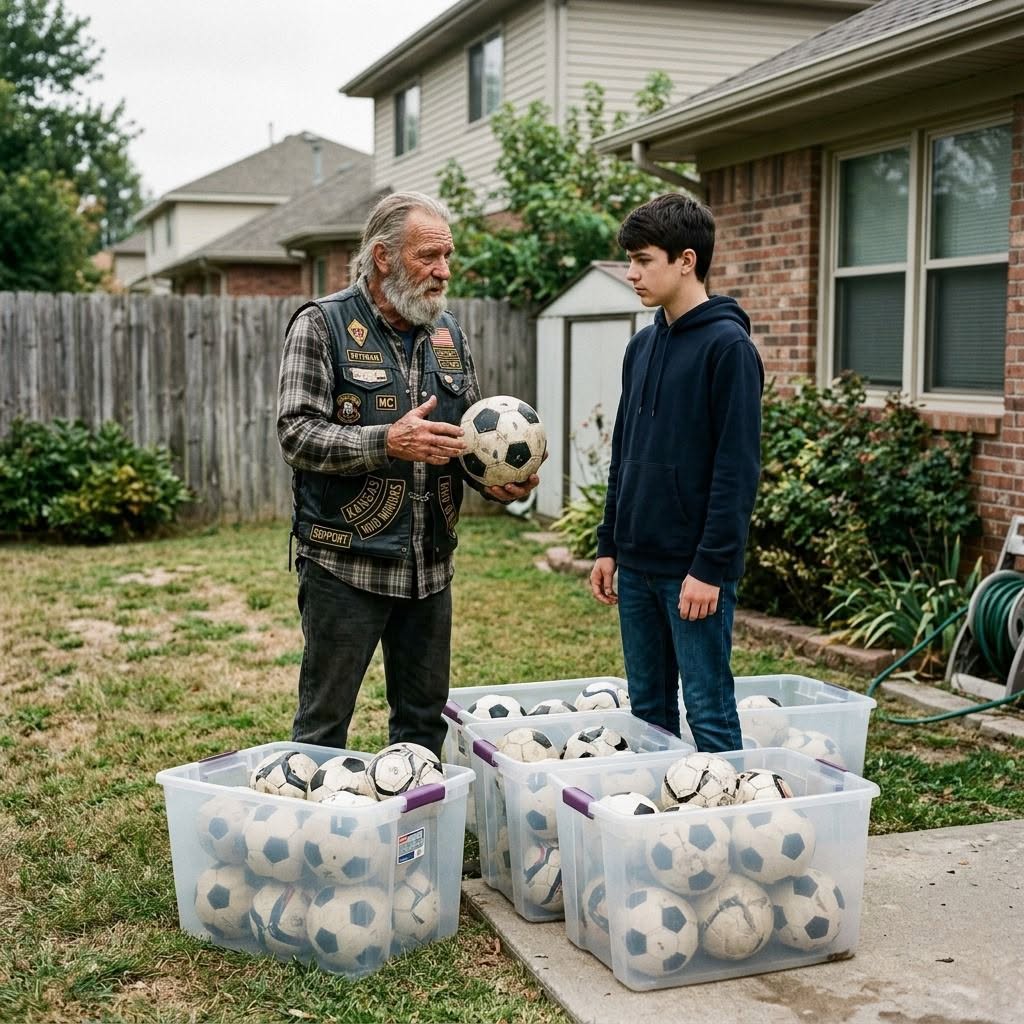
My dad, Marcus “Mack” Vance, didn’t care about the sun, the heat, or my teenage attitude. He was a mountain of a man, built like a brick wall, with grease permanently etched into the lines of his knuckles and a graying beard that made him look like he belonged on a billboard for a heavy-duty wrench company. On his back, he wore the colors of the Highway Kings—a local motorcycle club that most people in our conservative suburb crossed the street to avoid.
But to me, on those mornings, he wasn’t a fierce biker or a community savior. He was just the man forcing me to sell five-dollar soccer balls.
“Grab the other end of the table, Leo,” he’d grunt, his voice a low rumble that competed with the idling engine of his F-150.
“Dad, it’s raining,” I muttered one October morning, shivering inside my hoodie. “Nobody is buying sports equipment in a downpour.”
“Water wipes off, kid,” he said, pulling a blue plastic tarp over our inventory. “Set the sign.”
The sign. It was a piece of thick, white poster board he’d nailed to two wooden stakes. In bold, black sharpie, written in his blocky, no-nonsense handwriting, it read: EVERY KID DESERVES TO PLAY.
I hated that sign. I hated the way people looked at us—some with pity, assuming we were desperately poor and selling junk to get by; others with suspicion, wondering why a giant biker in a leather vest was hovering over a pile of deflated and re-inflated sports gear.
What I didn’t see back then was the work that happened between Sundays and Fridays.
The Secret Life of the Garage
Our garage didn’t smell like a normal garage. It didn’t just smell like motor oil and gasoline; it smelled like heavy-duty rubber cement, leather conditioner, and industrial soap.
Every weeknight after his shift at the diesel mechanic shop, Dad would head out to the garage. I’d hear the low hum of his air compressor kicking on at 9:00 PM. If I peeked through the door, I’d see him hunched over a workbench illuminated by a single, harsh halogen bulb.
His massive, calloused hands—hands that could rip a motorcycle engine apart—were incredibly gentle with the balls.
He’d submerge them in a bucket of soapy water, watching for the telltale hiss of bubbles that betrayed a puncture.
He’d use a curved leather needle to meticulously restitch seams that had burst from too many strikes against concrete walls.
He’d replace dried-out rubber valves, using a specialized tool he’d welded himself.
Finally, he’d scrub off the grass stains, the scuffs, and the names of kids who had long outgrown them, written in faded marker on the leather panels.
They came from everywhere. Thrift store bins, garage sales where people practically begged him to take them, and anonymous boxes dropped off at the Highway Kings’ clubhouse. To me, they were trash. To him, they were a ledger waiting to be balanced.
“Why soccer balls?” I asked him once, genuinely annoyed because the smell of the rubber cement was drifting into my bedroom. “Why not footballs? Or basketballs?”
Dad didn’t look up from his stitching. “Basketball needs a hoop, Leo. A court. Pavement. Football needs gear, coaching, a whole squad just to run a play. You know what you need for soccer?” He held up the ball, pulling the thread tight with a sharp snap. “A ball. And space. You can play it in an alley, a dirt lot, a backyard. You can play it alone against a brick wall or with twenty people. It’s the most honest game there is. No barriers.”
“Whatever,” I muttered, slamming the door. “It’s still five bucks.”
The Saturday That Broke the Script
By the time the middle of July rolled around during my junior year, my resentment had peaked. The heat index was hitting 102 degrees by noon. The asphalt of the grocery store parking lot was radiating waves of dizzying heat, and my sneakers felt like they were melting.
I was completely checked out, staring at my phone, hiding under the small shadow of our pop-up canopy. We had sold exactly three balls in four hours. Fifteen dollars.
“This is a waste of time,” I whispered, loud enough for him to hear.
Dad didn’t answer. He was sitting on a cooler, wiping sweat from his forehead with a bandana, his eyes scanning the parking lot. He had an uncanny ability to just exist in discomfort without complaining.
That’s when they walked up.
The family looked like they had walked through the same heat we were sitting in. The mother was young, but her shoulders were hunched with a heavy, invisible exhaustion. She held the hand of a little girl who looked about four, while her son, a boy of seven with scraped knees and worn-out sneakers, lagged a step behind.
The boy stopped dead in his tracks when he saw our table.
We had a particular ball right at the front—a classic black-and-white patch design, but Dad had conditioned the leather so well it shone like a mirror. The boy’s eyes went wide. He didn’t just look at it; he revered it. He took two steps forward, his hands twitching at his sides, looking at his mother for permission.
The mother sighed, a sound of deep internal calculation, and stepped up to the table. Her eyes immediately went to the sign: $5.00.
She opened a small, frayed cloth purse. I watched—actually looked away from my phone for once—as she began pulling out bills. A crumpled single. Another single. Then she started digging into the bottom of the bag, pulling out quarters, dimes, nickels. She began arranging them on the edge of our folding table, her fingers trembling slightly from the heat or something else.
One dollar… two dollars… three dollars… three-fifty…
She stopped. She turned the purse upside down. A lone penny rolled out.
My dad had been watching her hands the entire time. He didn’t look at the money. He looked at her face—the tight line of her jaw, the way she was trying to swallow down the reality of being a dollar and forty-nine cents short of a toy for her son.
“Take one,” Dad said. His voice wasn’t loud, but it had that gravelly finality to it.
The woman snapped her head up, a quick, defensive pride flashing in her eyes. “No, thank you. I can pay. I just… I have change in the car, I think. Let me just look.”
Dad gently reached out and pushed the small pile of coins back toward her side of the table. “It’s free, ma’am. Take the black-and-white one. The bladder’s brand new. It’ll hold air all summer.”
The boy didn’t wait. He scooped the ball into his arms, hugging it against his chest like it was made of solid gold.
The woman froze. She looked down at the money, then at her son, and then her gaze traveled up my father’s massive frame. She looked past his gray beard, past his gruff exterior, and her eyes locked onto the leather vest he wore. Specifically, the large, embroidered patch on the back: HIGHWAY KINGS MC.
The defensive pride in her face shattered. It didn’t just soften; it completely broke apart.
Before either of us could react, her knees gave out. She didn’t fall—she dropped, deliberately, right onto the hot asphalt, burying her face in her hands as deep, chest-heaving sobs took over her entire body.
I panicked. I thought she was having a heat stroke. “Dad, get some water from the cooler!” I yelled, stepping around the table.
But Dad didn’t get the water. He didn’t hesitate. He dropped down into the dust right next to her, his heavy leather vest creaking, his large hand hovering just an inch above her shaking shoulder, giving her space but letting her know he was there.
“Hey,” Dad said, his voice dropping into a register I had never heard before—soft, steady, and entirely devoid of his usual gruffness. “Hey, it’s alright. What’s going on? Talk to me.”
The woman wiped her eyes with the back of her wrist, her face streaked with tears and dust from the parking lot. “My brother…” she whispered, her voice cracking. “He… he rode with your club. He wore that same patch.”
Dad’s frame went incredibly still. The casual posture disappeared, replaced by a rigid, profound respect. “What was his name, sister?”
“Michael Harris. They called him ‘Hare.'”
I watched my father’s face closely. I had never seen him look vulnerable, but in that split second, a wave of pure, unadulterated grief passed over his features, followed quickly by a look of fierce recognition.
“Hare,” Dad whispered. “Michael was a good man. A hell of a road captain. We lost him six years ago down on Route 9.”
“Six years ago,” the woman nodded, fresh tears spilling over. “My husband died less than a year after that. We lost our house. I had a newborn and a three-year-old. I had absolutely nothing. No savings, no family left, nowhere to go.”
She looked up at me, then back at my dad, pointing a trembling finger at the club colors on his chest.
“Your club paid my rent for three months,” she said, her voice rising so that people passing by stopped to look. “You didn’t even know me. Two guys from the clubhouse showed up at my motel room with an envelope of cash. They bought groceries every week for a season. One of your guys—a mechanic named Big John—fixed my transmission for free so I could get to job interviews. You made sure my kids had Christmas trees and presents under them when I was sleeping on a mattress on the floor.”
She looked at her son, who was now sitting on the curb, spinning the soccer ball in his hands, completely mesmerized.
“You saved us,” she said flatly.
Dad shook his head, his eyes cast down toward the asphalt. “No, sister. We didn’t save anybody. We just helped a brother’s family. That’s the rule. We look after our own.”
“No,” she insisted, grabbing his massive forearm. “You saved us. My son played his very first youth soccer league season last year because an anonymous check showed up at the community center to cover his registration and his cleats. The director told me it came from the ‘Biker Ball Fund.’ I didn’t know what that meant until right now.”
She looked up at me, her eyes red but incredibly bright. “Your father never told you?”
I stood there, paralyzed, the July heat completely forgotten. I looked at the table. I looked at the fifty or sixty soccer balls neatly arranged under the tarp. I looked at the faded sign.
EVERY KID DESERVES TO PLAY.
“Those soccer balls?” she said, laughing softly through her tears as Dad helped her back to her feet. “The money doesn’t stay here, young man. Your dad isn’t selling junk for pocket change.”
I turned my head slowly toward my father. “Dad… where does the money go?”
Dad rubbed the back of his neck, suddenly looking very uncomfortable, like a man caught doing something he was desperately trying to keep a secret.
“School supplies,” he muttered, looking away. “Backpacks. Calculators. Sometimes sports registration fees when the county cuts the funding. Sometimes we pay a utility bill for a family so the city doesn’t turn their water off during August. It depends on who calls the clubhouse.”
The woman stood up, straightened her shirt, and pulled her children close. Before she left, she did something I had never seen anyone do to my giant, intimidating father: she threw her arms around his neck and hugged him with everything she had. Dad stood there, a bit stiffly, but he patted her back with a hand that looked big enough to cover her entire spine.
As they walked away, the little boy turned back, holding the soccer ball high above his head like a trophy. “Thank you, biker man!” he shouted.
Dad just waved, a small, genuine smile cutting through his beard.
The Architecture of a Legacy
That afternoon, the ride home in the truck was completely silent. The radio wasn’t on, and for the first time in three years, I didn’t complain about the heat, the sweat, or the boredom.
When we got back to the house, Dad started unloading the unsold balls into the garage. I didn’t go inside to play video games. I picked up a crate and followed him.
“How many years have you been doing this?” I asked, setting the crate down by his workbench.
“Since Michael passed,” Dad said, pulling a punctured ball from the bottom of the box. “He was a kid who grew up in the foster system. Told me once that the only time he ever felt like he belonged somewhere before the club was when he was on a middle school soccer field. Said nobody cares who your parents are or how much money you have when you’re running down a wing. When he died, I realized how many kids out there are sitting on porches, watching other kids play because their parents can’t swing the fifty-dollar league fee or the twenty bucks for a ball. It didn’t sit right with me.”