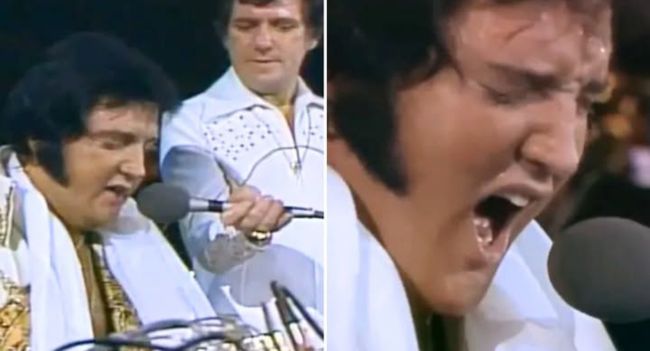
Music history is often defined by moments that seem ordinary at first—a song on the radio, a chance encounter, or a single performance that changes everything. One such moment reportedly came when Frank Sinatra, already one of America’s biggest stars, heard a young Elvis Presley on the radio.
What happened next has become part of music legend.
According to the story, Sinatra immediately recognized that something was different. The raw energy, the unmistakable voice, and the fresh sound stood in stark contrast to the polished crooners who had dominated popular music throughout the 1940s and early 1950s.
Legend has it that Sinatra picked up the phone and called his manager with a simple but powerful message:
“Everything is about to change.”
Whether those exact words were spoken has never been definitively confirmed, but they perfectly capture the seismic shift taking place in American music.
A New Sound Takes Over
By the mid-1950s, rock and roll was no longer a niche style. It was becoming a cultural movement, and Elvis Presley was its most recognizable face.
Blending country, rhythm and blues, gospel, and rockabilly, Elvis created a sound unlike anything mainstream audiences had experienced. His recordings didn’t just top the charts—they introduced a new generation to a completely different musical identity.
His performances were equally revolutionary. The charisma, the confidence, and the electrifying stage presence captivated young fans while shocking many older listeners.
Sinatra Saw the Shift
Frank Sinatra wasn’t just a singer—he was one of the smartest observers of the entertainment industry.
He had survived changing musical trends before, adapting from the big-band era into becoming one of the greatest solo vocalists of all time. When someone with Sinatra’s experience recognized Elvis’s impact, it spoke volumes.
Although Sinatra would later criticize rock and roll in interviews, describing it as a passing fad and questioning its musical value, he also acknowledged Elvis’s extraordinary popularity and influence.
In fact, by 1960, Sinatra welcomed Elvis onto The Frank Sinatra Timex Show, one of television’s biggest variety specials. The appearance symbolized more than entertainment—it represented two generations of American music sharing the same stage.
More Than a Rivalry
It’s tempting to frame Sinatra and Elvis as rivals, but the truth is more nuanced.
Sinatra represented elegance, vocal precision, and the classic American songbook.
Elvis embodied youthful rebellion, cultural change, and the explosive rise of rock and roll.
Rather than replacing Sinatra, Elvis expanded the possibilities of popular music. Both artists became defining voices of their respective generations, leaving legacies that continue to inspire musicians around the world.
A Turning Point in Music History
Whether Sinatra actually uttered the famous phrase or not, the sentiment rings true.
The arrival of Elvis Presley marked one of the greatest turning points in modern music. The rules changed overnight. Radio playlists evolved. Record sales exploded. Teenagers became the driving force behind the music industry, and rock and roll became a global phenomenon.
Few artists have altered the course of popular culture as dramatically as Elvis Presley.
And if Frank Sinatra really did hear that song on the radio and realize what was coming, he witnessed one of the most important moments in entertainment history—the instant the future of popular music announced itself through a young singer from Memphis.