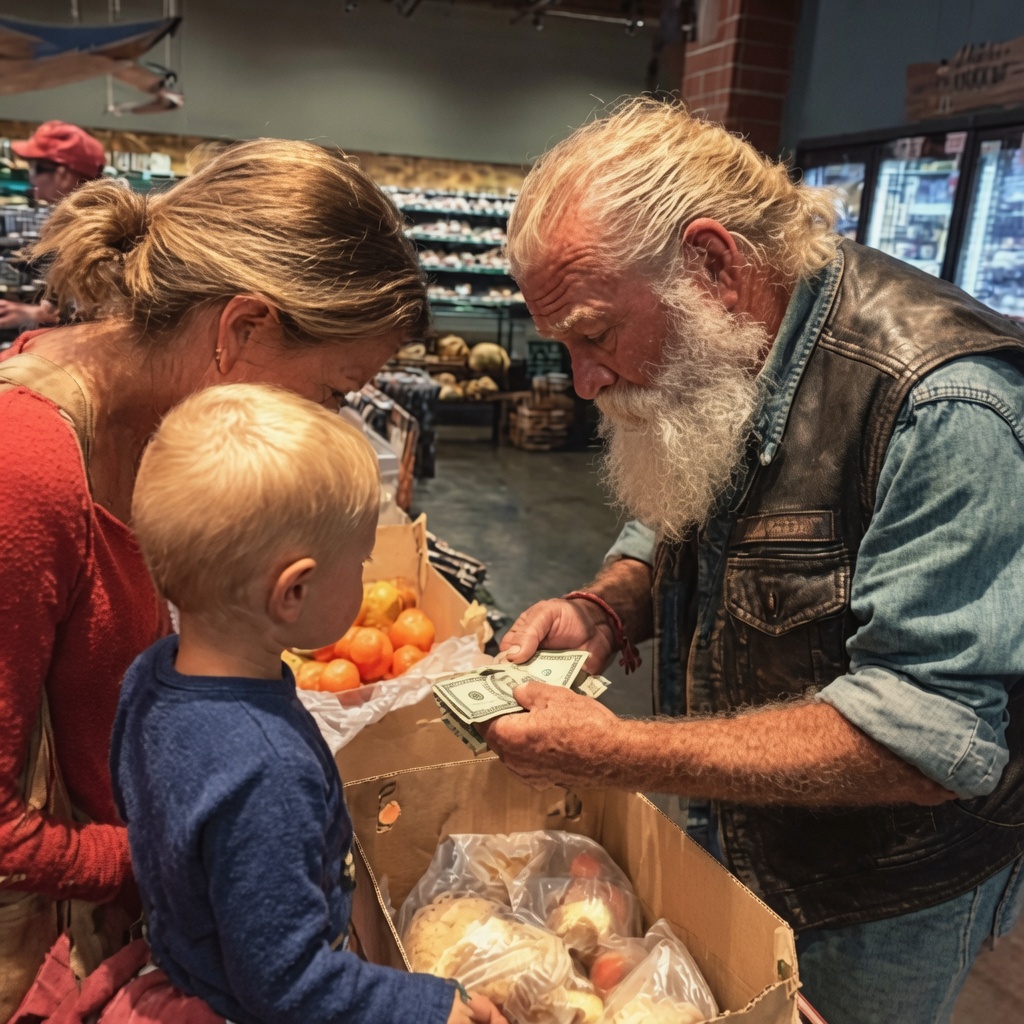
The low, throaty growl of the 1987 Honda Gold Wing rolled into the parking lot of Riverside Grocery like distant thunder every Tuesday at exactly 3:00 p.m. In the small river town of Willow Creek, people had started setting their watches by it. The rider killed the engine, swung off the big touring bike with the ease of a man who had spent a lifetime in the saddle, and hung his helmet on the mirror. Salt-and-pepper beard, faded leather vest over a flannel shirt, scuffed boots. No patches. No colors. Just a quiet man who walked the aisles like he was on a mission.
Nobody knew his name. The cashiers called him the Tuesday Guy.
He never bought much for himself—day-old bread, the cheapest canned soup, instant coffee, sometimes a single pack of ramen. But his eyes, the color of old river stone, were always moving, scanning the checkout lanes for the moment shoulders slumped and a cart started losing items.
Maria Santos felt those eyes on her one sweltering July Tuesday. Single mother of three, cart holding the cheapest possible version of survival: powdered milk, generic peanut butter, a small tray of chicken thighs on manager’s special, and a box of cereal her middle child had begged for. The total flashed $92.17. Maria’s face went hollow. She began pulling things out, voice tight.
“The chicken goes back. And the cereal. We’ll do oatmeal again.”
The young cashier had already started scanning reversals when a weathered hand, gentle but immovable, covered the scanner.
“Put it all back in,” the deep voice said. The Tuesday Guy stood beside her now, wallet open, the faint smell of leather, road dust, and motor oil drifting off him. “Every bit of it. I’ve got this.”
Maria’s eyes filled. “Sir, please, I can’t—”
“You’re not asking,” he said, and the smile that touched his eyes was soft enough to break something in her chest. “I’m just paying for groceries. Happens every week.”
He slid two hundred-dollar bills across the counter. “Keep the change for her next visit.”
By the time Maria turned to thank him properly, the automatic doors were already hissing shut behind him. The Gold Wing fired up and vanished down the highway before she could even reach the parking lot.
It happened again the next Tuesday. And the Tuesday after that. An elderly couple whose Social Security check had come up short. A twenty-something dad whose debit card declined on diapers and formula while his baby screamed in the cart. A high-school kid buying nothing but bread, bologna, and milk, counting crumpled singles with shaking hands because his mom was too sick to work.
Each time the same quiet ritual: the Tuesday Guy appeared, paid, offered a few steady words, and was gone before gratitude could catch him.
Store manager Elena Vargas started keeping a private tally on her phone. In four months the man had covered more than eight thousand dollars in other people’s groceries. His own purchases never cleared twelve bucks.
“He’s spending everything,” she whispered to her assistant manager one night while reviewing security footage. “Everything except what keeps him alive until the next Tuesday.”
Then the Tuesdays stopped.
The Gold Wing’s usual parking spot sat empty for three weeks. Regulars began asking at customer service. Maria Santos showed up with her kids specifically to thank him. Hank Thompson, the seventy-year-old Korean War vet the Tuesday Guy had once helped, stood at the register looking lost.
Elena tried the phone number on file—disconnected. She called in a favor at the DMV she knew could cost her later. The name that came back was James “Jimmy” Harlan, seventy-two, Vietnam Marine, two tours. Last known address: lot 19, River’s Edge Trailer Park.
She sent a message to every person she could remember the Tuesday Guy helping—twenty-eight names. “The man who paid for your groceries needs help now. Saturday, 2 p.m., Riverside Grocery. Please come if you can.”
Then she drove to the trailer park.
River’s Edge looked like the edge of something that had already given up—rusted single-wides, sagging porches, weeds tall enough to hide a dog. Lot 19 had a small, tattered American flag and a faded Marine Corps decal on the window. Elena knocked. Nothing. Knocked again, harder.
A screen door opened on the neighboring trailer. An older woman in a faded housecoat stepped out, arms crossed.
“You looking for Jimmy?”
“Yes, ma’am. Is he—”
“VA hospital in Millbrook. Been there five weeks. Cancer. They told him six months back in May.” The woman’s voice softened. “He said if he only had that long, he wanted every day to matter. Didn’t see the point in dying with money in the bank when folks right here were choosing between food and medicine.”
Elena felt the air leave her lungs. “May? That’s when he started coming every single Tuesday—”
“Spending every dime he had on strangers,” the woman finished. “Proud old Marine. Lost his wife ten years ago. No kids. Figured the best way to check out was quiet, doing what felt right. Helping people was the only medicine he wanted.”
Elena drove straight to the VA. Room 214 smelled of antiseptic and old coffee. Jimmy lay propped against pillows, thinner, oxygen line under his nose, but the storm-cloud eyes were still sharp. His leather vest hung on the back of a chair. The Gold Wing key rested on the nightstand like a talisman.
He saw her uniform and gave a weak chuckle. “Missed my shift, didn’t I?”
“Three of them,” Elena said, sitting close. “Jimmy, why didn’t you tell anyone you were sick?”
“What was I supposed to say? ‘Hey, I’m dying, mind if I buy your milk?’” He shook his head. “Better this way. Felt good. Like I still had a job to do.”
She told him about the people asking for him. His eyes glistened, but he looked away. “They got fed. That’s enough.”
It wasn’t. Not anymore.
Saturday at 2 p.m. the parking lot of Riverside Grocery filled with the low thunder of motorcycles and the quieter sound of car doors closing. Twenty-eight people he had helped showed up. Another hundred came because the local radio station had run the story. Three different motorcycle clubs rolled in together—chrome, leather, and respect. News vans from two counties parked at the edge of the lot.
Maria Santos stood near the entrance with her three kids, clutching an envelope that contained every extra dollar she had earned in overtime. Hank Thompson had brought two hundred in cash. The young father whose formula Jimmy had once paid for stood with his wife and baby, a check already written.
Elena stepped onto a milk crate. The crowd quieted.
“The man who helped most of you never asked for anything,” she said, voice steady. “He’s dying. And he’s doing it the same way he lived these last months—quietly, and broke. We’re not here to pity him. We’re here to finish what he started.”
For a long moment no one moved. Then Maria’s oldest boy stepped forward and placed the envelope on the folding table they had set up. The sound of that small envelope hitting the plastic was like a starting gun.
After that the donations came in a flood—cash, checks, even a local contractor who wrote a check for five thousand dollars on the spot. The motorcycle clubs pooled fifteen thousand between them. By the time the sun dropped behind the river, Elena had counted $112,000.
She used it the way Jimmy would have wanted. Paid the lot fees on his trailer for the next five years. Arranged round-the-clock hospice care. Bought a hospital bed and a lift chair so he could die at home if he chose. The rest went into an account labeled simply “Harlan’s Tuesdays.”
When she returned to the hospital with Maria, Hank, the young father, and a dozen others, Jimmy’s room could barely hold them all.
He tried to wave it off at first, that old Marine pride flaring. “I don’t take charity. I give it.”
Then Maria’s youngest climbed onto the edge of the bed and handed him a crayon drawing of a big motorcycle surrounded by hearts. Jimmy stared at it for a long second. His shoulders started to shake. The tears came hard and silent.
“You didn’t just buy food,” Elena told him, showing him the deposit slip. “You bought a promise. And we’re keeping it.”
Jimmy Harlan lived another eight months, stubborn as the machine he rode. Most of those months he spent in his trailer, the one now paid for and clean, with nurses rotating through and the Gold Wing parked right outside the window so he could see it. Every Tuesday at 3 p.m. Elena called or came in person with a list.
“Family of five, dad just lost his job, short sixty-eight dollars on the basics.”
“Cover it,” Jimmy would say from his recliner. “And add some fresh fruit. Kids need that.”
“Elderly man buying only cat food and crackers.”
“Cover it double. Ask if he’s got a way home.”
The fund grew instead of shrinking. Other grocery stores in the county started their own versions. Jimmy got to hear about every single one.
In his last weeks he was mostly bedridden, but on good days the Savage Sons MC would roll up, polish the Gold Wing until it gleamed, and sit with him on the tiny porch while he told quiet stories about Vietnam and the wife he had buried. On the very last Tuesday he was strong enough to sit outside, oxygen tank beside him, and watch the sun drop over the river.
He died in early spring, the American flag from his trailer draped over the simple coffin. Twenty-seven bikers who had never met him formed an honor guard. Dozens of people whose names he had never known stood in the small cemetery.
The minister who had never met Jimmy either spoke for less than two minutes.
“James Harlan was a Marine who served his country. A husband who loved his wife. A biker who rode alone. In his final months he became something rarer—he became proof that one ordinary person with a generous heart can change the world one grocery cart at a time. He thought he would die forgotten. He was wrong.”
Today, right inside the automatic doors of Riverside Grocery, a simple bronze plaque reads:
In Memory of James “Jimmy” Harlan – The Tuesday Guy
1952–2026
He came. He saw need. He paid it forward.
Every Tuesday at 3:00 p.m., the kindness continues.
And it does. A different person is chosen each week to be “The Tuesday Person.” They watch the lines. When someone starts putting items back, they step forward.
“I’m covering this,” they say, exactly the way Jimmy did.
“No explanations needed. It’s just what we do on Tuesdays.”
Because Jimmy Harlan didn’t leave behind money or monuments.
He left behind a chain of Tuesdays that never stopped multiplying.
And somewhere, an old Marine who once believed he would die alone is resting easy, knowing his last dollars bought something that outlived him by years, and miles, and hearts.
He made sure other people could eat.
And in doing so, he made sure he would never be forgotten.