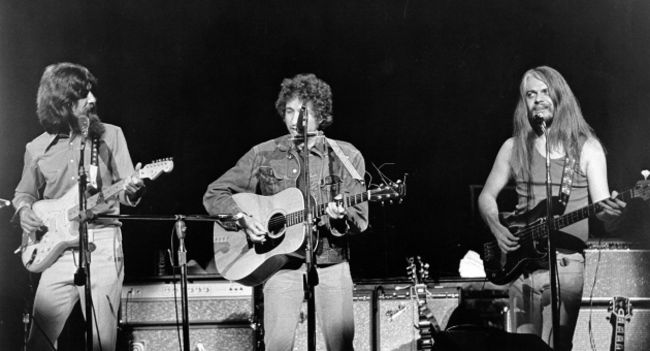
Few songwriters have shaped modern music like Bob Dylan. Across more than six decades, his catalog has inspired generations of artists while earning him countless accolades, including the Nobel Prize in Literature. Yet Dylan has often downplayed the idea that his songs sprang solely from his own imagination.
Instead, he has repeatedly described songwriting as something closer to receiving than creating. In interviews throughout his career, Dylan has spoken about songs arriving unexpectedly—as if they were gifts from an unseen source rather than products of deliberate craftsmanship.
Whether listeners interpret his comments as spiritual, mystical, or simply poetic, Dylan has consistently maintained that some of his greatest works came through him, not from him. Here are five songs that reflect that remarkable belief.
1. “Blowin’ in the Wind” (1962)
One of Dylan’s most enduring anthems, “Blowin’ in the Wind,” seemed to arrive almost effortlessly. Dylan has often expressed surprise at how quickly songs like this came to him during his early creative peak.
Rather than describing the song as something he carefully constructed, Dylan suggested it appeared almost fully formed. The questions at the heart of the song—about peace, justice, and human dignity—have resonated across generations, giving the impression that the song belonged to something much larger than its author.
2. “Mr. Tambourine Man” (1965)
Dreamlike and mysterious, “Mr. Tambourine Man” remains one of Dylan’s most enigmatic compositions. Fans have spent decades debating its meaning, but Dylan himself has rarely offered straightforward explanations.
Instead, he has suggested that songs like this emerged from somewhere beyond conscious thought. Rather than analyzing every lyric, Dylan has encouraged listeners to experience the song as it came to him—intuitively and without overthinking its origins.
3. “Like a Rolling Stone” (1965)
Widely regarded as one of the greatest rock songs ever recorded, “Like a Rolling Stone” transformed popular music with its biting lyrics and revolutionary sound.
Dylan has recalled that the song began as a lengthy piece of writing before suddenly revealing itself as a song. He described the process as less about invention and more about discovery, as though the finished work had been waiting to emerge on its own.
The song’s explosive energy and emotional honesty continue to make it one of the defining moments in rock history.
4. “Visions of Johanna” (1966)
Often cited by critics as one of Dylan’s lyrical masterpieces, “Visions of Johanna” unfolds like a surreal stream of consciousness.
Its vivid imagery and elusive storytelling have inspired endless interpretations, but Dylan has resisted assigning definitive meanings. Instead, his comments about songwriting suggest that lyrics such as these surfaced from a place beyond ordinary reasoning—a creative current he simply followed rather than controlled.
5. “Every Grain of Sand” (1981)
Perhaps no Dylan song better reflects his spiritual outlook than “Every Grain of Sand.” Written during a deeply reflective period of his career, the song explores faith, doubt, redemption, and humanity’s place in the universe.
Dylan has spoken of moments when songs seemed to arrive through inspiration rather than calculation, and many fans view “Every Grain of Sand” as one of the clearest examples. Its poetic language and quiet wisdom give the impression of an artist listening as much as writing.
Dylan’s View of Inspiration
Throughout his career, Bob Dylan has challenged the conventional idea of artistic genius. Rather than presenting himself as the sole architect of his songs, he has often suggested that creativity is something mysterious—an experience of receiving rather than manufacturing ideas.
In a well-known interview with CBS’s Ed Bradley for 60 Minutes in 2004, Dylan reflected on his early songwriting period by saying he could write those songs then because he was “holding the keys,” adding that he no longer knew how to do it in the same way. The comment reinforced his long-held belief that inspiration isn’t something an artist can simply summon at will.
Whether one views these statements as spiritual conviction, artistic humility, or metaphor, they offer a fascinating glimpse into how one of history’s greatest songwriters understood his own work. For Dylan, some of his most celebrated songs weren’t entirely his own—they simply found him at the right moment.