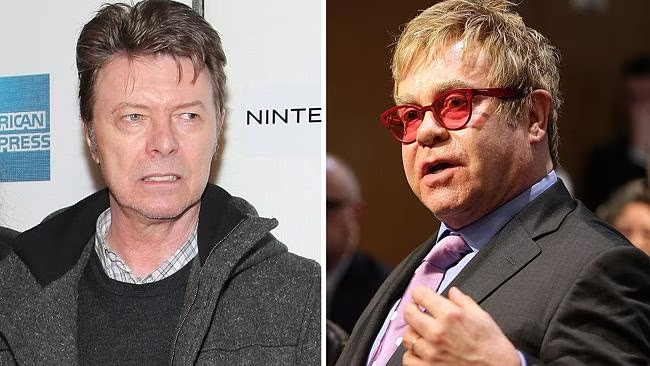
For decades, two of Britain’s greatest musical icons—David Bowie and Elton John—stood at the pinnacle of rock and pop music. Both were flamboyant, groundbreaking, and fearless in reinventing themselves. To fans, they seemed like natural allies who shared a similar journey through the glamorous 1970s music scene.
Behind the scenes, however, the relationship between Bowie and Elton John was far more complicated.
What began as mutual admiration gradually turned into one of rock’s most fascinating hidden rivalries—a tension that remained largely out of the public eye for nearly three decades.
A Friendship That Never Fully Blossomed
In the early 1970s, both artists were redefining popular music. David Bowie shocked audiences with his Ziggy Stardust persona, while Elton John was dominating charts with hit after hit, becoming one of the world’s biggest entertainers.
Although they occasionally crossed paths and respected each other’s immense talent, they were never particularly close friends. Their personalities differed dramatically. Bowie was often described as reserved, intellectual, and constantly experimenting with new artistic directions. Elton, on the other hand, was outspoken, emotional, and openly competitive.
As their careers soared, subtle tensions began to emerge.
Elton John’s Harsh Criticism of Bowie
Unlike many musicians who carefully avoided criticizing fellow legends, Elton John was remarkably candid whenever David Bowie came up in interviews.
Over the years, Elton described Bowie as “not a nice person” and accused him of being distant and difficult. He even suggested that Bowie wasn’t interested in maintaining genuine friendships, preferring instead to cultivate an air of mystery.
One of Elton’s most memorable criticisms came after Bowie released Let’s Dance in 1983. Elton admitted he enjoyed the album but felt Bowie had abandoned the experimental creativity that made him unique.
In Elton’s eyes, Bowie had traded artistic innovation for commercial success.
Bowie’s Quiet Response
Interestingly, David Bowie almost never responded publicly.
Rather than escalating the feud through interviews or media appearances, Bowie remained largely silent. Friends and collaborators noted that Bowie rarely discussed Elton John, choosing instead to focus on his own music and evolving artistic vision.
His refusal to engage only deepened the mystery surrounding their relationship.
Many fans interpreted Bowie’s silence as indifference, while others believed he simply preferred not to fuel unnecessary drama.
Two Very Different Approaches to Fame
Part of the rivalry stemmed from how each artist viewed celebrity.
Elton embraced superstardom. He loved performing, interacting with audiences, and living life in the spotlight.
Bowie viewed fame more cautiously. Throughout his career, he repeatedly reinvented himself, often stepping away from public attention just as his popularity peaked.
Their contrasting philosophies made it difficult for either artist to fully understand the other.
Respect Beneath the Tension
Despite Elton’s criticisms, there were always signs of mutual respect.
Elton never questioned Bowie’s extraordinary talent or his influence on popular music. Likewise, Bowie acknowledged Elton’s incredible songwriting abilities and commercial achievements.
They simply approached music—and life—from very different perspectives.
The rivalry was less about hatred and more about personality, artistic philosophy, and two enormous creative egos operating in the same era.
The Years After Bowie’s Passing
When David Bowie died in January 2016 after a private battle with cancer, Elton John put aside decades of criticism.
He publicly paid tribute to Bowie, calling him “a great star” and praising his immense contribution to music. Elton also reflected on Bowie’s originality, describing him as one of the most important artists of his generation.
It was a reminder that even complicated relationships can be built on deep admiration.
A Rivalry That Shaped Rock History
The relationship between David Bowie and Elton John remains one of rock music’s most intriguing stories. They were never bitter enemies, yet they were never true friends either.
For nearly 30 years, their quiet rivalry unfolded through occasional interviews, contrasting careers, and unspoken competition rather than public confrontations.
In the end, both men changed the course of popular music in their own unique ways. Bowie’s fearless experimentation inspired generations of artists to push creative boundaries, while Elton John’s timeless songwriting and electrifying performances made him one of the best-selling musicians in history.
Sometimes, the greatest rivalries aren’t the loudest—they’re the ones that quietly unfold behind the curtain, leaving behind a legacy as compelling as the music itself.