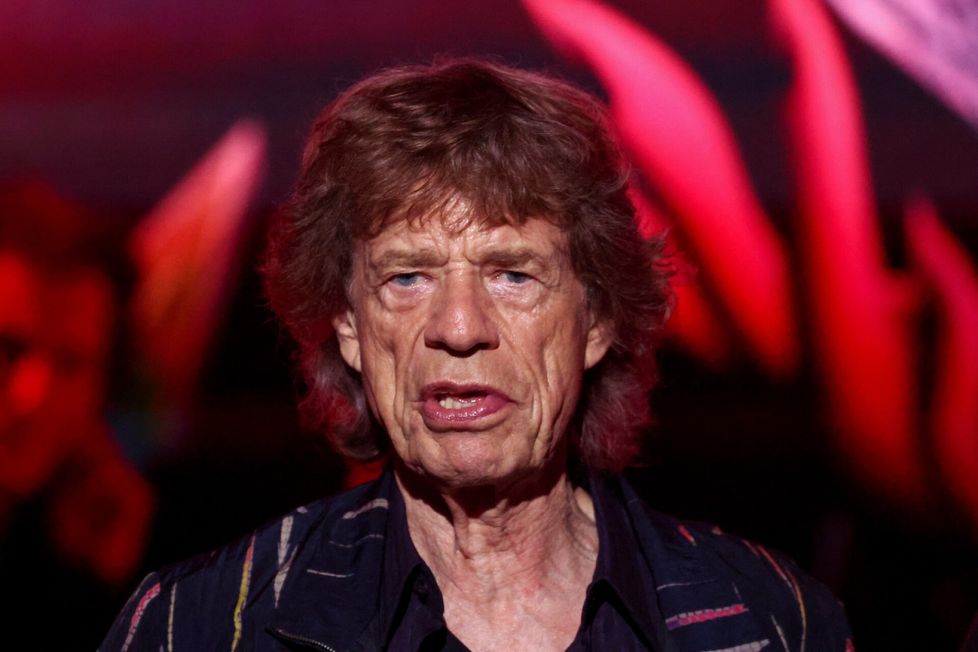
Mick Jagger has been imitated by more performers than almost any other rock musician alive — the strut, the lip, the way he occupies a stage as though it was designed specifically for him and could not fully function without him. What is less discussed, and what Jagger himself has addressed in interviews with more directness than the mythology of original genius usually allows, is the specific person whose stage presence Jagger studied, imitated, and internalized before it became his own.
The person was James Brown. The moment was 1963. The location was a concert in London that Jagger attended before the Rolling Stones had released their debut single, before he was famous, before the swagger was something the public had witnessed or associated with him. He was in the audience as a paying customer, a twenty-year-old music obsessive who had spent his adolescence absorbing American R&B records with the specific hunger of someone who understood that what was on those records was what he wanted to do and that he had not yet figured out how.
James Brown walked onto the stage and Jagger watched what happened for the following two hours with the attention of someone who is not watching a concert but attending a masterclass in something he has been trying to understand. The physical movement — Brown’s footwork, his spins, the way he used his body as an instrument that was distinct from and as important as his voice — was unlike anything Jagger had seen in a live performance context. British rock and pop performance in 1963 was relatively static by comparison — musicians stood at microphones, occasionally moved toward the audience, returned to their positions. Brown treated the entire stage as a space to be occupied differently at every moment, and his musicians responded to his physical directions in real time, the performance a living conversation between Brown’s body and the band’s playing.
Jagger went home and began practicing. This is not metaphor. People who knew him in the period immediately following the Brown concert have described him working on movement in rehearsal with a deliberateness that had not previously characterized his approach to performance. He was not trying to imitate Brown directly — the cultural and physical differences between a 20-year-old white Englishman from Dartford and James Brown from Barnwell, South Carolina made imitation both impossible and inappropriate. He was trying to understand the principles beneath the performance — what Brown knew about the relationship between music and body that British rock musicians had not yet accessed.
The Rolling Stones’ earliest television performances — available on YouTube, recorded in 1963 and 1964 — show a Jagger who is visibly developing rather than fully formed. The strut is present but tentative. The relationship with the camera and the audience is still being negotiated. By 1965, by the time of Satisfaction, something has crystallized. The hesitancy is gone. What remains is the performer who would become one of the defining images of rock and roll performance for the following six decades.
Brown and Jagger performed together on television in 1966 — a famous clip in which the two men share a stage for a performance that manages to be both a celebration of what they had in common and a demonstration of how different their approaches were. Jagger has said performing alongside Brown was one of the most educational experiences of his career. He did not say this at the time. He said it fifty years later, with the directness that age permits.