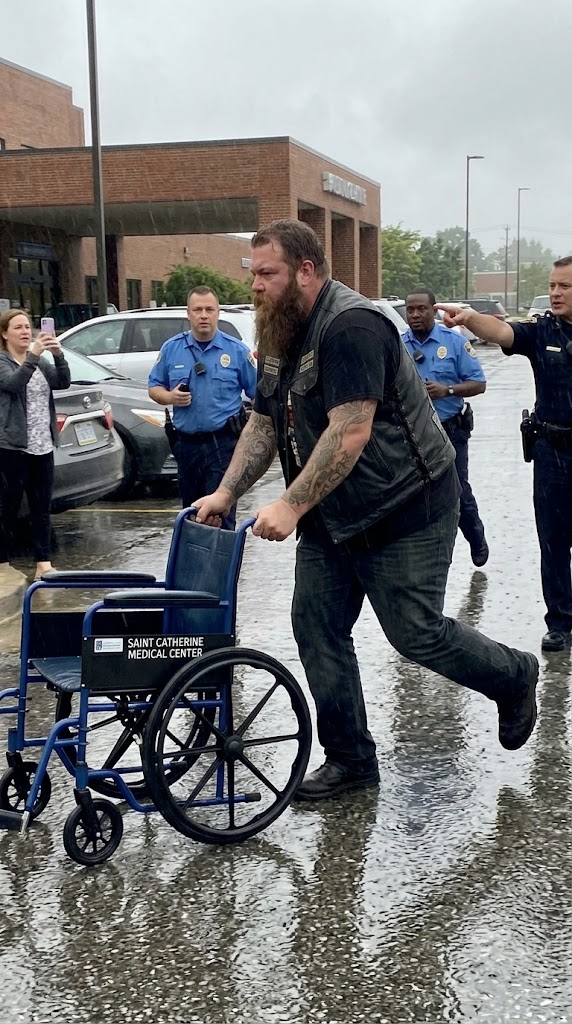
The old man was lying against the cold concrete foundation of the building, wedged between a industrial HVAC unit and the locked emergency exit door. He was wearing a faded grey suit that was now completely waterlogged, clinging heavily to his frail, ninety-year-old frame. His hands—gnarled by time and shaking uncontrollably from the onset of hypothermia—were desperately clutching a black leather cane that had snapped cleanly in half when he fell.
Next to him, a clear plastic folder containing a neatly organized stack of medical records from the Department of Veterans Affairs had burst open, its contents turning to mush under the steady downpour.
The biker, whose massive frame had looked so menacing on our security monitors, was now on both knees in a deep puddle, completely indifferent to the mud soaking through his jeans. He leaned over Harold, his giant hands remarkably gentle as he checked the old man’s pulse.
“I’m sorry it took so long, Harold,” the biker whispered, his deep voice thick with emotion. “Had a little company on the way back.”
Harold looked up through clouded, watery eyes. He didn’t look at me, Marcus, or the police officer. He just looked at the wet leather vest hovering over him. His trembling fingers reached up and tapped the small, soaked military memorial patch sewn near the biker’s chest—the one we hadn’t paid attention to during the chase.
“I knew you’d come,” Harold choked out, a single tear cutting a clean path through the grime and rain on his wrinkled cheek. “When I saw the patch before I fell… I knew an Army man wouldn’t leave a brother behind. I just… I didn’t want to die back here alone.”
The words hit the lot of us like a physical blow.
The police officer slowly let his hand drop away from his holster, his face flushing with a deep, immediate shame. Marcus stepped back, staring at his own hands, the hands that just moments ago had been aggressively gripping the biker’s vest. I felt a cold knot form in my stomach as I looked from Harold to the broken security camera directly above us. He had been lying here, in the freezing rain, completely invisible to the system we prided ourselves on running.
“What happened, sir?” I asked, dropping down to one knee beside them, my voice completely stripped of its supervisory authority.
Harold tried to swallow, his jaw clicking from the cold. “Had an appointment… at the outpatient clinic. The front transit dropped me off, but I… I got confused. Thought the rear door was the main entrance. I used to come here years ago before they remodeled. When I got to the door, it was locked. I turned around to go back to the front, but my cane… it caught in the drainage grate. It snapped. My hip gave out, and I went down.”
He paused, a ragged, wet cough shaking his chest.
“I called out,” Harold whispered, closing his eyes. “I called out for an hour. People passed by the edge of the planter, but the rain was too loud. Or they had their windows rolled up. I couldn’t crawl up the curb. I thought… I thought I was just going to fade out back here.”
“You’re not fading out anywhere, Pop,” the biker said firmly. He looked up at me, his eyes fierce but no longer panicked. “We need blankets from the ER. Now. And an emergency gurney if his hip is broken.”
“I’m on it,” Marcus said. He didn’t wait for my order. He took off at a dead sprint back toward the loading dock, pulling his radio to his lapel to alert the triage nurse.
The police officer knelt down on the other side of Harold, removing his own heavy, water-resistant patrol jacket and gently draping it over the old man’s legs. “Sir, I am deeply sorry,” the officer said, his voice quiet. “We’re going to get you inside right now.”
As we waited for Marcus to return, the biker leaned closer to Harold, carefully sliding his massive, tattooed arms beneath the old man’s shoulders and knees to keep him as far out of the pooling water as possible.
“You know, Harold,” the biker murmured, a faint, sad smile breaking through his soaked brown beard, “my old man was a lifer in the Infantry. 1st Infantry Division. Big Red One. He passed away three years ago. That patch right there? That’s his. When I was parking my bike around back to avoid the crowd, I swore I heard someone calling out ‘Medic.’ My dad used to yell that in his sleep when the nightmares got bad. I knew I wasn’t leaving this corner until I found who was calling.”
Harold’s frail hand tightened around the biker’s forearm, his thumb resting over a faded tattoo of the American flag. “Thank you, son.”
Within two minutes, Marcus returned with a triage nurse and a rolling gurney, followed closely by two ER techs carrying thermal blankets. The parking lot, which had been filled with suspicious glares and accusations just ten minutes prior, was now completely still as the team worked to stabilize Harold.
The woman who had been filming on her phone earlier was still standing near the planter. She had stopped recording. Her phone was lowered at her side, her face tight with a quiet realization of how badly she—and everyone else—had misjudged the situation.
Once Harold was safely secured on the gurney and wheeled through the service doors toward the warm interior of the emergency department, the parking lot felt incredibly empty. The rain began to let up, tapering off into a dull, gray drizzle.
The blue hospital wheelchair sat empty near the planter, the words Saint Catherine Medical Center glistening with rainwater.
The biker stood up slowly, wiping the wet hair from his forehead. He looked exhausted, the adrenaline completely draining from his massive frame. He turned back toward the rear service road where his Harley-Davidson was parked.
“Wait,” I called out, stepping toward him.
He stopped, his heavy boots squeaking against the wet asphalt. He didn’t look defensive anymore; he just looked like a man who wanted to get on his bike and leave.
“I need to apologize,” I said, standing right in front of him. “I looked at you on that monitor, and I made an assumption based on a patch and a vest. I didn’t ask questions, and I almost stopped you from saving a man’s life. If anything had happened to him because we delayed you…”
The biker looked down at me for a long moment. The hard, predatory edge we thought we saw earlier wasn’t there at all.
“People see the leather, they see the tattoos, and they write the story in their heads before I even open my mouth,” he said softly. “I’m used to it. But Harold didn’t see any of that. He just saw a soldier’s son. Next time, Dana… look at the person, not the property.”
He turned and walked around the concrete planter toward the rear lot. A few seconds later, the deep, unmistakable roar of a Harley-Davidson engine cut through the quiet afternoon air, echoing off the brick walls of the medical center before fading away down the highway.
I walked back inside the security office and sat down at the monitor console. The screen displaying the rear entrance was still black, displaying a flashing text overlay: CAMERA FEED DISCONNECTED.
I pulled up the maintenance log, found the ticket that had been marked “non-urgent” three weeks ago, and changed the priority status to CRITICAL – IMMEDIATE REPAIR REQUIRED. Then, under the notes section, I typed a single line that I knew I would never delete: System failure corrected by a citizen.