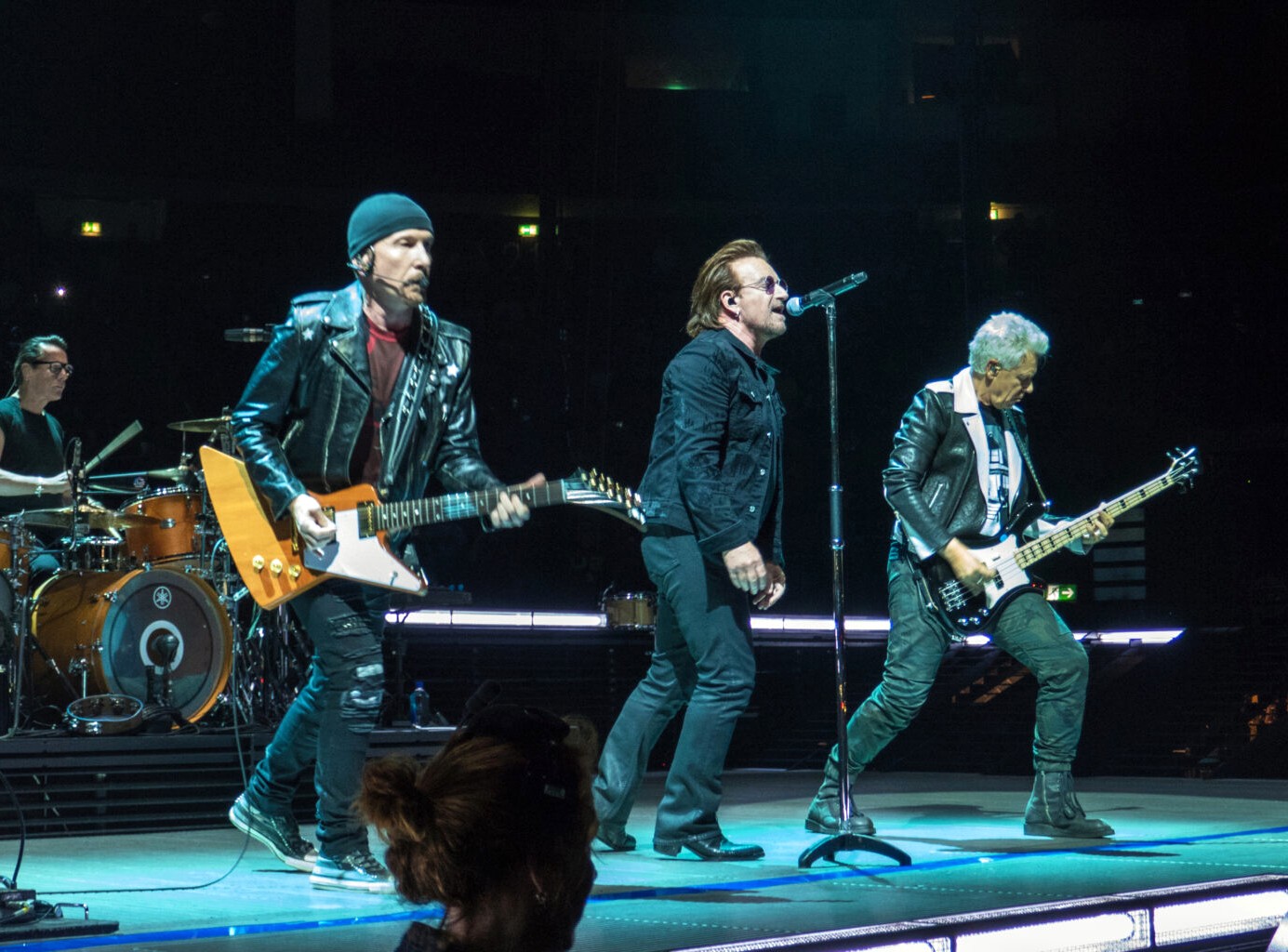
There is a specific kind of terror that precedes greatness when the person experiencing the greatness has enough self-awareness to understand what is happening before it fully arrives. Most musicians discover their success retrospectively — they look back and identify the moment the trajectory changed. Bono, who has never been accused of insufficient self-awareness, experienced the shift in real time and has described the specific feeling of it with a precision that is unusual in discussions of commercial ascent.
The moment was July 13, 1985. Live Aid. Wembley Stadium. U2 were not the headliners — Queen, David Bowie, Elton John, Paul McCartney were the acts that the global television audience of 1.9 billion had tuned in for. U2 were a successful Irish rock band with three well-received albums and a reputation as an intense live act. They were not yet the biggest band in the world. They were about to be.
Bono has described the specific decision he made during Bad — U2’s extended set piece that had been running for several minutes and that was approaching the point where the song needed to end and the band needed to leave the stage — to climb off the stage into the audience and dance with a woman he spotted in the crowd. The decision was not planned. It had not been discussed with the band. It consumed several minutes of performance time during which the band played on without knowing what Bono was doing or when he was coming back. Edge has said he assumed Bono had left the stage to be sick. Adam Clayton has said he continued playing with the specific determination of a man who has no other available option.
The moment of Bono dancing with the woman in the crowd — pulling her from the audience, moving with her at the front of the stage — was captured on the global television broadcast and was seen by an estimated 400 million people simultaneously. The response was immediate and overwhelming. The phones at U2’s management office began ringing before the band left the stage.
Bono has said he was terrified walking offstage. Not of the decision — he has said the decision felt, in the moment, like the only possible thing to do, the performance instinct operating faster than rational thought. He was terrified of the scale of what he had felt in the audience — the specific electricity of a crowd of seventy-two thousand people responding to a single human gesture. He had performed for large crowds before. This felt different. This felt like something that could not be managed or controlled or contained within the normal categories of a successful rock concert.
The Joshua Tree came two years later. It debuted at number one in twenty-two countries. U2 became, rapidly and completely, what Bono had felt approaching in that moment at Wembley — the biggest band in the world, in the specific way that means not merely the most commercially successful but the one that carries the largest share of what a generation understands music to mean. The terror, he has said, was appropriate. He was right to be afraid.