I landed in Seattle’s rain and stepped off the plane into my mother’s death.
Pancreatic cancer had taken her fast—too fast for the kind of reconciliation people write about in greeting cards. We hadn’t spoken in almost a year. Three years since I’d been home at all. I told myself it was the job, the distance, the life I’d built. The truth was uglier: we had broken each other in small, quiet ways until silence felt easier than fighting.
Sarah Ellison had been a high school librarian for thirty-four years. Strict. Orderly. The kind of woman who alphabetized her spices and believed rules existed for a reason. She hated motorcycles with a passion that bordered on religious. “Death traps on two wheels,” she used to say every time one roared past our house. I left for college in Seattle the week after graduation and never really came back except for holidays that grew shorter and colder.
Now she was gone at sixty-seven, and I was the only one left to deal with the house.
The place looked worse than I remembered. Paint curled off the siding in long, sad strips. Gutters sagged like tired shoulders. The front porch railing had rotted so badly I was afraid to step on it. Mom had been sick for over a year. Apparently no one had helped her keep the place up.
Or so I thought.
I spent the first day signing papers at the lawyer’s office and crying in the car afterward. That night I crashed on her floral couch surrounded by half-packed boxes, still wearing the same clothes from the flight. I woke sometime after three to the sound of scraping and low voices outside.
At first I thought it was raccoons in the trash. Then I heard the distinct metallic clink of a ladder being set against the house.
I crept to the front window and pulled the curtain aside.
My heart slammed against my ribs.
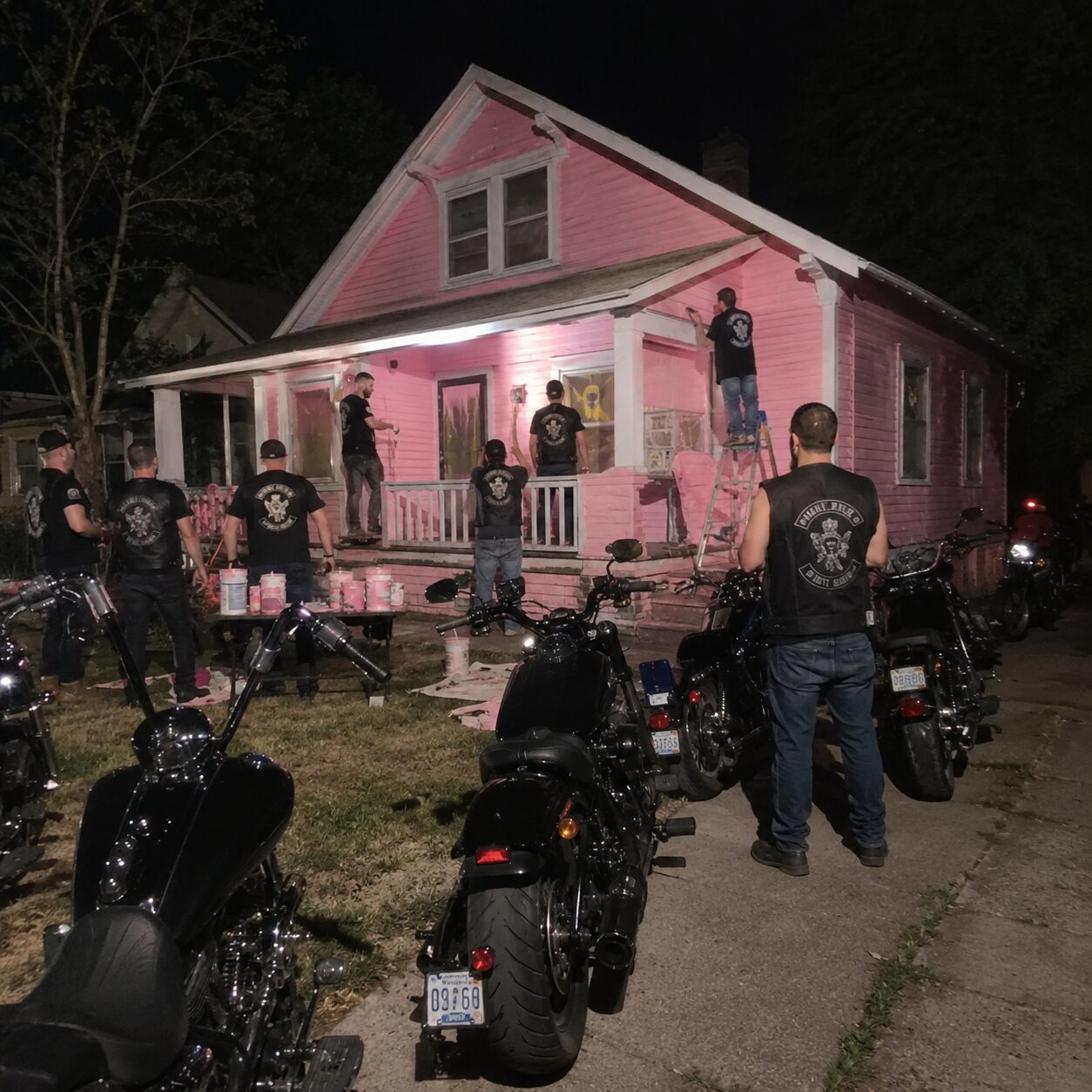
Nine motorcycles were parked along the curb like silent sentinels. Work lights on extension cords lit up the front yard in harsh white pools. Men in leather vests and faded jeans moved across the lawn and up ladders. Rollers hissed against siding. One man was carefully taping off the porch light. Another was on his knees fixing a loose board on the steps.
They were painting the house.
Bright, unmistakable, screaming pink.
Not a soft blush. Not a tasteful salmon. This was the kind of pink that would make a flamingo jealous. The kind of pink that said I dare you.
I grabbed my phone with shaking hands. My thumb hovered over 911. Then one of the men on the ladder turned his head and saw me in the window.
He was huge. Six-foot-four at least, broad as a refrigerator, with a long gray beard and a face that looked like it had been carved out of old leather. He held a paint roller in one massive hand and simply nodded at me. Not threatening. Not apologetic. Just… acknowledging.
Like he’d been expecting me.
I don’t remember deciding to go outside. One second I was in the living room; the next I was standing barefoot on the wet grass in my mother’s old Seattle Seahawks pajama pants and a faded T-shirt, phone still clutched like a weapon.
“What the hell are you doing?” My voice came out hoarse.
The big man climbed down from the ladder with surprising grace for someone his size. He wiped his hands on his jeans and walked toward me. His eyes were the saddest, kindest eyes I’d ever seen on a man built like a mountain.
“You must be Claire,” he said. His voice was deep and gentle, like gravel wrapped in velvet.
“How do you know my name?”
“Because you’re my guardian angel’s daughter.”
I stared at him. The night air suddenly felt twenty degrees colder.
“Name’s Bear,” he continued, extending a hand the size of a dinner plate. Paint speckled his knuckles. “Your mama… she was something else, Claire. To the rest of the world she might’ve just been the librarian who shushed people too loud. To the Iron Brotherhood, she was the reason a lot of us are still breathing.”
I took his hand without thinking. His grip was warm and careful, like he was afraid of breaking me.
“My mother hated bikers,” I said. “She called them—”
“Death traps on two wheels,” Bear finished with a small, sad smile. “Yeah. She told us that too. First time she showed up after the fire, she gave us a thirty-minute lecture on helmet laws while she was picking gravel out of Rusty’s arm.”
Another biker—thinner, with a faded red bandana holding back gray hair—looked up from taping a window and grinned. “She made us all wear helmets after that. Even the ones who grumbled about it. Said if we were gonna keep riding, we were gonna do it smart.”
I looked past them at the house. The pink was already swallowing the old white in wide, wet strokes. “Why pink? And why at four in the morning?”
Bear rubbed the back of his neck, suddenly looking almost shy. “Four A.M. because we didn’t want Gordon and his HOA goons showing up with clipboards before we could finish. Your mom hated that man. He cited her three times last year for peeling paint while she was in chemo. Threatened to put a lien on the house when she was in hospice. She told me once, sitting right there on that porch with an oxygen tank beside her, that if she had the strength she’d paint the whole damn thing neon pink just to watch his head explode.”
My throat closed. That sounded exactly like her. The same stubborn streak that had driven me away was the same one that had apparently adopted a motorcycle club.
Bear’s voice softened. “She made me promise, Claire. On her last good day. Said, ‘Bear, when I’m gone, you paint it pink for me. Do it loud. Do it proud. And tell my girl I’m sorry I was so hard on her.’”
Tears blurred the work lights into halos. I wiped them away angrily. “She never said any of that to me.”
“She didn’t know how,” Bear said simply. “Some people love with rules. Some love with chili and second chances. Your mama did both.”
I stood there on the damp grass watching these rough men work with surprising gentleness—trimming around light fixtures, protecting the bushes with drop cloths, moving like they were handling something sacred.
One of the younger guys—maybe late twenties, with a scar across his cheek—paused near me. “She taught me how to read good enough to pass my GED,” he said quietly. “I got my diploma last year. Got a job at the parts store now. She came to my graduation. Sat in the front row like it was her own kid.”
Another voice from the porch: “She let us use her garage all last winter when it was too cold to work outside. Fixed us soup. Yelled at us when we skipped meals. Never once asked for anything back.”
I swallowed hard. “Do you… have an extra roller?”
Bear’s face split into a huge, bearded grin. He reached into a five-gallon bucket and handed me a fresh roller still in its plastic sleeve.
“Right this way, Claire.”
We painted through the last hours of darkness.
The rhythmic sound of rollers against wood became almost meditative. Bear worked beside me on the porch railing, telling stories in a low voice so the others wouldn’t hear everything. How Mom had shown up the morning after their clubhouse burned with her Subaru full of blankets and first-aid supplies. How she’d sat with one of their members whose wife had left him and just listened while he cried into a bowl of her chili. How she’d bullied them all into getting regular check-ups after one of the older guys had a heart scare.
“She never judged us for the leather or the bikes,” Bear said. “Just told us to stop being idiots and start taking care of each other. Said the world was hard enough without us making it harder on ourselves.”
I thought about all the times I’d called her controlling. All the arguments about my “reckless” move to Seattle, my refusal to come home every holiday, my choice to become a high school counselor instead of a “real” teacher like her. She’d wanted me safe. Predictable. Close. I’d wanted air.
Maybe we’d both been right. And both been wrong.
As the sky shifted from black to deep purple, I stepped back and looked at what we’d done.
The house glowed. It was ridiculous. It was defiant. It was perfect.
By the time the sun crested the trees, the last roller strokes were drying. The bikers moved like a well-oiled machine—packing up ladders, coiling cords, sweeping up paint chips. True to Bear’s word, they’d also fixed the gutters, replaced the worst of the porch boards, and even tightened the loose shutter on the side window.
I made coffee in Mom’s old percolator and carried mugs out to them on the newly solid porch steps. We sat there drinking it black while the neighborhood woke up around us. A few early joggers did double-takes. One woman across the street actually smiled and gave a thumbs-up before hurrying on.
Then Gordon arrived.
He came in his golf cart, wearing pressed khakis and a polo with the HOA logo. His face went from confused to furious the second he saw the color.
“What in God’s name have you people done?” he sputtered, climbing out so fast he nearly tripped. “This is a violation of the covenant! I’ll have liens filed before lunch! You can’t just—”
Bear stood up slowly. All six-foot-four of him. The other eight bikers rose with him like a quiet wall of leather and denim. They didn’t say a word. They didn’t have to.
I stepped forward. “This was my mother’s wish, Gordon. She wanted it pink. And now it’s pink.”
He opened his mouth, closed it, opened it again. “There are procedures. Permits. Color guidelines—”
Bear’s voice was calm but carried the weight of someone who had seen worse than suburban busybodies. “The paint’s dry, friend. If you want to fight about it, we’ll see you at the hearing. Whole club’ll be there. We’ve got lawyers. We’ve got time. And we’ve got pictures of how this place looked when Sarah was too sick to climb a ladder.”
Gordon looked at the wall of bikers, then at me, then at the screaming pink house. His mouth worked silently for a moment. Then he got back in his golf cart without another word and drove away.
We watched him go.
Bear chuckled once, low and satisfied. “Your mama would’ve loved that.”
I laughed. It felt rusty, but real. “She really would have.”
The bikers didn’t leave right away. They stayed for breakfast—eggs and bacon I cooked in Mom’s kitchen while they washed up at the outdoor spigot. We ate on the porch like it was the most natural thing in the world. They told more stories. I listened like a woman starving for pieces of her mother she’d never known existed.
Before they rode out, Bear handed me a small, battered metal box. “She gave me this a month before she passed. Said if anything happened to her, I should make sure you got it. Told me not to open it. Said it was between mothers and daughters.”
I took the box with shaking hands.
After they left—nine motorcycles rumbling away like distant thunder—I sat on the pink porch steps and opened it.
Inside were photographs I’d never seen. Mom at a biker rally, wearing a leather vest over her cardigan, laughing with her head thrown back. Mom standing in the middle of the Iron Brotherhood like she belonged there. Mom on the back of a motorcycle—wearing a helmet, of course—arms wrapped around Bear’s waist, wind in her hair.
There were letters. Dozens of them. Thank-you notes from club members. One from a kid who’d been headed down a bad road until Mom made him study for his GED. Another from a man whose wife had cancer; Mom had sat with him through every chemo appointment when his own family couldn’t.
At the bottom was a single folded piece of paper in Mom’s neat librarian handwriting.
Claire,
If you’re reading this, I’m gone. I was never good at saying the important things out loud. I was too busy trying to keep you safe from a world that already took your father from us. I know I pushed too hard. I know I made you feel like you had to run to breathe.
I found my own way to breathe after you left. These men—these ridiculous, loud, loyal men—needed someone to remind them they were worth saving. Turns out I needed them too.
Paint the house pink if you want. Or paint it white again. Sell it. Keep it. Just know that I loved you the only way I knew how. And I was proud of the woman you became, even when I didn’t know how to say it.
Love, Mom
I cried until the pink house blurred into a watercolor.
I didn’t list the house that week. Or the next.
Instead I called my boss in Seattle and asked for a leave. Then I called a realtor and put my apartment on the market. I hired contractors for the bigger repairs, but the Iron Brotherhood came every weekend anyway—fixing, painting trim, teaching me how to use a circular saw. Bear showed up every Sunday with chili in a slow cooker. We ate on the pink porch and told Mom stories until the stars came out.
Gordon filed one complaint. The city inspector came, took one look at the now-beautifully maintained house and the group of bikers politely offering him lemonade, and left with a warning that the color was “non-standard” but the structure was sound. Gordon never bothered us again.
Three months later I stood in the living room—now painted a soft, warm gray with pink accents on the trim in honor of Mom—and looked out at the street where nine motorcycles had once lined the curb at four in the morning.
The house wasn’t perfect. It never would be. But it was mine now. And it was hers.
I kept the bright pink on the front door. A middle finger to Gordon, a beacon for anyone who needed reminding that the scariest-looking people sometimes have the softest hearts, and a permanent reminder that my mother had been more than the rules she lived by.
She had been a guardian angel in a cardigan.
And somewhere, I liked to think she was smiling at the ridiculous pink house and the daughter who finally understood why she’d painted it that way.
I was home.
For the first time in a very long time, I was exactly where I was supposed to be.