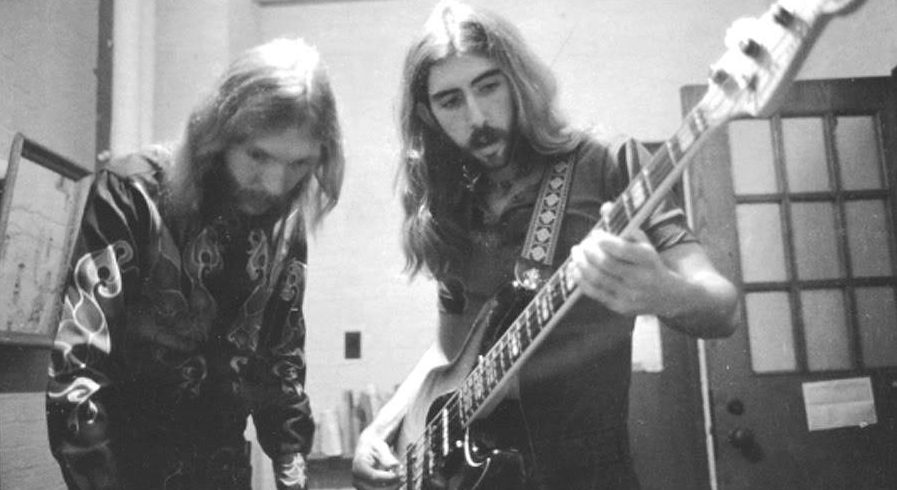
n October 29, 1971, Duane Allman, the guitarist and founding force behind the Allman Brothers Band, died in a motorcycle accident in Macon, Georgia, after swerving to avoid a truck. He was only 24 years old. A little over a year later, the band’s bassist, Berry Oakley, died in a motorcycle crash just three blocks away from the exact same intersection, at the exact same age.
Allman had just wished bassist Berry Oakley’s wife, Linda, a happy birthday at the band’s communal house in Macon, known affectionately as the Big House, when he climbed onto his motorcycle that October afternoon. Swerving suddenly to avoid a flatbed truck that had pulled into his path, Allman lost control and crashed, suffering crushing internal injuries. He survived the initial impact but died several hours later at the hospital. The band, then riding high off the success of their breakthrough live album “At Fillmore East,” was devastated.
Of everyone in the group, Oakley took the loss the hardest. Drummer Butch Trucks later said the spark that had defined Oakley simply disappeared after Allman’s death, recalling that the bassist began drinking heavily on a near-daily basis even as the band pushed forward with touring and recording. Trucks has said he didn’t believe Oakley ever really figured out how to exist in a world without his close friend and bandmate beside him.
On November 11, 1972, just over a year after Allman’s death, Oakley was riding his motorcycle in Macon when he crashed into a city bus only three blocks from the site of Allman’s fatal accident. Oakley initially declined medical treatment and returned home, walking and talking normally despite striking his head in the collision. Hours later, his condition deteriorated rapidly, and he was rushed to the same hospital where Allman had died the year before. He succumbed to cerebral swelling from a fractured skull, at the age of 24, the exact same age Allman had been.
The parallels didn’t end there. Both men had been riding motorcycles, both collided with much larger vehicles, and both initially survived their crashes before dying from their injuries later. The Allman Brothers Band buried Oakley beside Allman at Rose Hill Cemetery in Macon, the same cemetery where the band had spent countless hours together in their early years, drawing inspiration for songs including “In Memory of Elizabeth Reed.”
Remarkably, the band chose to continue rather than disband, eventually replacing Oakley with bassist Lamar Williams and going on to even greater commercial success with 1973’s “Brothers and Sisters.” Decades later, guitarist Dickey Betts made a point of bringing up Oakley’s enormous, often-overlooked contributions in nearly every interview he gave, frustrated that his friend’s legacy had become defined more by the eerie circumstances of his death than by the basslines that helped define some of the band’s most iconic songs. City officials in Macon eventually honored both men permanently, renaming a stretch of highway after Allman and a nearby bridge after Oakley, ensuring that two musicians whose lives ended in such strikingly similar fashion would also be remembered side by side in the city where they built their legacy together.