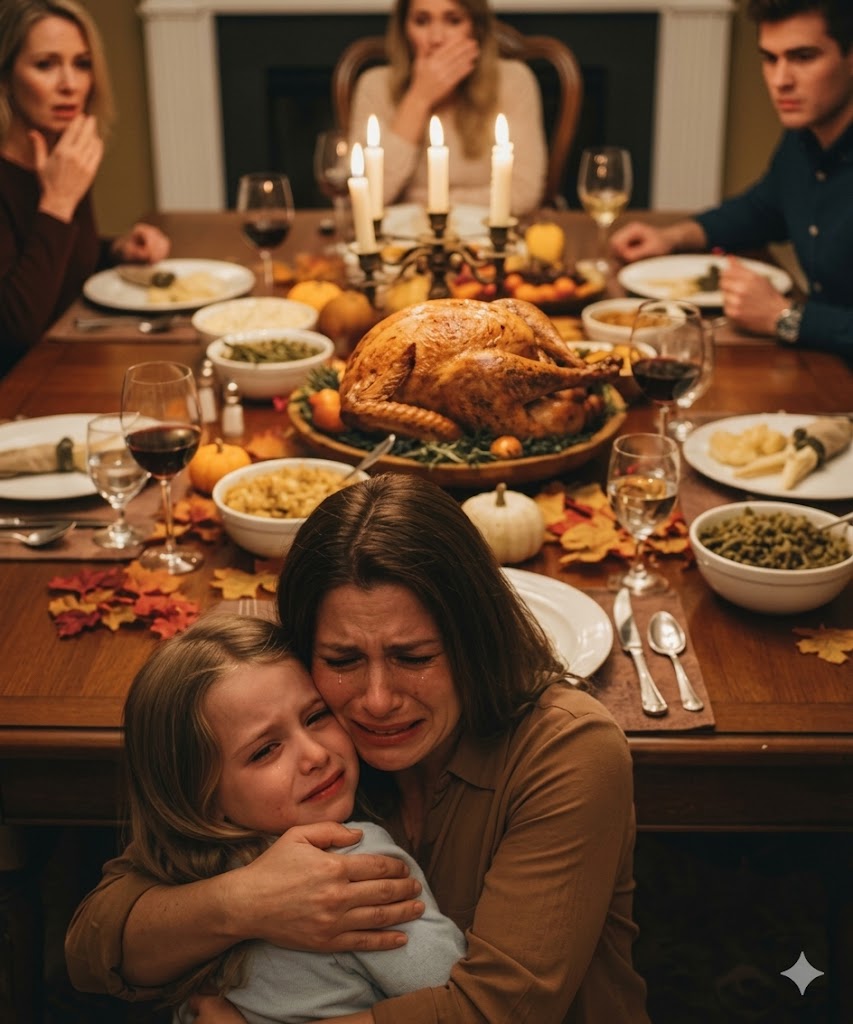
I unlocked the door with hands that wouldn’t stop shaking.
The warmth of the house hit me first—a heavy, suffocating wave of roasted garlic, melted butter, and the expensive vanilla candles my mother insisted on burning to mask the smell of old age in the house. The contrast was sickening. Outside, the air was lethal. Inside, the thermostat was cranked to seventy-four degrees.
The heavy oak door clicked shut behind me, and the sudden sound cut through the chatter in the dining room like a blade. The laughter sputtered out. One by one, their heads turned toward the foyer.
My mother, Eleanor, set down her crystal wine glass. It hit the mahogany table with a sharp clink. Her eyes traveled from my disheveled, tear-streaked face down to the bundle in my arms. I was still gripping Danny against my chest, his small body hidden beneath my heavy winter coat, his teeth clicking together in a rhythmic, terrifying chatter.
She didn’t gasp. She didn’t jump up. Instead, that cold, porcelain smile—the one she wore at charity galas and country club brunches—settled onto her face.
“Olivia, darling, you’re late,” she said, her voice smooth and entirely devoid of urgency. “The stuffing is getting cold. Put your bag away and come sit.”
“He was outside,” I whispered. My voice was raspy, completely stripped of its usual emergency-room authority. “He was on the porch, Eleanor. In twenty-eight-degree weather. In his pajamas.”
My sister, Lily, delicately wiped her mouth with a linen napkin. She sighed, an annoyed, theatrical sound. “Oh, stop dramaticizing everything, Olivia. He wanted to play outside, dear. Children need fresh air. He was being loud, and we were trying to have a nice conversation.”
“For forty-seven minutes?” I snapped, my eyes flashing to the digital clock on the microwave visible from the hallway. “I checked the Ring camera logs on my phone before I walked through the door. He was locked out for forty-seven minutes!”
My father, Arthur, didn’t look up from his carving. He carefully sliced a piece of white meat, his hands steady, his expression completely blank. “Don’t raise your voice in this house, Olivia. Your sister is right. The boy needs to learn discipline. He was throwing a tantrum because we wouldn’t let him play with his cousins’ iPads.”
They didn’t care. They truly, deeply didn’t care that a child—their own grandson, their own nephew—had been on the verge of freezing to death while they drank thirty-year-old Bordeaux.
That’s when I felt something shift inside me. The exhaustion from my twelve-hour shift vanished, replaced by a cold, clinical clarity. I looked at the beautiful table, the silver candle holders, the fifteen thousand dollars I had blindly wired to them because my mother claimed they were “struggling to get by.” I looked at Lily’s children, wrapped in expensive velvet, while my son’s lips were the color of a bruised plum.
I stared straight into my mother’s vacant, aristocratic eyes and said just six words.
“History repeats only if we allow.”
My mother’s smile froze. The porcelain cracked, just for a fraction of a second. Her eyes darted toward my father, whose carving knife stopped mid-slice. Lily frowned, looking between us, confused by the sudden change in the room’s atmosphere. They knew exactly what those words meant, even if Lily didn’t. It was a phrase my grandmother, Martha, used to whisper to me when I was a teenager, right before she was abruptly moved to a “private care facility” and never heard from again.
“Get out of my way,” I said, bypassing the dining room entirely.
I carried Danny straight into the downstairs bathroom. I didn’t turn on a hot bath—as a nurse, I knew sudden heat would shock his system and could cause cardiac arrhythmia. Instead, I stripped off his frozen pajamas, wrapped him in dry, room-temperature towels from the linen closet, and held him tightly, using my own body heat to slowly, safely bring his temperature back up. I forced him to sip small sips of lukewarm water from a paper cup.
As I sat there on the bathroom floor, rocking my son as his breathing finally began to stabilize, the rage inside me crystallized into a vow. I had spent twenty-seven years protecting strangers. I had spent my entire adult life funding my parents’ lifestyle, playing the dutiful, wealthy eldest daughter who quietly cleaned up every family mess.
No more.
By the time Danny fell into a exhausted, safe sleep on the guest bedroom bed upstairs, the house was quiet. My family had gone back to their dinner, assuming the storm had passed. They thought I would do what I always did: cry, complain, and then write another check to keep the peace.
They had no idea who they were dealing with.
The next morning, I didn’t go to work. I called in sick for the first time in four years. After dropping Danny off at a trusted coworker’s house, I drove straight to the old family estate in western Massachusetts—the house where my grandmother Martha had lived before her sudden “dementia” took her away. The property had been tied up in a family trust for decades, managed entirely by my father.
As a charge nurse, I had access to medical public records databases, and more importantly, I knew how to read between the lines of a coroner’s report. For years, a nagging doubt had lingered in the back of my mind about the speed with which my father had liquidated Grandmother Martha’s estate back in 2012.
I used the spare key hidden under the stone owl on the porch—a detail my father had undoubtedly forgotten. The air inside the abandoned house was thick with dust and decay. I bypassed the main floors and went straight to the basement, to my father’s old locked filing cabinets. It took me twenty minutes with a crowbar from the garage to bust the lock open.
What I found inside didn’t just break my heart; it shattered my entire reality.
There were medical records from 2011. My grandmother hadn’t died of natural causes. She had been heavily medicated with a cocktail of antipsychotics and sedatives—drugs she had never been prescribed by her actual primary care physician. And the signatures on the medication authorization forms? They weren’t her doctor’s. They were forged.
But it went deeper. Folded into a faded manila envelope were adoption papers dated fifty-two years ago. I pulled them out, my eyes scanning the text. My sister, Lily, wasn’t my biological sister. She was the biological daughter of a prominent local judge who had died in a mysterious house fire in the late 1960s. My father, who had been a young corporate lawyer at the time, had managed the judge’s estate.
According to the financial ledgers stuffed into the back of the drawer, my father hadn’t just adopted Lily out of the goodness of his heart. He had systematically embezzled millions of dollars from the deceased judge’s trust fund—money meant for Lily—and funneled it into offshore accounts. When my grandmother Martha discovered the fraud and threatened to go to the authorities, my parents had her quietly over-medicated, declared incompetent, and hidden away until her heart finally gave out.
The fifteen thousand dollars I had given them for Thanksgiving? It wasn’t for dinner. My father’s offshore accounts had been frozen six weeks prior under the Patriot Act for suspected international money laundering. They were completely broke, surviving entirely on the money they could grift from me.
My hands shook as I held the documents. My parents weren’t just cold, snobbish people. They were monsters. They had killed my grandmother, stolen a child’s inheritance, and raised that child to be a weapon of vanity and cruelty. And the cycle was repeating. They had left Danny outside because he was an inconvenience to their perfect, fraudulent world.
I didn’t call my mother. I didn’t confront my father.
I drove straight to the Federal Building in downtown Boston.
Because I was a medical professional with a spotless record, the federal investigators took me seriously. When I handed over the forged medical documents, the financial ledgers, and the bank routing numbers I had uncovered, the puzzle pieces fell into place for them with terrifying speed. My father had already been under a quiet investigation by the IRS and the FBI for a massive corporate fraud scheme involving shell companies. The documents I provided were the missing link they needed to prove intent and conspiracy.
The hammer fell three weeks later, just days before Christmas.
I was at my parents’ house when the federal marshals arrived. It was snowing, a soft, gentle flurry that contrasted sharply with the flashing blue and red lights reflecting off the frosted windows.
My father was led out in handcuffs, his expensive cashmere coat draped over his shoulders, his face pale and sunken. He looked like an old man suddenly stripped of his armor. My mother screamed at the agents, her porcelain facade completely shattered into an ugly, screeching mess of desperation, until an officer warned her that she was facing obstruction of justice charges.
Lily stood in the driveway, holding her children, weeping as she realized that the trust funds she had bragged about for years didn’t exist. She was the daughter of a man my father had ruined, raised by the thief who did it. The look of utter betrayal on her face when she looked at our mother was something I will never forget.
As the police cars drove away, leaving the grand house in complete, echoing silence, I stood on the sidewalk with Danny. He was wearing his heavy winter coat, his hand tucked safely inside mine, his cheeks rosy and warm.
My family was destroyed. The wealth was gone, the secrets were exposed, and my father would eventually be sentenced to twenty-five years in a federal penitentiary for fraud, conspiracy, and elder abuse. My mother would spend her remaining years drowning in legal fees and public shame.
It was a tragedy. But as I looked down at my son, who was alive, safe, and smiling up at me, I knew I had made the right choice.
History stops repeating the moment someone has the courage to break the machine. And I would do it all over again in a heartbeat.